The Bhutanese Leading the way.
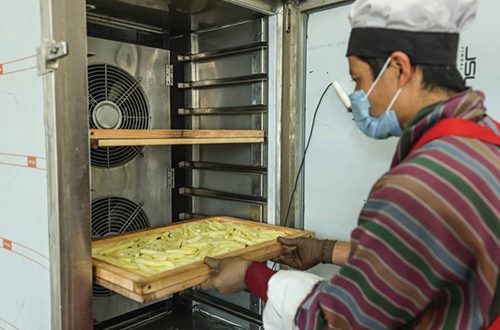
Back in 1st August, the Minister for Industry Trade and Commerce (MoICE), Namgyal Dorji, had assured that the ministry will help Entrepreneur, Jangchub Dorji, of Kuen-Gha Potato Fingerling.
In line with that promise, MoICE tried to push for the Nu 10 million (mn) ESP loan of Jangchub that had earlier been rejected.
The matter was put up for special discussion even in the main ESP committee, but it was rejected as it was felt that if Jangchub is given the loan then there were around 1,600 people whose loans were rejected and many of them would have to be made eligible, and in that scenario, the ESP funds would not be enough.
There was also a fear that if Jangchub’s loan is pushed through then there could be allegations of favoritism, etc., in the middle of all the controversy around the ESP loans.
Jangchub has been told he can apply when the Venture Capital fund comes, but he does not have much hope now.
If the denial of funds was not enough, the Department of Agricultural Marketing and Cooperatives (DAMC)’s National Post Harvest Center recently published a report on ‘Production and Cost Analysis of Locally Processed Frozen French fries on Trial’ that essentially said the cost of production of local frozen fries is much higher than imported fries, and it also does not match up to quality.
The first claim the report made, based on its own experimental production of frozen fries, was that the cost of production of local frozen fries was Nu 375.14 per kg.
It said in comparison a wholesaler imports frozen fries at Nu 155 to Nu 156 per kg and sells it to retailers and restaurants at Nu 194 to Nu 170.
Here, Jangchub Dorji said that when he was doing 50 kg of frozen fries a day, he was selling the fries at Nu 130 per kg and he still had enough profit to pay two staff Nu 10,000 each, the rent packaging costs and all other expenses.
He said while retailers buy at Nu 190 from wholesalers, they charge around 250 to clients. Jangchub said his plan was that once he was doing 300 kg a day after buying the machines from the ESP loans, he would charge lower than wholesalers and ensure that retailers sell at Nu 230 with a price advantage.
Jangchub said he buys his potatoes at wholesale from farmers at around Nu 36 per kg.
Jangchub said that imported frozen fries claim to be 500 gm, but in reality, they are closer to 400 gm.
The report said the difference in costs could be due to the fact that since this was a trial the production scale was smaller, raw material and labour costs are higher, and the recovery rate of the raw material is comparatively less leading to additional costs incurred per kg production of frozen french fries.
It, however, said that process automation and mechanization could, however, lead to reduced costs.
Jangchub said that while the above factors are true, he could sell his frozen fries at Nu 130 and still turn a profit.
The report said that out of Yusi-Maap (Chukha) 50 kg potatoes, the frozen fries derived was only 18.39 kg, while it was 22.72 kg for Yusi-Maap (Paro) and 19.27 kg for Yusi-Chip 1.
Here, Jangchub said the international standard for wastage is only 33.33% and so he does not know how the National Post Harvest Center managed to head into 64% to 58% wastage.
Jangchub said that when he used 50 kg of fries, the frozen fries he got was 33 kg.
The report further said that local fries become darker more quickly when frying, dirties the frying oil faster affecting the oil reusability, storage is questionable as responders reported poor storage performance in previously available locally processed sample products.
Jangchub acknowledged the above issues, but at the same time, he said this is why he applied for the ESP loan to get automated machines that would reduce these issues.
He said local fries becoming darker quicker was due to the higher sugar content of local potatoes and this could have been tackled with the automated machines and process which would reduce the sugar content. At the same time, he said when he did a trial at a restaurant, the fries and oil did not turn colour as the local fries had to be put in lesser quantity which is a bit less than full.
The oil turning darker is due to the sugar and water, and he said the machines would have reduced these two as well.
He said the automated machines would also have improved the storage life of the fries as there would be minimal exposure and better finishing.
Jangchub said, as a trial, he tried his stored frozen fries after two years and though the taste changed a bit it was still edible. However, he said the main aim of his fries was not for a very long shelf life but to give Bhutanese a fresh local option free of chemicals.
He said imported fries come with multiple chemicals in it to extend shelf life, prevent browning and also gave it a nice colour which are all not good for health.
He said by comparison, his fries would have had zero chemicals and be based on local potatoes.
He also pointed out that the maximum shelf life of imported fries is around 18 months but due to the distance the fries come here after 6 to 7 months and sometimes even after a year.
Jangchub said food testing in the country is still very limited as only tests for E-Coli and sugar content is done, but internationally there are much more tests to really check for the quality of packaged food.
Jangchub said he is aware of the limitations of Bhutanese potatoes, as it is not suitable for making chips as it burns, but at the same time is one of the best potatoes to eat as a curry. He said that making french fries with Bhutanese potatoes is not a problem.
The plan for Jangchub was to not only do frozen fries but also do other potato products like wedges, potato patties, etc.
One of the main reasons the BDBL rejected his ESP loan was due to their concern that the main Nu 8.8 mn blast freezer machine would be used well below its full capacity. Here, Jangchub said that the machine comes only in a couple of sizes. He said he did not want to present an overly ambitious proposal to BDBL, but when he started, his original plan was not only to capture the Bhutan market but also the North-East India market which does not have a frozen fries manufacturer and imports them like Bhutan.
He said when he started, one of the first calls he got was from a businessman in West Bengal who wanted to order his fries as he knew the quality of Bhutanese potatoes is good.
Jangchub said one of the people from the National Post Harvest Center who did the report called him abruptly one day to find out his rates and the locations he sold. He said there was no communication after that.
He said if the DAMC and National Post Harvest Center really wanted to help then they could have consulted him and involved him in the trials, but this was not done.
Jangchub said that senior MoAL officials were not happy he had approached the media last time. He said he did get an offer to come and use a semi-automated machine from Mongar being brought to Paro, but Jangchub requested if it could be done in Thimphu, his main market, and so there was no agreement.
The last article on Jangchub led to some criticism of the DAMC and the National Post Harvest Center.
Jangchub said the whole report and the way it was done by the DAMC and National Post Harvest Center feels like an attempt to defame him and show him in a negative light.
Background
From May 2021 till the end of the year, Jangchub spent time perfecting the technology, recipe and technique, and he ran his operation from 2022 to 2024 at the start up center in Changzamtog where at its peak, he was supplying up to 50 kgs of fries a day to seven cafes in Thimphu, shops and also to buyers in Paro.
However, Jangchub encountered two problems. The first was that the machine he had initially bought was not big enough to meet the demand, and secondly, he said the Bhutanese potatoes contained higher sugar starch content, and so there were issues with the fries turning brown due to the caramelization of the sugar in the potatoes.
The only solution was to buy a bigger machine with the capacity to process 300 kgs or more fries in a day, and at the same time, reduce the starch and sugar content.
He needed around Nu 10 mn for the complete set up.
He said he learned that the National Post Harvest Center had procured a big commercial sized machine for the blast freezing of fries’ worth around Nu 8.8 mn and since they were not using it, he approached the Department of Employment and Entrepreneurship (DoEE) under MoICE for help in getting access to the equipment on a cost sharing basis.
Director General of DoEE, on 13th May 2024 wrote to the DAMC asking for support, but there was no response.
His next step was to apply for the Nu 10 mn ESP loan to buy the Nu 8.8 mn machine and other smaller machines, but it was rejected.
Unable to scale up or improve the quality further, Jangchub could not continue on a small margin, and so he had to pause the making of frozen french fries. To make ends meet he started driving a taxi.
Jangchub said he will continue driving his taxi for now, and come up with a business plan in one or two years’ time but this time for the Gelephu Mindfulness City (GMC) as he is from Gelephu, and he feels the GMC will be more supportive of entrepreneurs.