The Bhutanese Leading the way.
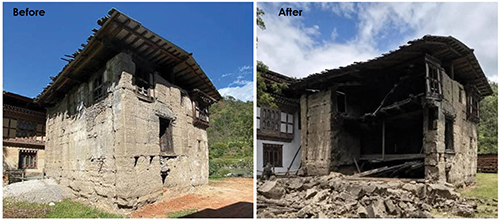
The government has acknowledged a conservation gap that left the Changyul Galem House vulnerable to further deterioration before its collapse on 9th August 2026, with the Department of Culture and Dzongkha Development (DCDD) now exploring alternative funding and a revised conservation approach for the historic structure.
The DCDD, in coordination with the Punakha Dzongkhag Administration (PDA), assessed the remaining structure following the collapse and prepared an Emergency Stabilization Plan.
Temporary stabilisation measures were implemented on 11th August 2026 to prevent further deterioration and reduce the risk of another collapse.
Responding to questions during the 31st Meet-the-Press session on the government’s decision following the collapse, the Ministry of Home Affairs (MoHA) said the department was currently assessing the appropriate long-term conservation intervention based on the condition of the remaining structure.
The Changyul Galem House had previously been identified as a heritage structure of national significance requiring conservation.
The DCDD, together with the PDA, had pursued restoration funding through Pro Bhutan Germany.
Protective fencing had also been installed around the structure as an interim safeguard.
However, the MoHA said restoration of a structure of this scale and significance, particularly one dependent on international funding, and a formally agreed conservation framework required time for funding, technical planning and procurement.
During this period, the condition of the building, particularly its roof and upper portions, continued to deteriorate.
The DCDD acknowledged that this gap left the structure vulnerable and said it had highlighted the need to undertake emergency stabilization independently of the timeline for securing full restoration funding.
The external funding initially pursued for the restoration was ultimately not released due to changes in the funding eligibility criteria.
The department is now actively exploring alternative funding sources to support comprehensive conservation of the building, as restoration can no longer be pursued through the original external funding arrangement.
On the proposed dismantling and reconstruction of the house, the MoHA said the approach would be guided by established heritage conservation principles.
The objective will be to retain as much of the original historic fabric as technically viable and ensure that any reconstruction remains faithful to the building’s historical character and traditional construction.
Original timber, stone and rammed earth materials will be carefully assessed and reused wherever structurally viable.
The building will also be systematically documented before and during any dismantling. This will include documenting its original dimensions, rammed earth construction, traditional joinery and other architectural features.
Skilled traditional craftsmen will be engaged, while a detailed conservation and reconstruction plan will be developed as part of the revised technical scope in consultation with the PDA and the owner.
The MoHA said the experience has also prompted the department to strengthen its approach to at-risk privately owned heritage structures across the country.
Measures include more frequent condition monitoring, prioritising emergency stabilization independently of full restoration funding cycles, and closer coordination with dzongkhag administrations for early reporting of deterioration.
These measures will also inform the strengthening of guidelines and procedures for privately owned heritage properties.
The MoHA said the work will build on the existing Guidelines for Seeking Clearances for Works Related to Heritage Sites, with the aim of moving towards a more preventive and risk-based approach to heritage conservation.