The Bhutanese Leading the way.
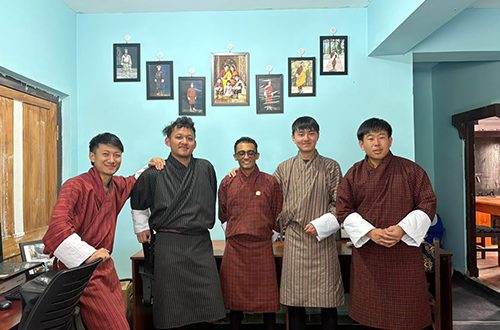
As Artificial Intelligence (AI) continues to reshape the global digital landscape, a local collaboration is working to ensure Bhutanese language and dialects are not left behind.
NoMind, in partnership with its research arm, Aplos Lab, has launched a project to develop a multilingual AI model capable of understanding and translating Dzongkha, and local dialects like Tshangla, Bumthapkha, and Kurtoepkha.
Launched in late January 2026, the initiative aims to address a fundamental imbalance in current AI technology, which is overwhelmingly trained on Western data and English-centric frameworks.
“Modern AI is densely populated with Western data, and we want to create something that represents Bhutanese culture in the wide global sphere of AI,” said Ugyen Dendup, the young founder of NoMind. “We seek to develop an AI for Bhutan.”
The project centers on two core systems: “Dotu,” a speech and voice model, and “Lotsawa,” a translation model. By utilizing automatic speech recognition (ASR) and text-to-speech technology, the team is working to digitize the spoken word in local dialects. Because local dialects lack a standardized written form, the team is performing the “heavy lifting” of creating a massive language corpus from scratch.
This foundational work involves interns and language students who are documenting and digitizing data to train the model. Currently in the early stages of development, the model is being refined to expand its vocabulary range and accuracy.
A key technical focus for the team is the development of a Dzongkha “tokenizer,” which is the essential first step that allows a machine to break raw text into tokens to understand and process human language.
According to the team, this project is effectively a research and development endeavor where they are building the product while simultaneously refining their methodology.
The potential applications for the technology are far-reaching. Ugyen Dendup envisions a future where language barriers to essential services are removed.
“For instance, in an eastern remote village, a farmer may wish to learn about a plant he has never heard of, but the information is only available in English,” Ugyen Dendup explained. “With this model, he could use his phone to speak in Tshangla and instantly receive the information in a language he can understand.”
Beyond agricultural support, the team believes the model could simplify access to government services for the elderly and revolutionize professional workflows, such as live AI-integrated note-taking for multilingual presentations.
Despite the promise, the team faces significant hurdles. As a “deeptech” startup in a sector that is still a nascent area in Bhutan, financial constraints remain a primary challenge. While they have received support from the Department of Employment and Entrepreneurship and funding from events like the Startup Launchpad 2026 and the GCIT-Tarayana Hackathon, the team emphasizes the need for a broader support ecosystem.
“Similar to how the Department of Media, Creative Industry and Intellectual Property (DoMCIIP) created a great ecosystem for creative artists and content creators, there is a need for a similar support system for AI development in Bhutan,” Ugyen Dendup noted.
Looking ahead, the team is optimistic about the progress made thus far. “From a research perspective, we are very satisfied with the present results,” said Deepshik Sharma, the AI and R&D lead of the project team.
“We are operating with very limited resources, but we have found ourselves learning and upskilling constantly. Going forward, we hope to reach international standards,” he added.
While the team aims to bring the product to market by the end of this year, they acknowledge that the timeline remains ambitious. For now, the focus remains on the foundational work of expanding language corpora and refining the technology that promises to give Bhutan a voice in the age of AI.