The Bhutanese Leading the way.
The National Centre for Hydrology and Meterology (NCHM) advises Bhutanese citizens, especially those living in risky areas to stay updated with any information that is provided by the NCHM.
The centre says that it has been strengthening efforts against potential Glacial Lake Outburst Floods (GLOFs) by enhancing GLOF early warning systems and awareness programs, but the overall responsibility of this matter reaches out to everyone.
Being informed with up-to-date information passed by the NCHM and knowing one’s area well are core messages that the centre wishes to relay to the public.
An official from NCHM, Ugyen, said, “The message we would like to share to the public would be to stay updated with information passed by NCHM, throughout social media handles for quick dissemination of information.”
“The general public can stay ahead of making informed decisions by keeping updated with our daily and three-day forecasts,” he added.
Another important factor is to understand one’s area well, especially for those living along river sides.
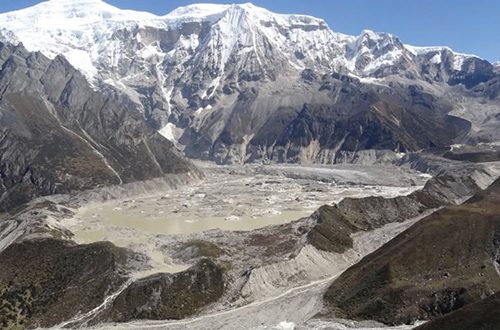
To grasp an image of the size and impact of Thorthomi, It is important to compare the lake with how it was years before.
Now, Thorthomi has turned into a huge water body, since all the glaciers have melted.
“23 years ago, Thorthomi was a huge glacier, now it has completely turned into a huge water body measuring a maximum of 4 km in length, 1.3 km in width, and over 300 metres of depth,” said Karma.
“The surface area of Thorthomi is 4.35 km sq. By empirical formula, we have calculated that the lake holds a volume of around 277 million cubic metres of water,” he added.
To grab a picture on its potential risk and hazard, this is compared to the 1994 GLOF incident.
“The water volume that came from the 1994 Luggye Tsho GLOF incident was only 18 million cubic metres,” Karma said.
This puts into perspective the sheer massiveness of Thorthomi Lake.
“Based on this, the centre has identified Thorthomi Lake as one of the most critical lakes in Bhutan in terms of GLOF,” he added.
Studying data from GLOFs that have occurred in the past, the official said that their only fear is the timing.
The data showed that GLOFs were recorded to be occurring only at nighttime for unknown reasons, which makes it all the more terrifying.
It is also important in understanding GLOF risks in a well-defined manner.
The NCHM explains that it is important to adopt a holistic perspective when assessing risks of GLOFs, which the public tends to misunderstand.
“Rising water levels in the lakes alone does not fully mean that the risks have increased. It is just one of the factors that would lead to potential GLOF. Other factors such as moraine wall stability needs to be taken into perspective as well,” Karma said.
“Taking Rapstreng Tsho for example, it has a stable surrounding moraine wall with rich vegetation. Even if the water level rises, the moraine wall contains it” he added.
He said that comparing how the lakes are currently and how it was before is important to get a picture of the size of Thorthomi Lake and its associated hazards and risks.
Pilot siphoning project
The official mentioned that siphoning water from the lake is only a pilot project which makes use of pipes and most of all, natural gravity for the water to flow.
This technique has been used in countries like Peru, but it has been attempted in the Himalayan region and failed, mainly due to extreme winter temperatures, which causes gradual ice buildup in the pipes leading to blocks and slows down water flow.
In 2023, the NCHM studied the year-round temperature and saw that extreme winter temperature fell to -11 degree Celsius for only one-two days. “That’s how we thought siphoning may work,” said Karma.
“Since this was never tested, we needed it to run all year-round and that’s why we started as a pilot phase.”
The phase failed because water flow couldn’t be initiated due to topographic/terrain complexity.
Karma said that they learned a lot of valuable lessons from this first pilot phase. The NCHM has planned a second phase at a new location, which is likely to begin later this year.
Measures implemented
The NCHM is monitoring these lakes 24 hours, with permanent staff deployed in the areas, early warning systems in place and CCTV cameras installed to monitor the lakes.
Since GLOF incidents were recorded to be happening mostly during nighttime, the NCHM also plans to install more night vision CCTV cameras to monitor the glaciers and lakes.