The Bhutanese Leading the way.
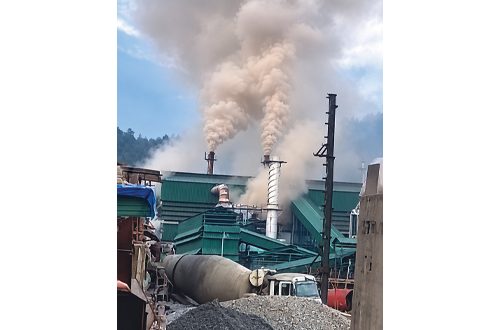
A growing cloud of concern hangs over the settlements near Samtse’s Norbugang Industrial Park and the Daina area, as residents and local observers flag periodic, heavy plumes of smoke billowing from newly established factories.
What began as a viral social media warning about an area “grappling with severe air pollution” has opened a broader conversation about industrial scaling, infrastructure reliability, and the environmental oversight of heavy manufacturing in southern Bhutan.
The ground reality
The initial alarm was raised after a local resident, Shyam Lal, posted images on social media capturing heavy smoke pouring from a factory stack, warning that the once-lush landscape was changing. He noted that the visible haze occasionally stretches toward neighboring communities and even filters down toward Samtse town.
However, a closer look at the ground reveals a more nuanced picture. Local leaders and administrative heads clarify that continuous toxic dumping is not the daily norm.
Samtse Dzongda, Melam Zangpo, explained that the alarming smoke plumes are frequently tied to technical glitches, machinery repairs, and operational hiccups reported by factory operators.
A local official, speaking on the condition of anonymity, echoed this sentiment: “As depicted in social media posts, it is not entirely true. Emissions of thick smoke and pollutants do not occur regularly and they are only seen occasionally. From what I have heard, heavy emissions are usually a product of machine breakdowns and halting of some machine processes”.
Because many of these manufacturing units have been operational for less than a year, local leaders suggest that teething troubles, power fluctuations, and startup phases are driving these unexpected emission spikes.
A gathering scent of concern
Despite the explanation that these events are temporary or accidental, residents living closer to the fence line report early signs of environmental stress. A resident of nearby Chengmari, noted that while the impact feels minimal day-to-day, a faint foul smell and visible air haze occasionally drift through the valley.
“At times it also feels like the pollution reaches Samtse town,” Deepen said. Observers also note that proximity to the border raises questions regarding potential transboundary emissions from across the southern frontier, a variable that local authorities have yet to officially map or verify.
Attempts by this paper to reach the Department of Environment and Climate Change (DECC) under the Ministry of Energy and Natural Resources (MoENR) for comments regarding technical monitoring protocols and air quality assessments went unanswered.
The technical stakes: What’s coming out of the stacks?
Because Norbugang is predominantly designated for heavy metallurgical manufacturing and ferro-alloy production, the primary emissions of concern carry serious health and environmental implications:
Suspended Particulate Matter (SPM) & Micro-Silica Dust: Composed of extremely fine silicon dioxide (SiO2) particles from smelting processes. If filtration systems fail, this fine dust travels wide distances and penetrates deep into human airways.
Emissions such as Carbon Monoxide (CO), Carbon Dioxide (CO2), Sulfur Dioxide (SO2) and Nitrogen Oxides (NOx) are also byproducts of industrial processes which can have impacts on health and the environment.
The regulatory framework and the cumulative question
Under the National Environment Commission’s Environmental Standards (ES), 2020 (specifically Section 5 covering industrial technologies like arc and induction furnaces), emissions are explicitly capped to prevent severe degradation.
The maximum allowable threshold for SPM, SO2, and NOx is set at 150 mg/Nm3, 100 mg/Nm3, and 100 mg/Nm3 respectively, with CO restricted to 50 mg/Nm3. Total Fluoride is similarly capped at 25 mg/Nm3 for applicable specialized processes.
While these legal parameters exist on paper, local stakeholders point to a deeper structural question: While an individual factory might technically comply during optimal operation, what happens when five or ten heavy ferro-silicon plants operate simultaneously within a tight geographic pocket like Norbugang?
As Samtse rapidly cements its status as an industrial hub, the pressing challenge for regulators is moving beyond single-plant compliance to assess cumulative, long-term regional impacts.
This paper will continue to follow up with updates from relevant authorities in coming issues.