The Bhutanese Leading the way.
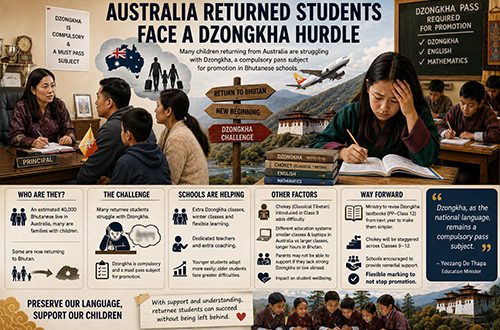
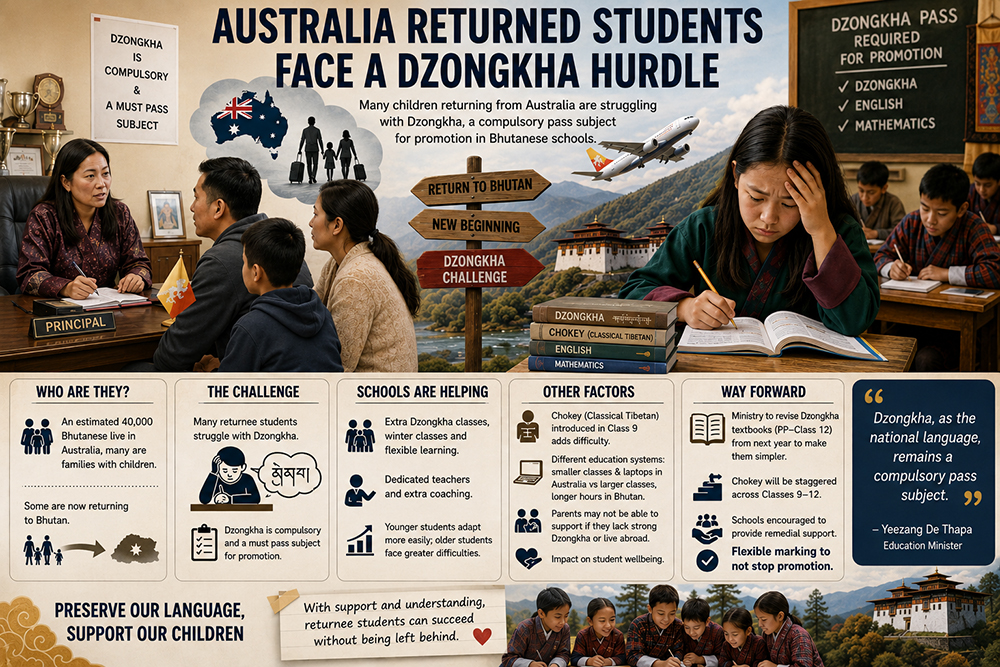
AI generated Image
An estimated 40,000 Bhutanese are living in Australia, many of them families with children who either migrated from Bhutan or were born in Australia.
As some families begin returning to Bhutan, many children are facing challenges with the compulsory pass requirement in Dzongkha for promotion in schools.
Pelkhil School Principal Rie K. Dorji said she recently met three families who had returned from Australia and were seeking to enrol their children in the school, mistakenly believing that the Cambridge curriculum followed by the school did not require Dzongkha.
One of the parents had come as a representative of a much larger group of Bhutanese parents in Australia with children who planned to move back, but only if their children could get admission into a school without compulsory Dzongkha or one where it is not a must pass subject.
The parent left disappointed when Rie told him that Dzongkha is not only compulsory but it is a must pass to get promotion.
Rie K Dorji said the families wanted their children to study Dzongkha, but their proficiency was so limited that they feared failing the board examinations, which they believed could affect the children’s wellbeing.
Pelkhil School has admitted around a dozen students returning from Australia, and the Principal acknowledged that many were struggling with Dzongkha. She said students entering at the primary level were able to adapt more easily, while those joining in higher classes were facing greater difficulties.
The school has been providing additional Dzongkha support through winter classes, extra lessons, and flexible learning arrangements to help the students cope.
The Druk School Principal Phuentsho Tashi said the school has around a dozen students who recently returned from Australia, and that all of them are facing difficulties with Dzongkha.
He said the school has teachers supporting such students, including a dedicated Dzongkha teacher who provides extra coaching. He added that younger students had shown improvement after a few months.
He said he was aware of several cases, including that of a friend, whose children struggled to cope with the Dzongkha standard after returning from Australia. Fearing that the children could be held back academically, the families enrolled them in schools in Darjeeling, including North Point School.
He said children who studied Dzongkha in Bhutan until around Class 7 before moving to Australia and later returning generally cope better, as they still retain the foundation in the language. However, he said the challenge is far greater for students who lack that basic grounding in Dzongkha.
The principal said that the introduction of Chokey in Class 9 has added further difficulty, noting that it is classical Tibetan rather than Dzongkha, and that many students are struggling as a result.
Dr Tobgyel School Principal Bir Bdr Battarai said the school has around half a dozen students who have returned from Australia.
He cited one case where a student had completed Class 8 in Australia but was placed in Class 7 upon enrolment due to difficulties with Dzongkha, and subsequently struggled to pass school examinations.
He said younger students are generally able to catch up with additional support and extra after-school instruction, but the situation is more challenging for older students.
He also recalled a case involving a Class 5 student whose family returned to Bhutan after being inspired by a Speech by His Majesty in Australia. However, the child could not cope with Dzongkha and eventually left the school, with the parent informing the Principal that they were returning to Australia for the sake of the child’s education.
The principal added that the Ministry of Education and Skills Development is increasingly focusing on student wellbeing, and said the impact of mandatory Dzongkha pass requirements for such students needs to be carefully assessed.
He said the school has to follow the directives of the ministry, including in Dzongkha, as they get assessed by the ministry. He said the struggle is especially acute for parents who do not have a good Dzongkha background and so are unable to guide their children.
He said while Dzongkha is the main challenge for Australia returned students, there are other issues too.
He said the education system in Australia is more student centric with smaller class sizes, classes only till 1 to 2 pm and a lot of assignments being done in laptops. As a result, even weak students who struggle in Bhutan do well in Australia and blossom there.
Back in Bhutan, students often face longer school hours, larger class sizes, a heavier academic workload, and a greater emphasis on written work over the use of technology, which can make adjustment difficult in the initial period.
He said while most students are eventually able to adapt and cope with other subjects, Dzongkha continues to remain a persistent challenge.
The principal said there are also cases where parents migrate to Australia while leaving their children in Bhutan under the care of grandparents. He noted that these children often face difficulties, as the grandparents are generally less educated and unable to provide the same level of academic support and guidance.
He added that some of these students also develop behavioural issues, as grandparents may not be able to exercise the same level of supervision and discipline as parents.
In one case, a student at Yangchenphug Higher Secondary School who returned from Australia and enrolled in Class 9 in 2020 was able to cope, as he had previously studied Dzongkha before leaving the country. He went on to clear his Class 12 examinations in 2025.
Motithang Higher Secondary School Principal Jigme Choden said she is aware of a case where parents holding permanent residency in Australia returned to Bhutan with their child and enrolled them in school. However, after the child failed Dzongkha and was not promoted, the families reportedly returned to Australia, taking their child with them.
The issue is not limited to returnee families from Australia, but also affects parents living in Bhutan, due to the mandatory pass requirement in Dzongkha, compounded by the introduction of Chokey in Class 9.
Even within Bhutan, an increasing number of parents are sending their children to boarding schools in Darjeeling, Kalimpong and other locations, in an effort to avoid promotion being affected by Dzongkha-related requirements.
The implications of returnee students from Australia facing difficulties with Dzongkha are considered significant, particularly as Australia now hosts a large number of Bhutanese families with young children in education.
Concerns have been raised that if Bhutan hopes to encourage their return, steps may be needed to ensure that students are not academically disadvantaged due to Dzongkha requirements while studying in Bhutan.
An Education Ministry source said it is mandatory for schools in Bhutan to teach Bhutanese history and Dzongkha to Bhutanese students, including in any international schools established in the country. The source added that, in addition to Dzongkha, students are required to pass English and, more recently, Mathematics.
The source also said schools are encouraged to provide additional support to students who are weak in Dzongkha, including remedial classes.
Education Minister Yeezang De Thapa said Dzongkha, as the national language, remains a compulsory pass subject. She said the ministry’s main intervention will be curriculum reform, with Dzongkha textbooks from pre-primary to Class 12 to be revised from next year to make them simpler and reduce the academic load.
She added that Chokey cannot be removed from Class 9, but will instead be staggered across Classes 9 to 12 to ease the burden in Class 9.
Lyonpo said she had consulted the Dzongkha Development Commission and was informed that the Dzongkha curriculum framework is guided by the Zhung Dratshang, which provides the overall academic outline, and that Chokey was reintroduced in Class 9 based on that structure.