The Bhutanese Leading the way.
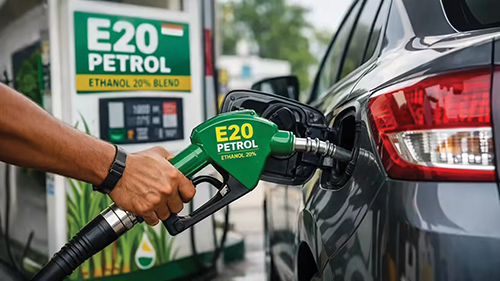
These days, there are a lot of media and social media reports from India on how the ethanol introduced into petrol there, especially the widespread E20 blend, which consists of 80% petrol and 20% ethanol, is causing havoc for vehicles.
A consistent issue being reported is the breakdown of vehicles and vehicle parts, as well as reduced mileage.
Right now, consumers in India have no choice but to use ethanol-blended petrol, as all major public and private fuel retailers, such as Indian Oil (IOCL), Bharat Petroleum (BPCL), Hindustan Petroleum (HPCL), and Jio-bp, supply E20-blended petrol as their standard petrol fuel.
India’s Ministry of Petroleum and Natural Gas has mandated that E20 be supplied nationwide as the standard petrol fuel, with only a few exceptions.
The big question now is whether Bhutan is also importing ethanol-blended petrol, since IOCL, BPCL, and HPCL are the main fuel suppliers to Bhutan.
The Bhutanese put this question to the Department of Trade and asked if our lab at Chunzom is testing for ethanol.
The Department said that Bhutan is not importing E20 petrol.
It has been learnt that Indian Oil Marketing Companies (OMCs) have been offering to supply E20 petrol to Bhutan, but Bhutan has resisted so far.
The Department said that, unlike normal MS (petrol), ethanol-blended petrol contains a hydroxyl (-OH) group, making it hygroscopic in nature, meaning it readily absorbs and mixes with water.
Once water contaminates ethanol-blended fuel, the water and fuel cannot be separated easily, which is likely to affect fuel quality and vehicle performance.
“Further, considering the existing condition and quality of several of the underground storage tanks maintained by fuel dealers, the import and handling of ethanol-blended fuel may pose challenges in ensuring fuel quality and preventing contamination.”
The Department said that, in view of these concerns, the Public Sector Undertakings (PSUs)/OMCs in India were requested during technical meetings to continue supplying normal MS for Bhutan as long as such fuel remains available in the Indian market.
“Even in the event that India transitions to higher levels of ethanol blending or eventually adopts fully ethanol-blended petrol, Bhutan has requested that advance notice be provided. This would allow fuel dealers, in collaboration with PSUs/OMCs, sufficient time to upgrade underground storage tank infrastructure and related fuel handling systems to ensure leak-proof and seepage-free storage facilities capable of safely handling ethanol-blended fuels.”
An official explained that many of Bhutan’s fuel tanks are very old and, given their age and the Himalayan terrain, it is expected that there is some slight seepage of water into the fuel tanks.
The official said that if E20 is stored in such tanks, the ethanol component of the fuel will absorb water, which will both dilute the fuel and change its chemical composition.
The official said that, in such a scenario, there is a high chance of major engine issues, and the vehicle may even fail to run. He said this would quickly become a public issue and then a media issue.
When asked how Bhutan could know if OMCs sent E20 to Bhutan, either intentionally or by mistake, the official said it would be evident even without testing because the fuel would turn milky if even a small amount of water entered it. He said this would likely happen given Bhutan’s fuel tanks, which have some seepage.
He said that if Bhutan is ever mandated to accept E20 fuel, advance notice must be given so there is enough time to overhaul the entire fuel storage and transportation system. He added that Indian OMCs should provide leak-proof tanks.
According to the official, Bhutan will not accept E20 under the current circumstances.
An official with Tashi BOD, the nation’s largest fuel distributor, had the same things to say. He said that currently fuel stations in Bhutan cannot handle ethanol because of the water seepage issue, which would destroy the fuel.
He said all underground fuel tanks would have to be replaced, and measures would need to be taken to ensure there is no seepage.
He said E20 is especially not suited to hilly terrain like Bhutan because of groundwater and seepage issues. Even without those concerns, vehicles require more power in the hills, and E20 will not provide optimum performance.
The official said that Bhutan currently buys the higher export-quality petrol and diesel from India, which is priced higher than the fuel sold at petrol pumps in India.
E20 was introduced in India with the aim of reducing crude oil imports, saving billions in foreign exchange, and supporting farmers who grow sugarcane and maize.
India’s Ministry of Petroleum and Natural Gas has formally clarified that the Ethanol Blending Programme is scientifically validated and that there are no verified instances of widespread engine breakdowns.
However, media and social media reports from the ground paint a different picture.
While early official estimates from the Automotive Research Association of India (ARAI) pegged fuel efficiency losses at a minor 1% to 6%, real-world data paints a harsher picture.
Independent consumer surveys and automotive forums indicate that nearly half of petrol vehicle owners with models purchased in 2022 or earlier are experiencing real-world mileage drops of between 10% and 20%, with vehicles operating in congested stop-and-go urban traffic being the most heavily affected.
Because E20 fuel is highly hygroscopic, owners of older vehicles are seeing premature degradation of fuel pumps, clogged fuel injectors, and rusted fuel tanks. Workshop data shows that long-term usage in incompatible vehicles can result in an additional annual repair expense of INR 5,000 to INR 10,000 for parts replacement and specialised fuel additives to counter moisture build-up.
In countries like Brazil, ethanol-heavy fuels are heavily subsidised to offset the mileage loss. In India, E20 petrol retails at the same premium price as unblended petrol, meaning consumers effectively pay the same amount for fuel that delivers less range while increasing overall household vehicle maintenance costs.
India has accelerated its transition much faster than other global markets. With E20 now the standard and the rollout of E85 (85% ethanol) and higher blends underway, buyers planning long-term vehicle ownership are facing considerable confusion.
Unlike international markets, where consumers have the choice of lower blends (such as E5 or E10) or pure petrol from a separate nozzle to protect classic or older commuter vehicles, Indian fuel stations universally dispense the standard blended fuel.
This could become a problem in Bhutan in the future if the country is not given options when E20 eventually arrives.
An additional concern is that only vehicles manufactured from 2023 onwards in India are designed to handle E20. As a result, it is causing more problems for vehicles bought before that year, which make up the majority of vehicles in both Bhutan and India.
After achieving its E20 target for petrol, the Indian government is planning to introduce isobutanol blending with diesel to reduce imports. Umashankar, Secretary at India’s Ministry of Road Transport and Highways (MoRTH), said the proposal is being taken “very seriously” and could be rolled out later this year.
Isobutanol is a biofuel made from ethanol. It contains more energy than ethanol and is less corrosive.
It is likely to be mandated by the Indian government.
A 2% blend of isobutanol is currently being tested on a pilot basis by Tata Motors and BPCL.
With such dramatic changes taking place in India’s fuel sector, there are already instances of consumers holding off on buying vehicles because fuel technology is advancing faster than vehicle technology.
The sole source of petrol and diesel for Bhutan is India, and it is important that Bhutan closely observe what is happening there on the fuel front and with the various fuel blends, especially given the issues surrounding pricing, engine impact, mileage, transparency, compatibility, Bhutan’s storage conditions, and the possible lack of consumer choice in the future.