The Bhutanese Leading the way.
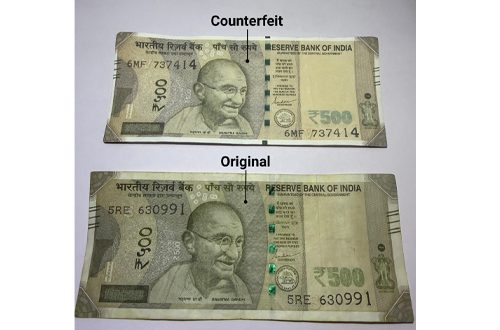
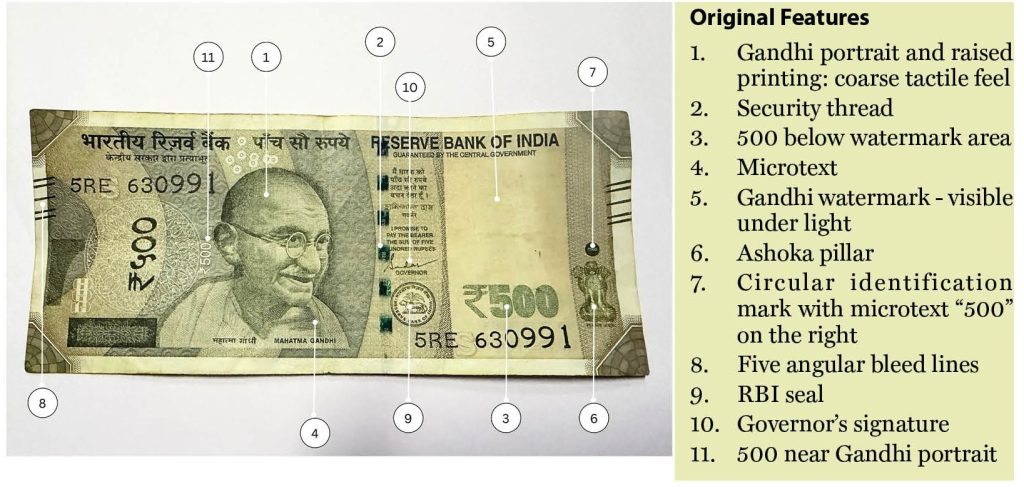
Following The Bhutanese’s recent coverage on the Royal Bhutan Police seizure of counterfeit Indian currency worth INR 1.77 million, this reporter examined a confirmed counterfeit ₹500 note alongside a genuine note to highlight the key security features that help distinguish real currency from fake notes.
The case, involving two Bhutanese individuals arrested for circulating counterfeit Indian currency, underscores the need for greater public awareness in identifying fake notes during routine financial transactions.
Visible features for quick identification
A genuine ₹500 note issued by the Reserve Bank of India (RBI) contains several visible features that can be verified without special tools.
The note carries the portrait of Mahatma Gandhi at the centre, along with the denomination numeral “500” printed prominently on both sides.
It also includes a language panel showing the denomination in multiple Indian languages, the Ashoka Pillar emblem on the right side, and the RBI seal along with the Governor’s signature.
When tilted, the colour of the denomination numeral shifts from green to blue, which is one of the most commonly used quick verification methods.
Other visible checks include a continuous security thread, a see-through register where the numeral “500” aligns on both sides when held against light, and raised printing on key elements that can be felt by touch.
These features form the first line of verification during everyday cash transactions.
When held against light, a genuine ₹500 note reveals a watermark of Mahatma Gandhi along with the numeral “500” embedded in the watermark area.
Counterfeit notes often fail to reproduce the clarity of the watermark, appearing blurred, uneven, or entirely absent under light.
The security thread is another key feature.
In genuine notes, it appears as a continuous embedded strip reading “भारत” and “RBI” when viewed against light or tilted.
In fake notes, this thread is usually printed on the surface rather than embedded within the note.
A genuine ₹500 note contains a latent image of the numeral “500” located near the portrait of Mahatma Gandhi. This becomes visible only when the note is tilted at a specific angle.
Microtext is also embedded in several areas of the note, including small inscriptions of “RBI” and “₹500”, which are only visible under magnification.
These features are difficult to replicate accurately and are commonly missing in counterfeit notes.
The numeral “500” on the lower right corner is printed using colour-shifting ink, which changes colour from green to blue when tilted.
Also, the security thread in genuine notes, which appears as a continuous embedded strip changes from green to blue when tilted.
Genuine notes also feature intaglio or raised printing, features for the visually impaired where elements such as the portrait of Mahatma Gandhi, the Ashoka Pillar emblem, circular identification mark with microtext 500 on the right, five angular bleed lines on both the left and right sides.
Counterfeit notes generally lack this tactile quality and feel smoother and flatter.
Further, it was also noticed in the recent counterfeit note that the four borderlines were triangular in shape while genuine currency had a different one. The quality of fake counterfeit notes vary but a bad counterfeit is smaller in size and the paper feels different.
Why counterfeit notes are hard to detect
According to RBI security guidelines, counterfeit notes have become increasingly sophisticated in replicating surface-level features.
However, they often fail in replicating layered security mechanisms such as watermark clarity, embedded security threads, latent images, and tactile printing.
This makes it essential for users to conduct more than a single visual check, especially in high-cash environments such as fuel stations and retail transactions.
Context
In the recent RBP case, counterfeit ₹500 notes were used in transaction on 12th May before being detected, including at a fuel depot in Thimphu.
The two individuals aged 36 and 37 involved were arrested on 14th May 2026 and the counterfeits seized before further circulation.
The was forwarded to the Office of Attorney General (OAG) on 10th June 2026.
The incident highlights how counterfeit currency can circulate quickly when verification checks are not consistently applied at the point of transaction.
Authorities have since urged the public to remain vigilant and report suspicious currency to the nearest police station.