The Bhutanese Leading the way.
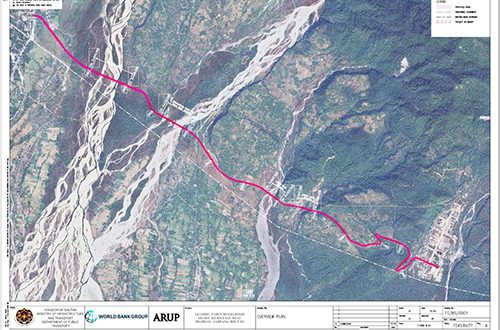
The overall road length has been reduced to 12.6 km from 14.1 km
The Gelephu-Tareythang road will now be 12.6 km long, 1.5 km shorter than the originally proposed 14.1 km alignment, following the finalization of a new greenfield alignment for the Tareythang segment.
The update was shared by the Minister for the Ministry of Infrastructure and Transport (MoIT), Lyonpo Chandra Bdr Gurung, during the 31st Meet-the-Press session on 11th September 2026.
Lyonpo said the new alignment was finalized over the past three months following an overall assessment of available options, including road safety considerations.
The revision has reduced the length of the originally proposed two-lane carriageway road widening in the Tareythang segment from 3.9 km to 2.4 km.
The approximately 4 km four-lane carriageway from Gelephu to Chhuzanggang remains unchanged.
With the new alignment, the project will also have six bridges instead of the five originally planned.
The bridge span arrangements and bridge types have also been finalized.
The project includes an approximately one-kilometre-long Mau River bridge, which will be a four-lane, dual-carriageway bridge.
The bridge will span the wide Mau River floodplain and include an underpass for elephants and other wildlife to maintain wildlife movement.
The Gelephu-Tareythang road and bridges form part of the Southern East-West Highway and are being developed under the Accelerating Transport and Trade Connectivity in Eastern South Asia (ACCESS) Bhutan Project, funded by the World Bank.
The ACCESS Bhutan Project became effective on 20th May 2026, with an overall allocation of approximately USD 233.35 million, equivalent to about Nu 20.39 billion.
The feasibility study for the road and bridges was completed through collaboration between the Ministry of Infrastructure and Transport and the Gelephu Mindfulness City (GMC) authority.
The Environmental and Social Impact Assessment has also been finalised.
The contract for the Detailed Engineering Design was signed on 7th January 2026 with a joint venture between Consulting Engineers Group Limited of India and DOHWA Engineering Co., Ltd of South Korea, with Progressive Research & Consultancy Service of Bhutan as the sub-consultant.
The contract became effective on 21st January 2026, and detailed engineering design work began the same month.
With the major alignment and bridge decisions now finalized, the project is at an advanced stage of detailed study.
The department is targeting completion of the full detailed design by December 2026.
Construction is still scheduled to begin in June 2027, with completion targeted for December 2030.
The MoIT is also undertaking the prequalification of contractors in parallel with the detailed design to reduce procurement time and identify technically and financially capable contractors for the construction works.
The prequalification documents have already been published, inviting national and international contractors to submit applications.
The deadline for submission is October 2026.
Following evaluation, contractors meeting the specified technical, financial, experience and other qualification requirements will be shortlisted and invited to participate in the subsequent bidding process.
Once completed, the Gelephu-Tareythang road will provide a missing link in the strategic transport corridor connecting the Southern East-West Highway, which runs from Samtse to Samdrupjongkhar, with GMC and its planned international airport, railway and dry port.
The road from Gelephu to Chhuzanggang is being designed as a four-lane divided highway, with two separate carriageways, each carrying two traffic lanes.
The design is intended to improve traffic capacity and safety while accommodating future growth.
Meanwhile, the project is expected to require acquisition of approximately 4,670 decimals of private land, affecting around 223 land plots and 69 structures belonging to approximately 20 households in Namkhaling, Chhuzanggang, Umling and Tareythang.
The department under the ministry is currently finalising the land acquisition requirements, including assessments of affected assets and applicable compensation.
In line with the World Bank Environmental and Social Framework, the finalized land acquisition and compensation information will be publicly disclosed to affected communities and the public through appropriate channels, including stakeholder consultations.
Following finalisation and clearance by the government and the World Bank, compensation will be initiated, with the objective of completing the required compensation before construction begins.