The Bhutanese Leading the way.
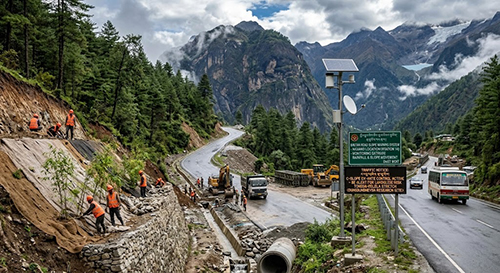
Drainage improvements, slope stabilization and early warnings among measures to reduce recurring road damage
The Ministry of Infrastructure and Transport (MoIT) is strengthening road resilience against extreme weather, with a focus on drainage, slope stabilization, preventive maintenance and early warning systems to reduce recurring road damage. Speaking during the 32nd Meet-the-Press, MoIT Secretary Karma Wangchuk said emergency clearance alone was not enough to address repeated road damage, and that sustained attention was needed to improve drainage, slope stability and pavement performance.
He said high-altitude sections such as Dochula face additional challenges from low temperatures, freeze-thaw cycles, moisture and difficult drainage conditions. The MoIT acknowledged these challenges in Parliament in June 2026, along with the need for technical standards suited to mountain road conditions.
The Department of Surface Transport (DoST) is strengthening road resilience along key corridors, including the Wangdue Phodrang to Thimphu highway. Under the Guidelines for Road Drainage System 2021, the ministry is improving roadside drainage based on rainfall and runoff, providing standard drain sizes according to road classification and using subsurface and aggregate drains to protect pavements from seepage. Drainage systems on steep gradients also incorporate measures to reduce water flow energy.
At landslide-prone locations, geotechnical and geological investigations are carried out to identify risks and determine appropriate stabilization measures. The Road Slope Failure Database helps prioritize interventions, while guidelines developed with the Japan International Cooperation Agency under the C-Slope Project in 2024 provide measures for cut slopes, rockfalls, slope failures, debris flows and bio-engineering works. The ministry is also gradually shifting towards preventive maintenance through regular inspections of critical slopes and drainage systems. The approach aims to address the underlying causes of repeated road damage while maintaining the capacity to respond to emergencies.
Under the Guidelines on Design, Construction and Maintenance of Road Infrastructure Incorporating Climate-Resilient Features 2019, drainage systems and cross-drainages on new and upgraded roads are designed to accommodate 20 to 25 percent more discharge to account for heavier rainfall.
The guidelines also require at least five cross-drainages, each with a diameter of no less than 1,200 millimeters, per kilometer of road, with cascading outlets to prevent scouring. Greater emphasis is placed on hydrological and geotechnical studies, gentler cut slopes through bench cutting and controlled blasting, and the use of bio-engineering and environmentally friendly construction practices to stabilize slopes.
To improve road performance in cold regions, the MoIT has started a drainage research study along the Dungdungneysa–Pelela section of the Wangdue–Chuserbu highway. The study includes trial stretches to test materials and admixtures under different exposure conditions. The findings will be used to improve specifications for mountain passes and assess whether similar pavement performance studies are needed elsewhere. The ministry is also developing an early traffic control system under the C-Slope Guideline for Ex-ante Traffic Control 2024. Rainfall and slope movements at hazard-prone locations are monitored, with data transmitted in real time to the Road Slope Warning System at DoST headquarters. When rainfall exceeds set thresholds, warnings are issued and traffic on high-risk stretches can be stopped before landslides or debris flows occur.
To speed up the restoration of blocked roads, heavy-equipment units are stationed at frequently affected locations during the monsoon. The ministry also maintains 18 sets of Bailey bridge parts nationwide, with two sets at each regional office, to facilitate the quick restoration of damaged crossings. Private machinery is hired when departmental equipment is insufficient, while engineers and technical staff from regional offices are deployed to affected sites when required.
During the monsoon, DoST coordinates with the National Center for Hydrology and Meteorology, local governments and disaster-management authorities. Restoration procedures have also been revised to speed up the processing of funds and reduce delays that could push repair work into the following monsoon season. To keep travelers and businesses informed, designated focal persons at the department and each regional office share roadblock information through the Bhutan Road Watch App, the DoST Facebook page and official messaging groups. Updates include the affected location, cause of the blockage, estimated clearance time and road reopening information.
MoIT Secretary said the ministry would continue to prioritize road resilience along key corridors, including the Wangdue Phodrang to Thimphu highway, based on assessments by the responsible regional office and the resources available.