The Bhutanese Leading the way.
Rising household, EV and industrial consumption expected to reshape electricity demand over the next decade
Bhutan’s electricity demand is expected to rise sharply over the next five to ten years, driven by growing residential consumption, electric vehicles, industrialization and the construction of new hydropower projects.
According to the Ministry of Energy and Natural Resources (MoENR), national electricity consumption increased by 6,204 million units (MU) between 2021 and 2025, recording a compound annual growth rate of 20 percent. The coincidental national peak load also increased by 1,042 MW during the same period, with a CAGR of 19 percent.
Residential electricity consumption is projected to increase by 1.3 to 1.8 times over the next five to ten years. Urban consumption has grown at a CAGR of 6.55 percent over the past five years, while rural consumption has increased by 5.80 percent. Electricity consumption from cottage and small industries has recorded a higher CAGR of 7.45 percent.
The growth in electric vehicles is also expected to add to domestic electricity demand. The registered EV fleet increased from 133 vehicles in December 2021 to more than 1,343 by April 2026, with 525 EVs added in 2025 alone. EV electricity consumption increased by 18 percent between 2023 and 2025 and is projected to grow three to five times over the next five to ten years.
Electricity consumption for the development of Gelephu Mindfulness City (GMC) is projected to increase from 88 MU in 2025 to around 1,000 MU by 2034.
Industrialization is expected to place further pressure on electricity supply. Around 800 MW of industrial loads have sought power clearance or sanctions from the Department of Energy and are expected to come online within the next five years, with a significant portion expected to come from the Norbugang Industrial Park. Construction activities for hydropower projects are also expected to create substantial electricity demand. Construction power requirements from hydropower projects under construction and in the pipeline are projected to peak over the next five to ten years, with estimated annual consumption reaching around 3,000 MU in the peak year.
With these developments, the MoENR expects electricity demand to double by 2040. In the near term, rising domestic demand is expected to outpace the commissioning of new generation capacity, resulting in lower electricity export volumes until 2030. Exports are expected to increase thereafter as projects currently under construction are commissioned as planned. The MoENR said domestic energy security remains the priority under the National Energy Policy 2025. Hydropower exports, while important for national revenue, will not come at the expense of reliable domestic electricity supply.
The government plans to meet rising demand by expanding generation capacity, diversifying the energy mix and strengthening the transmission network. The National Energy Policy 2025 targets 25,000 MW of installed generation capacity by 2040, comprising 20,000 MW from hydropower and 5,000 MW from solar, supported by energy storage and grid expansion.
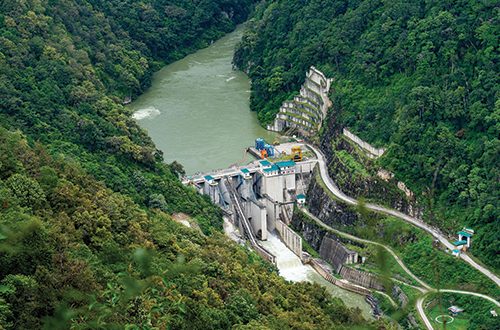
Bhutan currently has around 3,576 MW of installed generation capacity. Projects under construction are expected to add approximately 3,690.5 MW. These include Punatsangchhu-I with 1,200 MW, Dorjilung with 1,125 MW, Khorlochhu with 600 MW and Wangchhu with 570 MW, along with several small hydropower projects. A further 17,407 MW of hydropower and pumped-storage projects are at the detailed project report stage. The Ministry said pumped-storage projects will provide greater flexibility and help provide firm renewable power, particularly during periods of low hydropower generation.
The government is also pursuing solar generation, energy storage, transmission expansion, grid modernization and energy efficiency measures to address rising demand and seasonal variations in hydropower generation. The ministry said electricity exports will continue to be based on the availability of surplus power after meeting domestic demand. During periods of high-water flow and surplus generation, electricity can be exported, while imports, energy banking and power purchase arrangements may be used when domestic supply falls short.
The government is also developing a Bhutan Power Market Platform to improve electricity scheduling, trading and allocation. The platform is expected to support reliable and competitively priced electricity for domestic industries while allowing surplus power to be traded more efficiently. With domestic electricity demand rising rapidly, Bhutan’s challenge over the coming decade will be to expand generation capacity quickly enough to meet industrial and household requirements while maintaining its role as a regional electricity exporter.