The Bhutanese Leading the way.
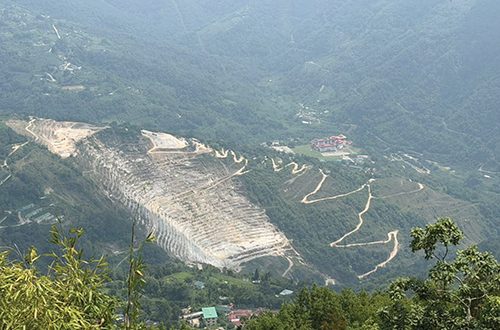
TB: With the current Gypsum mines winding down, what is the capacity left in the current mines and what are the expansion plans?
DGM: Khothakpa Gypsum Mine (KGM) is located under Shumar Gewog, Pemagatshel Dzongkhag in the eastern part of Bhutan. The gypsum deposit was first discovered by GSI with a total proven reserve of 25.942 million tonnes in the 1980s.
The KGM was first auctioned in 1993 for a period of 10 years, and subsequently for another 15 years in 2004 with both auction terms operated by Druk Satier Corporation Limited. At the end of the auction lease period in 2018, about 6 million tonnes of gypsum had been extracted from Khothakpa in a 15 year auction lease.
To harness economic opportunities, DGM re-evaluated the mine and estimated 14.33 million tonnes of gypsum with +80% CaSO4.2H2O at Khothakpa. In 2019, the government approved the interim operation of the Khothakpa Gypsum Mine (KGM) to the State Mining Corporation Limited (SMCL) for a period of 2 years.
After the expiry of the interim period, the Government approved a long term lease of 80.50 acres for 15 years, and SMCL has extracted an average of 0.65 million tonnes of gypsum per annum in the last 7 years.
Today, the reserve stands approximately 10 million tonnes. The mine is surrounded by human settlement in all four directions. To mitigate the impacts from mining operations, DGM in collaboration with the Pemagatshel Dzongkhag and Shumar Gewog carried out an impact assessment, and recommended a stand-off distance of about 150 m between settlement and mine boundary.
Within the stand-off distance, the team identified 70 privately registered landowners, encompassing 113 private plots totaling 58.351 acres. The affected land and property owners were compensated and the land survey was completed for land substitution under Nganglam Drungkhag, Pemagatshel Dzongkhag in the month of April 2026. DGM is exploring additional gypsum deposits in the region beyond the current mine boundary and planning to adopt geophysical tools in such exploration activities.
TB: Bhutan is estimated to have 128.24 million metric tons of Gypsum reserves. It is true and where are these found?
DGM: The proven reserves of gypsum at Khothakpa and Cherungri stand at 10 million and 69.03 million tonnes respectively. In addition, a total of 22.46 million tonnes of gypsum under probable and inferred level has been also identified under Pemagatshel Dzongkhag
TB: Please explain how the Gypsum mines expansion will happen and what are the plans for relocation of affected people or villages?
DGM: Gypsum mine expansion will remain as a priority objective of the Department since it is one of the essential minerals used across multiple industries such as construction, manufacturing, agriculture and pharmaceutical industries. The cement manufacturing industries use gypsum as a critical additive, in construction sector gypsum is used as plasterboard, in agriculture sectors gypsum is used as soil conditioner, in pharmaceutical industries gypsum is used as source of calcium, and in breweries it is used as acidity regulator.
The discovery of new gypsum deposits in the region may require detailed techno-economic feasibility studies to determine the cost-benefit of opening the new mine. In case of the discovery of huge deposits, DGM will seek government intervention and necessary approval to carry out relocation and compensation of the affected people and villages falling within the proposed mining area like we did in the past years.
TB: There are reports of Talc deposits being exhausted or nearing exhaustion. Is this true or not and please explain if there are reserves to be explored?
DGM: Talc deposits are distributed from Samtse to Sarpang Dzongkhags in the southern region of Bhutan. Based on the DGM’s existing mineral cadastre, a total of 0.1397 million tonnes of talc deposits have been identified in Bhutan.
In Bhutan, economically viable talc deposits are primarily confined to the Pangsari Formation, one of four stratigraphic subdivisions of the Baxa Group within the upper Lesser Himalayan Sequence (LHS). Extending across the southwestern region from Samtse to Pasakha, this lithostratigraphic unit hosts 25 identified talc occurrences, with the highest concentration in the Samtse district. Covering various stages of geological investigation, these deposits account for an estimated total resource of 0.1912 million metric tonnes (MT).
To systematically evaluate this potential and upgrade resource confidence, the Department of Geology and Mines has issued four Exploration Permits (EPs). Ongoing field exploration under these permits aims to refine structural controls, improve seam delineation, and potentially increase the national talc resource base to support Bhutan’s expanding industrial mineral sector.