The Bhutanese Leading the way.
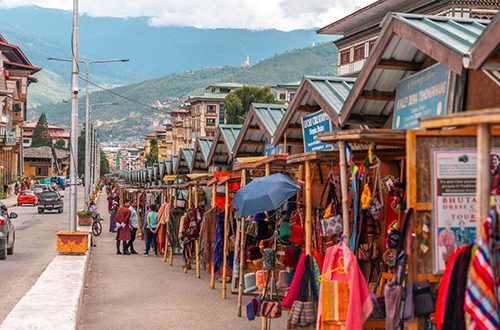
A study was done on 31 small-scale craft retailers located in Thimphu and Paro, two of Bhutan’s most popular tourist destinations and the primary hubs of craft retail activity in the country, by the Competition and Consumer Protection Authority (CCAA). These two locations were selected given their high concentration of craft retail outlets and their significance as points of first and frequent contact between tourists and Bhutanese craft products.
Categories
Two broad clusters emerge. The first comprises categories in which Bhutan holds a comparative advantage and where local production dominates or is exclusive — bamboo and cane products, wood products, yathra and yathra products, and souvenirs and knick-knacks, together with clay and thangka products to a somewhat lesser extent.
The second comprises categories where Bhutan lacks the domestic raw-material base or manufacturing capacity to compete, chiefly metal and ceramic products, where imports account for the overwhelming majority of stock. Textile and textile products form a notable exception to this pattern: despite reasonably strong domestic weaving capability, only 16% of retailers stock exclusively local textiles, with 81% mixing local and imported lines. This suggests that, unlike metal and ceramics, the constraint in textiles is not one of capability but of price and product variety, a distinction with direct implications for the type of support the category needs.
Textile and textile products show significant import penetration: 81% of retailers stock both locally made and imported items, 16% deal exclusively in local textiles, and a further 3% stock imported textiles only.
Yathra and yathra products, together with wood products, are predominantly locally produced. Local goods are stocked by 65% of yathra retailers and 67% of wood product retailers, with imports accounting for only 12% and 7% of these categories respectively, and the remainder stocking both.
Bamboo and cane products are entirely locally made, with no imports reported in this category — a reflection of Bhutan’s comparative advantage and ready access to raw material.
Metal and ceramic products show the opposite pattern, being overwhelmingly imported. Among metal product retailers, 72% stock only imported items and the remaining 28% carry both local and imported goods; none deal exclusively in locally crafted metal products. Ceramic products follow a similar trend, with 83% of retailers stocking only imported goods and just 4% dealing exclusively in locally made ceramics, with the remaining 13% carrying both. In both cases, the near-total reliance on imports most plausibly reflects Bhutan’s limited domestic metalworking and ceramic manufacturing base rather than a lack of retailer or consumer preference for local goods, and should be read differently from the import penetration seen in categories – such as textiles – where domestic capacity already exists.
For clay products, local production leads: 58% of retailers stock locally crafted goods only, 25% rely solely on imports, and the remaining 17% stock both.
Thangka and embroidered products reflect relatively strong local craftsmanship, with 45% of retailers stocking only locally made items, 48% carrying both local and imported products, and a smaller share (7%) dealing solely in imported items.
Souvenirs and knick-knacks are dominated by local production, with 72% of retailers stocking locally made items only – indicative of a comparatively dynamic domestic souvenir-making sector – while 20% carry both local and imported goods and 8% deal only in imports.
Source
Sourcing channels for craft products Craft retailers source their products through several channels: local wholesalers or dealers, individual artisans, artisan or producer cooperatives, and combinations of these. The coexistence of multiple channels reflects a fragmented supply chain in which retailers, rather than a centralised or standardised procurement system, determine sourcing arrangements on a case-by-case basis. Just under half of retailers (48%) acquire their goods exclusively from local dealers or wholesalers, whether the products themselves are imported or locally made. A further 26% combine artisans and local dealers as sourcing channels, while 23% draw on multiple sources simultaneously, and a small remainder (3%) combine artisans with craft cooperatives or producer groups. This layered, retailer-driven sourcing structure also helps explain why reliable information on a product’s true origin does not always travel from producer to end consumer, a theme that recurs in the findings on misrepresentation.
Reason for depending on imports
Retailers identified several reasons for relying on imported rather than locally made craft products. Limited diversity of locally available products was the most frequently cited factor, accounting for 27% of responses, closely followed by the higher price of locally crafted goods at 26%. Unavailability of desired products on demand accounted for a further 19% of responses, while unreliable or inconsistent supply was cited by 13%. Poor quality of local craft products was flagged by a smaller share of respondents (6%), with the remaining 10% attributing their reliance on imports to other factors. Taken together, these findings suggest that import dependence is driven less by an absence of demand for local products and more by structural weaknesses on the supply side – cost, variety, availability and consistency – that collectively push retailers toward imported alternatives even where they might otherwise prefer to stock local crafts.
Misrepresentation
One of the more concerning practices identified by the study is the misrepresentation of imported craft products as locally made, particularly to tourists and other buyers who may be unable to distinguish genuine local craftsmanship from imported substitutes. While 30% of retailers reported that this practice does not occur, an equal proportion (30%) indicated that it happens frequently, and a further 17% stated that it is a consistent, ongoing practice in their business.
Taken together, close to half of all respondents acknowledge that misrepresentation occurs to some degree, pointing to a material integrity gap in the market that undermines consumer trust and places genuine, transparent retailers and artisans at a competitive disadvantage. Retailers who acknowledged this practice cited several underlying motivations. The most significant driver, cited by 29% of respondents, is buyer preference: foreign tourists in particular place high value on locally crafted goods as part of the touristic experience, creating a direct incentive to mislabel imported goods as local. General market practice and competitive imitation were equally significant, cited by 19% of respondents, with a further 19% pointing specifically to the better profit margins the practice yields once it becomes common among competitors – together indicating that unethical practice, once established by a few retailers, tends to become normalised across the market. Price and supply considerations were comparatively secondary, with 11% citing the higher cost of local crafts and 4% citing short supply of local products; the remaining 18% cited other reasons.
Consumer awareness
Despite the prevalence of misrepresentation, consumer demand for authenticity remains high. A large majority of retailers (84%) reported that buyers sometimes or frequently ask to confirm the origin of a product, while only 16% said buyers rarely or never do so. This indicates that most consumers actively value and seek assurance of authenticity but currently have limited reliable means of independently verifying retailer claims – leaving them exposed to misrepresentation despite their own diligence, and underscoring the potential value of a credible, independently administered certification or labelling system.
Price discrimination based on buyer
The study also found evidence of differential pricing based on buyer nationality. More than half of retailers (52%) charge international tourists (from outside the region) 10-25% more than local buyers, while a further 32% charge as much as 26-50% more, and only 16% apply a markup of less than 10%. Pricing practices toward regional tourists are comparatively more moderate: 46% of retailers add less than 10% to the price charged to local buyers, 29% add 10-25% more, and 25% still charge as much as 26-50% above the local price. While a degree of price differentiation is not unusual in tourism-oriented markets, the scale of the markups applied – particularly to international tourists – raises consumer protection concerns around price transparency, fairness, and the absence of any disclosed basis for the differential.
Commission-based referral practices by tour guides
A further practice reported almost universally, by 94% of retailers, is the payment of commissions to tour guides in exchange for directing tourists to specific shops or recommending those shops over others. Commission rates range from 10% to 25% of the value of goods sold, with 20% being the most common rate. While commission-based referral is common in many tourism-dependent economies, the practice embeds a hidden cost within the price paid by the tourist – a cost that is undisclosed, unrelated to product value or authenticity, and capable of distorting guide recommendations toward retailers offering the highest commission rather than the best product or price. Read alongside the price discrimination findings above, guide commissions of this magnitude are a plausible structural contributor to the elevated markups charged to international tourists, since retailers must recoup the commission cost somewhere in the price they charge.
Key challenges facing the craft sector
The craft sector faces several structural challenges. Of the 75 responses received on this question, competition from mass-produced imported crafts was the most frequently cited specific challenge, accounting for 21% of responses – second only to the 31% of responses grouped under other, more varied concerns. Other significant challenges included low and erratic demand (16%), the absence of an effective product certification system (15%), and limited or unreliable supply of local products (12%). Inconsistent quality among local products was cited by a smaller but still notable 5% of respondents. The relatively even spread of responses across these categories suggests that the sector’s difficulties are multi-dimensional rather than attributable to any single cause, reinforcing the case for a coordinated policy response rather than isolated interventions.
Craft retailers expect a range of support and intervention from government to help build the sector. Of the 76 responses received on this question, skills development for artisans and producer groups was the most frequently cited form of support (24%), directly consistent with the quality and consistency weaknesses identified elsewhere in this study. Stronger enforcement to penalise unethical business practices followed at 21%, and support for a proper, reliable quality certification system at 17% – both of which speak directly to the misrepresentation and authenticity concerns discussed above. Higher tariffs on imported crafts (8%) and greater support for small-scale enterprises producing souvenirs and other knick-knacks (7%) were also raised, along with calls for a dedicated bazaar for authentic crafts (4%). Taken together, retailers’ priorities align closely with the structural weaknesses identified through the rest of the survey, lending confidence to the recommendations that follow.
Recommendations
The findings point to a sector that is structurally stable and culturally significant, but held back by gaps in quality assurance, market transparency, and support for local production. The following recommendations are drawn directly from the evidence gathered and are intended to be read as a coordinated package rather than a menu of standalone options.
Establish a national craft quality certification and standardisation scheme
Inconsistent quality was raised as a concern both directly (as a challenge facing the sector) and indirectly (as a reason for import dependence and a barrier to consumer trust), and a certification system was the second most-requested form of government support. A voluntary, independently administered certification mark for genuine, quality-assured Bhutanese crafts would give consumers a reliable way to verify authenticity, allow compliant retailers and artisans to differentiate themselves credibly in the market, and provide a practical foundation for any future country-of-origin labelling requirement.
Mandate country-of-origin disclosure and strengthen enforcement against misrepresentation
With close to half of retailers acknowledging that imported products are misrepresented as local to some degree, and 84% of buyers actively seeking origin assurance, a clear regulatory gap exists between consumer demand for authenticity and the means available to verify it. The government should consider a mandatory point-of-sale origin disclosure requirement for craft retailers, paired with a visible enforcement and penalty regime for non-compliance – the form of intervention most requested by retailers themselves after skills development.
Introduce transparency requirements for tour-guide commissions
The near-universal payment of undisclosed commissions to tour guides (94% of retailers) embeds a hidden cost in the price paid by tourists and risks distorting purchase recommendations away from product quality or value. Government, in coordination with the tourism associations, should consider requiring disclosure of guide commission arrangements to tourists at the point of sale or referral, and should assess this practice as part of any broader review of price transparency in the sector.
Invest in artisan skills development and product diversification
Skills development was the single most-requested form of government support (24%), and limited product variety and higher prices were the two leading reasons retailers turn to imports (27% and 26% respectively). Targeted training in design diversification, production efficiency, and costing would directly address both constraints, particularly in categories such as textiles and thangka products where domestic capability already exists but is not fully meeting retailer and consumer demand.
Calibrate trade and industry policy to each category’s underlying comparative advantage
Import dependence has different roots in different categories, and policy should respond accordingly. In categories where Bhutan has an established production base but faces a price or variety gap – textiles, clay, and thangka products – support for local producers (through the measures above) is likely to shift the local-imported balance. In categories where Bhutan lacks the domestic raw-material or manufacturing base, notably metal and ceramic products, import substitution is unlikely to be realistic in the near term; policy in these categories should instead focus on ensuring imported goods are honestly represented as such, rather than on tariff measures that raise costs without a corresponding increase in local supply.
Support market and channel diversification to reduce tourism dependency
The sector’s near-total dependence on tourist footfall, noted at the outset of this study, leaves retailers and artisans structurally exposed to fluctuations in arrivals. Government and industry bodies should explore support for e-commerce and export channels for certified authentic crafts, which would both diversify demand beyond tourism and extend market access for high-quality producers beyond Thimphu and Paro.
Dedicated marketplace for certified authentic crafts
Although a dedicated bazaar for authentic crafts was a comparatively lower priority among retailers (4%), it would provide a natural, visible venue to showcase products carrying the certification scheme proposed above, and could serve as a pilot site for testing origin-disclosure and anti-commission measures before wider rollout.