The Bhutanese Leading the way.
A year ago, Pelsung was an idea.
Today, 981 young Bhutanese have passed through its first three cohorts, 44 alumni are in recorded employment, 15 Pelsups have been selected to develop potential ventures, and the program is preparing to change the way it develops talent for Gelephu Mindfulness City (GMC).
On 7th October, Pelsung marked its first anniversary with the launch of the Pelsung Annual Report, offering the first detailed account of how the program has evolved since His Majesty The King launched it on the same day in 2025.
What started as “Innovate for GMC” was given a broader national purpose when His Majesty The King named it Pelsung, and established it as the third pillar of nation-building alongside De-suung and Gyalsung.
Meaning Guardians of Virtuous Prosperity, Pelsung was conceived at the intersection of two ambitions: building GMC and developing a 10X economy by 2050.
But its larger challenge was to answer a practical question: how can Bhutan prepare its young people for an economy and institutions that are themselves still taking shape?
The first year has been an attempt to answer that question.
From discipline to capability
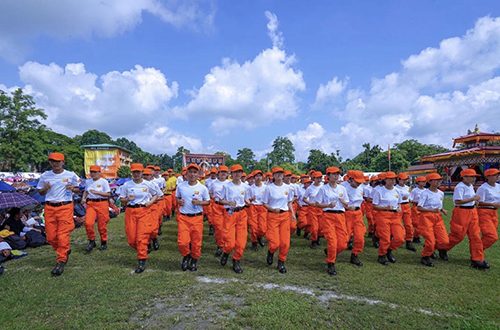
According to the report, Pelsung does not begin with a job placement, it begins with 21 days of De-suung military training, followed by learning on GMC and the 10X Bhutan vision before participants move into capacity building, workplace exposure, ventures and employment pathways.
The program was created to turn educated youth into people who can solve problems, build systems and take on responsibilities in an emerging economic environment.
The report states, “Pelsung exists to build workforce-ready, mission-aligned youth; to bridge the gap between education and real-world capability; and to connect youth to meaningful opportunities.”
Its structure is built around three pathways: Innovate, focused on idea generation, entrepreneurship and problem-solving; Build, focused on technical execution, infrastructure and systems; and Sustain, focused on governance, compliance and long-term stewardship.
Participants are selected through applications and screening, including medical and drug tests, before beginning the programme.
The military training provides the initial foundation. The immersion in Gelephu is where the model begins to face the realities of work.
Cohort One: Testing the model
The first cohort had no established Pelsung model to follow.
Cohort One comprised 324 participants selected from thousands of applicants from across Bhutan and beyond, shortly after His Majesty The King announced Pelsung in October 2025.
After military training, the participants underwent intensive orientation with GMC planners, senior government officials and experts. They were introduced to the philosophy behind Gelephu Mindfulness City and its connection to the 10X Bhutan ambition.
Then came three months in Gelephu.
The first cohort moved from learning about GMC to engaging with its emerging ecosystem through fieldwork, stakeholder consultations and collaborative projects.
This was where Pelsung began testing whether its participants could move beyond academic knowledge and apply what they knew to real problems.
Some of the prototypes developed during the immersion later grew into full-fledged ventures.
The first cohort therefore did more than complete a program. It helped establish what the programme itself could become.
Cohort Two: Refining the approach
The lessons from the first cohort shaped the second.
With 348 Pelsups, Cohort Two entered a program that had already been tested once.
The orientation became broader, engagement with GMC leadership and partner organizations deepened, and pathway mapping was introduced to help participants identify where their skills could fit within GMC’s future.
The three-month immersion again brought participants into Gelephu, but the emphasis had shifted.
Pelsups worked on more advanced projects, supported ongoing GMC work and revisited ideas developed by the first cohort while also pitching new ones.
The program was becoming less about understanding a vision and more about finding ways to contribute to it.
Cohort Three: From one model to specialized pathways
By the third cohort, Pelsung was no longer simply repeating what had worked before.
The 309-member Cohort Three marked another change, moving from a broad immersion model towards specialised capacity building aligned with the needs of GMC and 10X Bhutan.
The cohort was divided into five specialized mini-cohorts.
According to the report, instead of asking all Pelsups to follow the same route, Pelsung began developing different capabilities around specific institutional requirements.
Across its first three cohorts, the program had therefore moved through three stages: establishing the model, refining it and then beginning to specialise it.
The journey does not end in Gelephu
Completing the immersion is not the end of the Pelsung pathway.
After returning from Gelephu, Pelsups moved into post-immersion programs in Thimphu and GMC. These ranged from one-week intensive training programmes to three-month workplace attachments, covering areas such as investor pitching and field implementation.
Ten post-immersion programs were rolled out.
The idea was to give participants different routes depending on where their interests and capabilities could lead them, whether towards employment, further training or entrepreneurship.
For those whose ideas showed potential, Pelsung created another route through the Innovation Lab.
Where ideas are tested
The report notes that the Innovation Lab is designed as a permanent sandbox for viable ventures.
It brings together high-potential founders from the immersion programs to develop prototypes, test business models and work on challenges emerging from GMC and 10X Bhutan initiatives.
The ideas are not simply assessed on whether they sound promising. They move through milestones covering validation, prototype development, customer interest, viability and execution.
Fifteen Pelsups from the three cohorts have been selected for the Lab.
Those that prove viable can move towards incorporation and investment. Others may be merged, restructured or closed.
That process gives Pelsung another measure of its first-year ambition: not every idea has to succeed, but ideas need to be tested against whether they can work in the real world.
The first signs of an outcome
The report points to employment and further education as some of the pathways emerging from the first three cohorts.
“Beyond the training, immersion and projects, the true impact of Pelsung can be seen in the pathways its Pelsups have taken since completing the program,” the report states.
According to the report, 44 alumni are in recorded employment across GMC, GMC-linked and other agencies, while others have pursued further education through scholarships.
For a programme that is only a year old, these are early outcomes rather than a final measure of its impact, but they indicate the direction Pelsung is trying to establish: connecting youth development to actual opportunities rather than ending the journey when training is complete.
The next test: What does GMC actually need?
Pelsung’s first year has also exposed a larger question.
The report highlights that as GMC develops, the skills it needs will become more specific, a program preparing young people for that future cannot remain fixed. That is why Cohort Four is expected to mark another shift, towards a demand-led model of talent development.
The approach will be guided by the GMC Workforce Demand and Skills Framework, which maps potential roles and skills requirements across the city.
The framework is expected to inform more streamlined and specialised pathways, internships and post-immersion opportunities. In other words, the direction is changing from developing talent first and finding opportunities later, towards understanding the demand and developing talent around it.
The report notes, “The next phase of Pelsung will build on the lessons of the first three cohorts and move towards a more demand-led approach to talent development.”
Moreover, the report highlights that the bigger measure of Pelsung will come with time: whether the skills developed become jobs, whether ideas become viable ventures, and whether the young people trained through the program can fill the specialized roles required as GMC and the wider 10X Bhutan vision take shape.
A year after it was named, Pelsung is no longer only a program being tested, it is becoming a system designed to connect Bhutanese youth with the economic transformation the country is preparing for.