The Bhutanese Leading the way.
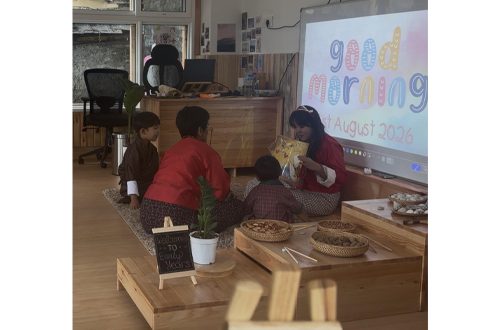
EtonHouse Bhutan International School is Bhutan’s first international school, established in partnership with the EtonHouse International Group of Singapore to provide an internationally benchmarked education within the country.
The school follows an international curriculum and will offer the Cambridge pathway, including IGCSE and A Level qualifications, as it expands up to Year 13.
The school has commenced classes for Nursery 2 to Year 6 for the 2026-2027 academic year, with Year 7 scheduled to open in January 2027.
School to expand up to Year 13
In an insightful conversation with this paper, EtonHouse Bhutan Executive Principal and Head of Pedagogy, Atima Joshi, said the school will progressively expand from its current Nursery 2 to Year 6 intake to offer education up to Year 13 when fully operational.
The school’s pathway will begin with Nursery 2 as part of the early years, followed by Years 1 to 6 at the primary level and Years 7 to 9 at the lower secondary level. Years 10 and 11 will lead to Cambridge IGCSE qualifications, followed by Years 12 and 13, where students will pursue Cambridge International A Levels before progressing to university.
She said each class will have a maximum capacity of 25 learners, while early years classes will be limited to 22 learners to allow for more focused attention during the foundational years.
Principal Michael Leahy said the Cambridge curriculum will be introduced from Year 7 as the school enters its next phase of expansion.
“From next August, we will be taking seniors, even further, and we will follow the Cambridge curriculum,” he said.
The school will eventually accommodate more than 500 learners when the full pathway is operational.
Inquiry-based learning and Reggio Emilia approach
On how students are taught, Atima said EtonHouse follows an inquiry-based and child-responsive approach, where students are encouraged to actively participate in the learning process rather than simply receive information from teachers.
“At EtonHouse, we believe that children learn best when they are actively involved in constructing meaning rather than simply receiving information,” she said.
She said the approach is grounded in strong relationships between educators and learners, with the early years program drawing heavily on the Reggio Emilia approach.
Under this approach, children are viewed as capable and curious learners, while the learning environment itself is intentionally designed to support the learning process.
As students progress through the school, learning will continue to emphasise inquiry, conceptual understanding, discussion, collaboration and real-world application.
Teachers will provide explicit instruction where required while also giving students opportunities to investigate questions, solve problems, make connections across subjects and communicate their understanding in different ways.
Cambridge pathway and EtonAspire
In the secondary years, this approach will be complemented by the Cambridge pathway, including Cambridge IGCSE and A Levels.
While the qualifications are intended to provide students with strong subject knowledge and preparation for university, Atima Joshi said academic examination results would not be viewed as the only measure of a student’s development.
Alongside the academic curriculum, students will also be developed through EtonAspire, the school’s learner development framework, which focuses on five areas: Capability, Care, Creativity, Connection and Contribution.
The framework will include areas such as life skills, entrepreneurship and financial literacy, passion projects, design thinking, wellbeing, service learning, mentorship and real-world experiences.
Different pathways for different learners
Atima said the school recognises that students of the same age may learn differently and at different paces.
As a result, differentiation will be an integral part of classroom practice, with teachers adjusting the level of challenge, support and learning resources according to individual learners.
“Our aim is not to create a single pathway that every child must fit into, but to maintain high expectations while providing different pathways for children to reach them,” she said.
She said the school may use small-group teaching, individual conferencing, scaffolded tasks, extension opportunities and additional language or learning support to cater to different learning needs.
Ultimately, she said the school aims to develop students who go beyond academic qualifications and become capable, creative and compassionate individuals with the confidence to apply their learning and contribute to the wider world.
Admissions based on age and individual needs
On admissions, the school follows an age-based admission criterion, while the academic records of older learners are reviewed mainly to understand their educational background and determine whether the school can meet their individual learning needs.
The school works closely with parents during the admission process and may hold a conversation or interview with the family to determine the most appropriate placement for the learner.
“Our team works closely with parents and may have a conversation or an interview to determine the right fit for the learners,” Joshi said.
Applications are also considered based on the learner’s previous educational experience, academic and linguistic background, individual learning needs and availability of places in the appropriate year level.
Families are required to submit previous school reports and other relevant documents, which the academic team reviews to determine the appropriate year-level placement.
The school said there is not necessarily a formal entrance assessment for every applicant, although an assessment or meeting may be arranged if further information is needed about a learner’s academic level, English-language proficiency or additional learning needs.
Each application is considered individually to determine whether the school can provide the support required by the learner.
Mix of Bhutanese and international learners
The school is open to both Bhutanese and international learners and expects its student community to comprise a mix of both.
EtonHouse Bhutan said it has been receiving interest from both Bhutanese and expatriate families, including Bhutanese families who have moved abroad for education and are now exploring enrolment at the school.
The school said it is working closely with interested families to facilitate the enrolment process.
Teachers include Singapore-based and Bhutanese educators
CEO of EtonHouse Bhutan Evelyn Tay said the school currently has three expatriate teachers from EtonHouse Singapore, bringing years of teaching experience from Singapore.
“We also have a local Bhutanese teacher who has years of teaching experience overseas and has come back; she is our Dzongkha teacher,” Tay said.
She said the school will also have three Bhutanese associate teachers who will support the main homeroom teachers while receiving training and professional development.
Fees differ for Bhutanese and expatriate families
While fees are likely to be a key consideration for families considering the school, EtonHouse Bhutan has not disclosed the fee amounts publicly.
The school said it has a differentiated fee structure for Bhutanese and expatriate families and asked parents to contact the school directly for details.
With its phased expansion to Year 13, EtonHouse Bhutan is positioning itself as a new education pathway for families seeking an international learning experience within the country. As the school grows, its approach will be tested not only by its Cambridge qualifications and international curriculum, but also by how effectively it can adapt to the diverse learning needs of students.