The Bhutanese Leading the way.
By Emily Wang
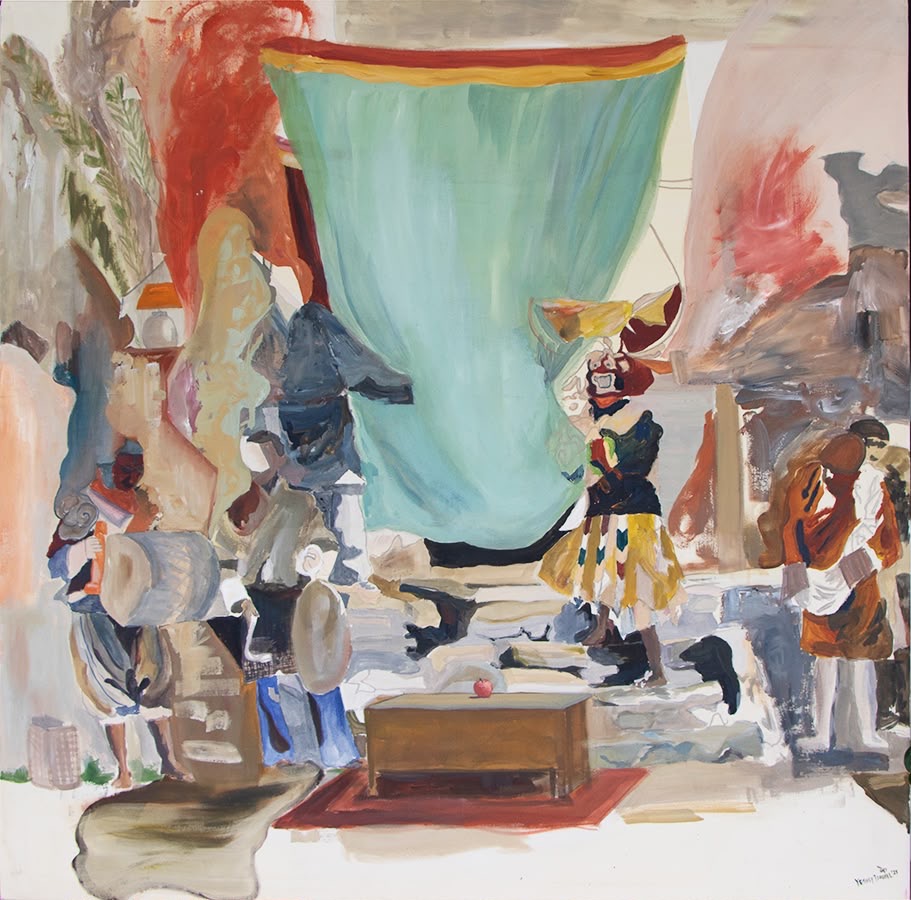
In one painting, someone is weaving a wedding dress. In another, people watch television. Elsewhere, a figure goes for a walk, flowers are collected, and a group gathers around an apple. These ordinary activities appear to take place while something larger and less certain waits in the background.
This tension was at the center of Marrying a Blue Statue, the first solo exhibition by Bhutanese contemporary artist Yeshey Tsogyal. Presented in Thimphu earlier this year, the exhibition brought together abstract and semi-abstract paintings created primarily with mineral pigments and acrylic.
“The blue statue represents the unknown—something that we cannot completely understand or control,” she says. “Marrying it is about accepting that uncertainty and choosing to live with it.”
Rather than illustrating this idea through dramatic events, Tsogyal approaches it through familiar actions. Her figures wait, prepare, walk, watch, gather and repeat small gestures. The paintings carry titles such as Weaving the Wedding Dress, Watching Television, Going for a Walk, Waiting for the Wind and Asking the Stars for Permission.
The titles bring humour and simplicity to a subject that could otherwise feel heavy. They also reflect how uncertainty is often experienced in everyday life. Even when facing an important decision, a loss or an unknown future, people continue with ordinary routines. They make tea, watch television, arrange objects or wait for the weather to change.
“I am interested in ordinary moments and the strange weight they can sometimes carry,” Tsogyal says. “The paintings are not meant to provide an answer. They are more about how we continue living and doing familiar things even when we do not know what is coming.”
Use of mineral pigments
One of the defining features of Tsogyal’s practice is her use of mineral pigments, often combined with acrylic. Mineral pigments have a long history in Bhutanese and Himalayan painting, particularly in traditional Buddhist art. Tsogyal uses the material within a contemporary visual language rather than following traditional iconographic structures.
Her paintings are built gradually through layers of colour, repeated forms and changes in transparency. Figures are sometimes fragmented or only partly visible. Objects and spaces may appear familiar, but they do not always follow ordinary perspective or scale.
Tsogyal says her connection to Bhutanese visual culture is present in how she sees and handles materials, even when her paintings do not directly illustrate Bhutanese traditions. “I do not always want to represent Bhutan through recognizable symbols,” she says. “My way of seeing has naturally been shaped by growing up and living here. That influence can be present through the materials, colours and the way the work is made.” This approach allows her to work between different visual languages.
Painting Memory, Waiting and Uncertainty
Before developing Marrying a Blue Statue, Tsogyal had already been exploring memory, loss and the emotional importance of small domestic moments. Part of this interest began with the death of her grandmother and the gradual realization that memories of a person can soften and change over time.
Instead of attempting to preserve memories exactly, her paintings consider how remembering itself is unstable. A room may tilt, colours may shift, and a familiar gesture may become difficult to place. What remains is often not a complete image but a feeling, posture or fragment.
In Marrying a Blue Statue, this interest expands from personal memory into a broader question: how does a person prepare for something that cannot be fully known?
The exhibition does not answer the question. Instead, it places the monumental idea of the unknown beside mundane and sometimes playful activities. A wedding dress is prepared for an unusual marriage. People ask the stars for permission, wait for the wind to turn, collect flowers and open a jar of alcohol before the ceremony. This mixture of seriousness and humour keeps the paintings grounded. The exhibition does not treat uncertainty as a purely philosophical idea. It presents it as part of daily life.
Making space for contemporary art
Tsogyal’s solo exhibition also reflects the gradual growth of contemporary art practices in Bhutan. Bhutanese artists often work in relation to a strong and highly developed traditional visual culture. While this provides an important foundation, it can also create expectations about what art from Bhutan should look like, particularly for international audiences.
Tsogyal’s work does not reject this tradition. Instead, it asks how an artist can carry its influence while developing an individual contemporary language.
Alongside her studio practice, she co-founded Pada Art Studio in Thimphu, where she has worked with children, young people and adults to widen access to art education. She has also contributed to Bhutan’s contemporary art community through exhibitions and teaching programs.
In 2024, she was commissioned to create Journey of Sudhana, Meeting 52 Bodhisattvas, a large-scale work for the National Library of Bhutan based on the Gaṇḍavyūha Sutra. The project reflects another side of her practice: a continuing engagement with Buddhist narratives and Himalayan visual traditions.
Her first solo exhibition, however, gave her the space to present a more personal and experimental body of work. For Tsogyal, the exhibition was not intended to explain uncertainty or turn it into something comfortable. It was an attempt to remain with it.
“Uncertainty is something everyone experiences, but we usually try to solve it or move away from it,” she says. “With this body of work, I wanted to stay with that feeling and see what could come from it.”
Following the Thimphu exhibition, Tsogyal is preparing to present her work in Hong Kong in September. The opportunity will bring the paintings into a different cultural and artistic setting while introducing a wider audience to a contemporary practice emerging from Bhutan.
Marrying a Blue Statue may have concluded, but its central question continues beyond the exhibition: what does it mean to commit to life when so much of it remains unknown?