The Bhutanese Leading the way.
By Dhanapati Sharma
The recent report by The Bhutanese that 299 cases of bullying were reported in Bhutanese schools over the past two years makes every parent, educator, policymaker, and citizen rethink education and the education system. The increase in bullying cases from 116 in 2024 to 183 in 2025 is not just a statistical trend. This is a reflection of a deeper challenge confronting our education, our education system, and our society.
Moreover, it is painful to hear that principals in their interviews believed that these figures represent only a fraction of the actual problem.
Many bullying cases go unreported as many children remain silent due to embarrassment, fear, or a lack of confidence in reporting. While our first instinct would be to ask, “How can we stop bullying?”, perhaps the more important question should be, “Why are our children bullying in the first place?”
The actual answer to this question is far more complex than simply labeling some children as aggressive or ill-disciplined. Modern research in developmental psychology tells us that bullying is rarely an isolated behavior. It is often the product of multiple factors such as peer culture, family relationships, emotional development, digital media, school climate, and societal values influencing them.
Albert Bandura, a renowned child psychologist, through his Social Learning Theory, shares that children learn their behaviors primarily by observing adults and peers. His famous Bobo Doll experiments demonstrate that aggression is not inherited; rather, it is learned through observation and imitation.
When children repeatedly witness shouting, humiliation, intimidation, or violence, be it at home or in their communities, they begin to see aggression as normal. They feel that these means of resolving conflict or asserting power are socially accepted.
On the other side, children who consistently observe empathy, respect, and constructive communication are more likely to show positive behaviors. This does not mean that every child who bullies comes from a dysfunctional family; however, it reminds us that every interaction children observe contributes to the development of their own behavioral patterns. The same has been confirmed by the child psychiatrist Dr. Bruce Perry. He said, “The greatest predictor of a child’s behavior is the environment in which that child develops.” Therefore, we need to understand that bullying is often less about individual malice and more about environmental influence.
One of the greatest misconceptions about bullying is that bullies are simply bad or undisciplined kids. However, developmental psychologist Dan Olweus, whose work focused mainly on the foundation for modern bullying prevention programs, shared that some children who bully struggle with insecure relationships, emotional regulation, low empathy, or a desire to uplift their social status within their group of friends. Others may themselves have experienced rejection, neglect, or bullying. This doesn’t excuse harmful behavior. We must be reminded that effective intervention measures require a good understanding as well as accountability to fix the issue at its root. Thus, punishment alone may suppress behavior temporarily, but it seldom addresses the actual underlying causes.
Today’s children spend significant amounts of time using digital gadgets. Social media platforms, online gaming, and short YouTube videos expose young people to language and behaviors that often normalize ridicule, humiliation, exclusion, and public shaming. Social media often promotes shocking or negative content because it gets more attention from people and increases views. Psychologist Jonathan Haidt, who studied adolescent mental health and digital technology, shared that excessive digital exposure alters how young people regulate emotions, build relationships, and respond to conflict in society. Thus, when online aggression becomes commonplace, it is unsurprising that similar behaviors become visible in classrooms and playgrounds.
Bhutan has rightly invested huge effort in improving the quality of education. However, parents and educationists together must ask whether academic achievement alone is sufficient. The psychologist Daniel Goleman, the Emotional Intelligence (EQ) expert, argues that success depends not only on cognitive ability but also on self-awareness, empathy, emotional regulation, and interpersonal skills.
A child may achieve outstanding examination results but can still be lacking the emotional maturity to understand the consequences of excluding, humiliating, or intimidating others. Schools devote considerable time to teaching mathematics, science, and languages. We need to ask: should they not devote equal attention to teaching love, compassion, empathy, conflict resolution, and responsible digital citizenship? These are not just soft skills; they are life skills in the actual sense.
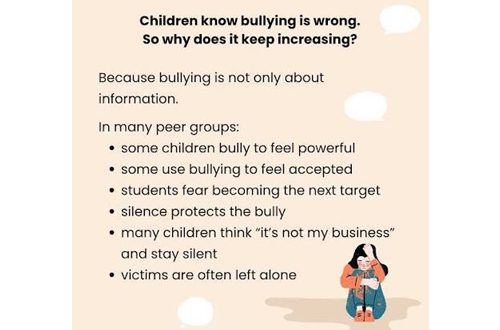
Adolescence is a period of great social development. Psychologist Erik Erikson described adolescence as the stage of identity versus role confusion. At this age, young people seek acceptance, recognition, and belonging. Many times, bullying becomes less about hostility and more about social positioning.
Children bully others because they wish to impress peers, avoid becoming victims themselves, or wish to establish dominance within their social group. Equally concerning are the silent bystanders. When classmates laugh, record incidents on their phones, or simply remain passive observers, these kinds of behaviors unintentionally reinforce bullying behavior in others. Thus, bullying is not just an individual issue; it is often a group phenomenon.
Teachers spend only part of a child’s day with him/her in school. Traditionally and factually, parents remain children’s first educators and close companions. Families shape values long before formal education actually begins. The schools reinforce those values and the communities help sustain them. Therefore, preventing bullying cannot be solely delegated to teachers, school counselors, or the education system. It requires genuine partnerships and coordination among families, schools, communities, religious institutions, and policymakers. International evidence demonstrates that whole-community approaches—where students, teachers, parents, and communities share responsibility—are significantly more effective than isolated disciplinary measures exercised by the school authority.
Bhutan’s educational philosophy is deeply rooted in the principles of Gross National Happiness. GNH always reminds us that education is not simply about producing employable graduates. It is about nurturing compassionate, responsible, and emotionally resilient human beings. The Buddhist values of loving-kindness, compassion, sympathetic joy, and equanimity provide a powerful ethical foundation for preventing bullying if exercised consciously.
When children genuinely learn to recognize the suffering of others, bullying becomes increasingly difficult to justify. Therefore, our schools should measure success not only by examination results but also by how each child helps the school management create a safe, respected, and valued school environment. This would enable the development of the intended values in our children.
The 299 cases of bullying are more than just a number. Behind every case is a child who has experienced loneliness, fear, humiliation, stress, or emotional pain. They also remind us that some of the children who bully others may themselves be struggling with emotional or social challenges which often go unnoticed.
The question before us is no longer whether bullying exists; we now know that it exists, and is rooted far and deep. The real challenge is whether we have the courage to address its root causes rather than just reacting after the harm has been done. Punishment alone cannot end bullying. The permanent solution will come when families, schools, and communities work together to raise children with empathy, respect, and compassion.
The education system is not just responsible for producing students with high grades or securing good jobs. The greatest purpose of education is to shape responsible, compassionate, and respectful human beings rooted in Bhutanese values, who think for the country and its people. When every child feels safe, valued, and respected in school, and every parent feels confident that their child is learning in a caring and secure environment, we can truly say that our education system is fulfilling its purpose.
Gedu College of Business Studies