The Bhutanese Leading the way.
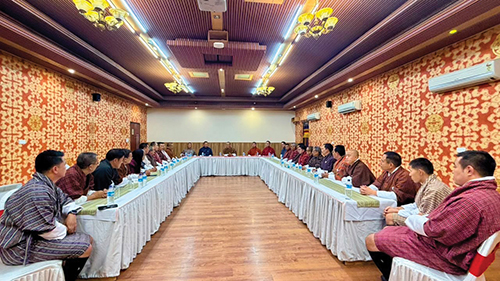
Despite having 31 MPs in the National Assembly, the People’s Democratic Party (PDP) lost the post of the Speaker to the Opposition Bhutan Tendrel Party (BTP), with 24 votes for Tempa Dorji and 23 for Lyonpo Tandin Wangchuk.
This meant that eight PDP MPs voted for the Opposition candidate, which is around 25 percent of the PDP MPs.
This reporter talked to several PDP MPs, and it appears a variety of factors came into play which, all put together, led to the result.
On the morning of August 15, news came in that the resignation of the Speaker Lungten Dorji had been accepted by His Majesty The King. This paper then learnt that the Speaker had resigned because he was supposed to take over the post of the Home Minister, and the Health Minister Tandin Wangchuk would be standing for the post of the Speaker.
The paper also learnt that Shompangkha MP Dr T.B Rai was supposed to be the next Health Minister on the Health Minister becoming the Speaker.
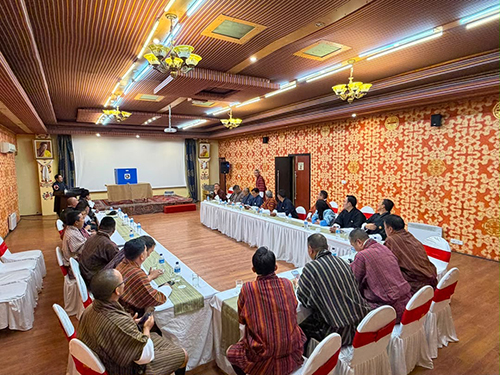
The August 15 meeting where all PDP MPs could not decide on the nomination
The meetings
A meeting of all PDP MPs was called for at 5.30 pm on August 15 by the former Speaker when the Prime Minister was out of station on an official trip to Bangkok.
The party Secretary General had requested an EVM machine from the Election Commission of Bhutan (ECB), and the gathering was informed by the former Speaker that the purpose of the meeting was to select PDP’s candidate for the Speaker as the Kasho accepting his resignation had come and the new Speaker had to be selected by August 19. The gathering was informed that the PM had nominated Lyonpo Tandin Wangchuk but other nominees were also welcome to be voted through a secret ballot.
Following this announcement, there was some confusion and also grumbling about the sudden announcement and how there was no consultation.
Lyonpo Tandin made it clear here that it is not his desire to become the Speaker, but he is following orders.
In the middle of the talk, the Drujeygang-Tseza MP Sonam Dorji got up and said he would like to nominate the Deputy Speaker Sangay Khandu for the post of the Speaker, and this was soon seconded by MP Kamal Bahadur Gurung from Kilkorthang-Mendrelgang.
In response, Sangay Khandu said that this was not the way to do the meeting and he cannot decide at the time and needs some time to think about accepting the nomination or not.
The meeting was adjourned and it was decided the next meeting to finalize PDP’s Speaker candidate would be held on August 17 with the PM present.
On 17 August, under the chairmanship of the Party President, all 31 PDP MPs met to elect the candidate through a secret ballot, with the EVM and ECB officials present.
The PM explained to the MPs that he chose Lyonpo Tandin not because he failed in health but due to the importance of the Speaker’s post and also the experience of Lyonpo Tandin.
At the same time, the PM made it clear that all eligible MPs are free to come forward if they wished to represent the Party. He emphasized that this was an internal Party matter and that no one should hesitate to express their interest. He also stressed that, once the Party selected its candidate, all Party MPs should support that candidate in the National Assembly as the party candidate.
Right after this, Sangay Khandu got up and declined his nomination by his two colleagues and said he is not contesting.
The PM still wanted to conduct a yes or no formal secret ballot vote in the EVM, but most MPs felt that a formal vote was unnecessary. Then, in a show of hands, all the MPs agreed to support the Health Minister as the PDP candidate unanimously.
Lyonpo Tandin accepted the nomination and thanked the President and MPs for the trust placed in him, and PDP issued a press release on August 17 saying Lyonpo Tandin is their candidate.
After a hurried meeting on the morning of August 18, the Opposition Party put up Tempa Dorji from Maenbi-Tsaenkhar as its candidate for the post of the Speaker.
The vote
On August 19, all 47 MPs were present in Parliament with an EVM and ECB team for a secret ballot to elect the Speaker, with the Deputy Speaker now presiding over the election.
As nominations were moved for the respective candidates, the Gangzur-Minjey MP, Loday Tsheten, speaking for Tempa Dorji, in Parliament, said that Lyonpo Tandin is already a Health Minister and while there is no law that says a sitting minister cannot sit for the post of Speaker, the Constitution makes it clear that His Majesty has to accept the resignation of a minister and if for some reason the resignation is not accepted then there would be no Speaker.
He said the Speaker is not about either party but a Speaker is required to strengthen the institution and that the former Speaker had been strengthening the institution.
In an interview with The Bhutanese, MP Loday Tsheten said that in the first Speaker election in 2024 the BTP decided to not put up a candidate as Lungten Dorji was considered a credible candidate. He said this time around if PDP had put forward two candidates that were MPs, then BTP would not even bother as there would be a choice, but when they learnt that there is only one candidate and that too a sitting minister, the BTP decided to put forward a candidate on the last day if only to give a choice.
“Even in our wildest dreams we did not think we would win and at the best we hoped to win a couple of votes from the ruling side and that would have been a moral victory for us,” said Loday.
The votes were counted and there was shock when Tempa Dorji won the Speaker race with 24 votes and Lyonpo Tandin only got 23 votes.
What happened on the votes?
After the results, there was intense national debate on the results and what was behind it, with some celebrating it as democracy winning and others pointing out disunity in PDP.
Since it was a secret ballot, there is really no way of knowing who voted for whom and especially who were the eight MPs who defected to the other side.
However, after talking to several PDP MPs and even some ministers, there are a few theories.
The view of the PDP party leadership is that the main people responsible for this result are a core group of people in PDP who could never accept that they were not made ministers and these same people, in fact, tried to undermine the government many times. The leadership view is that members of this core group went around and influenced a few other MPs.
The leadership at the same time feels that while this group wanted to vote against Lyonpo Tandin and not necessarily for Tempa as a kind of protest vote, they made a grave miscalculation and they did not necessarily think Tempa would win. The leadership feels this core group has in fact undermined its own interest as there is one less cabinet slot now due to this.
Talking to a wider group of PDP MPs and even members, there is a more complex theory. Some of these MPs and members feel that the clue to what happened lies in the nomination of Sangay Khandu of Tashichhoeling (Samtse) by Sonam Dorji from Dagana, seconded by Kamal Bahadur Gurung from Tsirang in the first meeting.
Some MPs feel that there was a consolidation of around four MPs of Southern Dzongkhags behind Sangay Khandu as their candidate, and then disgruntled MPs from Western and Central Bhutan made up the rest, leading to the eight votes against PDP.
While a regional angle is pointed to by some MPs, the actual reason for some MPs backing each other could be more practical. Sangay Khandu, Sonam Dorji and Kamal Bahadur Gurung all served together from 2013-18 in the National Council representing their respective Dzongkhags, and all three joined PDP in 2018.
Coincidentally, even Tempa Dorji was there in the NC at the same time from 2013 to 2018, though he later won a second NC term from 2018 to 2023 too.
However, since it was a secret ballot, the above are only theories and permutations within PDP, and it cannot really be proven on the ground. It must be mentioned here that no PDP MP has come out to say they voted for Tempa Dorji.
Cabinet and MPs divide
Whatever the combinations above, what is clear is that there is a clear divide between the MPs and the Cabinet led by the Prime Minister.
Some PDP MPs said there was surprise and unhappiness that instead of the Speaker being chosen from among the MPs, it was being given to a sitting minister in the Cabinet.
When asked if that was the case, why did all 31 MPs raise their hands in support of Lyonpo Tandin on August 17, one MP said that in the Bhutanese system nobody wants to come out and criticize and oppose openly as they may get targeted later by not getting tickets in future elections or in other ways.
The MP said instead of just bringing in Lyonpo Tandin as the nominee of the PM, what should have been done is that there should have been extensive deliberations at a one on one level and then a natural choice through common consensus should have been selected and brought forth.
Some PDP MPs felt Lyonpo Tandin was being imposed on them and they did not like it.
Another MP said the issue is not just about the way Lyonpo Tandin was brought in but in the second term there is not much of a coordination between MPs and the Cabinet or the MPs.
This MP said the Prime Minister is not as accessible and available in his final term and is always very busy and on the move. He said it would have been good if the PM and Cabinet kept in more touch with the MPs and even candidates and they had more regular meetings and interactions which are generally restricted to a few meetings during Parliament sessions to essentially know in which line to vote. He said MPs are not given any importance and only used when it suits the government.
There was an attempt to organize a monthly dinner for all PDP ministers and MPs, but it fizzled out.
The MP said there is also an anxiety about the future of PDP among MPs after the PM and on how the PM is not seen to be grooming future leaders. There is an anxiety among some MPs that even policy pledges like relooking at Bell Curve and reforming SDF made during the election trail are not getting done and this could cost them with voters.
There is also a feeling among some MPs that PDP lacks adequate discussion and certain things like ministerial appointments are decided without consultation and consensus seeking.
At the same time, it must be said this is not the unanimous view of PDP MPs but some critical voices, and there are equally those who also defend the PM and party saying the PM is accessible and always makes it a point to reply to texts, gives appointments even when he is busy and stays in touch with MPs.
One such MP said on pledges PDP is fulfilling or in the process of fulfilling most of them with the third child, Nu 150,000, Education loan, chain-link fencing, blacktopping of roads etc., and works are going on well.
Another MP said he is against meeting every month as MPs are very busy and it takes away from office and family time. The MP also said it is too early to start identifying a future President as this could lead to another split and distraction and a second power center in the party.
Ministerial appointments, reshuffle and personal ambition
While there are different views on the cause of the crisis, there is almost a unanimous view within the party on all sides that the current issue was triggered by the reshuffling of ministers.
There are both MPs and party members who feel that the current crisis would never have happened if not for the reshuffle.
The whole aim of getting the Speaker to resign was to make him the Home Minister to replace Tshering, and then the aim of making Lyonpo Tandin the Speaker was to let Dr T.B Rai become the Health Minister.
MP Sonam Tashi from Paro was a likely candidate for the position of the Minister for Energy and Natural Resources.
The reshuffle had awakened Ministerial and even Speaker hopes among some PDP MPs, and when this was dashed the reaction was predictable.
A party member said that not just the current reshuffle, but there was already resentment right from 2024 among ministerial hopefuls when younger and new faces were given a chance like Lyonpo Tshering as the Home Minister, Lyonpo Younten Phuntsho as the Agriculture Minister, Lyonpo Yeezang De Thapa as the Education Minister and Lyonpo Namgyal Dorji as the Minister for Industry Commerce and Employment.
The party member said PDP had taken on younger ministers to give youthful ministers a chance and also bring about fresh and new ideas.
A source said that the recent reshuffle itself was to strengthen the party and government with the Home Minister resigning on moral grounds due to a personal controversy and the MoENR Minister giving way to younger leadership for the future of the party. Many in the party saw Dr T.B Rai as a good candidate for Health Minister, but at the same time the Health Minister stepping down with no post was not considered feasible since he is the second most senior leader after the PM and acts as the acting PM when the PM is not in the country.
Lungten Dorji was seen as a good candidate to replace Tshering as Home Minister given his past experience as a Director General there.
There is an attempt to keep a brave face within PDP on losing the Speakership with some saying PDP still has the majority in deciding bills, but one MP admitted that a Speaker has a lot of informal powers in controlling the flow of debate, stressing on certain issues, allowing questions, allowing motions and more.
One MP said that the government will now face a lot more scrutiny in Parliament and in the current state even getting the budget through may become a challenge.
A former PDP leader said that the failure of the cabinet and party leadership was to manage the MPs and the failure of the MPs was to let personal ambitions get in the way of the national interest, and in doing so it has hurt both the party and the country. The former leader said that this is now a fractured government and party and it is tragic for a party that once only had two MPs in the Opposition, but came to power twice. He said that even future MP candidates may now wonder about joining PDP given the divisions within it.
The PM responds
The Prime Minister Dasho Tshering Tobgay said the result shows that eight MPs did not honour the collective decision and voted for the Opposition candidate, which raises serious questions about the honour, integrity and collective responsibility of the individuals concerned.
The PM disagreed with the claim that he has become detached from the Party as this is his final term. “My commitment to the Party remains as strong as ever.”
On the pledges, he said many have already been fulfilled, several are underway, and some face legal, constitutional or institutional challenges.
On future leadership, he said the PDP has capable Ministers and MPs, many of whom have the potential to lead and perform even better than him, and that the present transition provides an opportunity to strengthen the Cabinet’s performance while allowing emerging leaders to assume greater responsibility.
The complete interview with the PM on the whole issue is on page one.
Structural issue?
A Tour leader, writer and Bhutan watcher Michal Thoma, in a Facebook post, pointed to a less discussed structural issue.
He said Bhutan’s current election system of only two parties making it to the final round was designed for stability and so it has avoided the frequent fall in governments like in neighboring countries.
However, he said, “The drawback is that parties always risk electoral oblivion, as PDP and other parties experienced previously. You can’t maintain a cohesive party if cadres are regularly denied positions after failing to reach the opposition threshold. MPs know their party cannot guarantee their seats in the next election, limiting their loyalty to the party line – as demonstrated yesterday (Speaker election).”
This hypothesis by Michal makes sense as even strong parties like PDP, DPT and DNT have faced or are facing oblivion outside the Parliament.
What adds to this is the strong anti-incumbency factor in Bhutanese politics where a ruling party is almost guaranteed to not only lose but also exit the Parliament. In a winner takes all scenario like this, MPs can get very tough and aggressive to get ministerial posts as this may be their last chance or one chance in a long time.
While PDP’s internal struggles and ambitions have come to the open due to the Speaker race, there have been instances in the past where MPs were unhappy with new appointments like in the case of DNT government in 2021 when five MPs openly questioned the appointment of Karma Dorji as the MoICE Minister after winning a by-election. The five said they have 18 DNT MPs who feel the same, with one MP even saying DNT is like a family business with more senior leaders taking up all ministerial posts.
Another cue here could be that with each new Parliament, MPs are increasingly voting less and less on party lines and there can be major changes in Bills and Laws that even surprise the ruling government. This may be seen as a maturing of Parliament on one hand but it is also the unraveling of the party line.
The large number of candidates floating between parties and also the upper and lower house does not inspire much core party loyalty.
The structure of Bhutanese democracy may ensure stable governments that complete five years, but the winner takes all system also ensures weak and disunited parties.