The Bhutanese Leading the way.
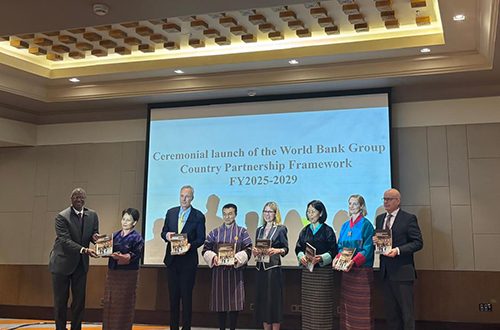
The World Bank Group (WBG) aims at increasing private investment, improving the overall business environment, and creating more and better jobs. This effort is part of the Country Partnership Framework’s (CPF) first outcome, increasing private investment.
The goal is to raise private investment from 32.8 percent of GDP in 2024 to 60 percent by 2029. The WBG will follow an “If and Then” approach, which links the level of engagement and instruments used to the implementation of key structural reforms by the government.
For FY 25-29, the entire World Bank Group’s indicative financing in Bhutan can range up to USD 1 billion, if large infrastructure projects materialize.
The WBG in an important move earlier approved USD 300 mn financing for the Accelerating Transport and Trade Connectivity in Eastern South Asia (ACCESS) Phase 2 project.
Its Private Sector arm, IFC’s financing can range up to USD 194 million in FY25 and FY26 and may be around USD 400 to 500 till FY 29.
The private sector side funding of World Bank could even touch USD 2 bn if the right conditions and projects are there and the IFC could also pitch in a higher amount that USD 400 to 500 mn too.
Among the priority reforms are the extension of External Commercial Borrowing to the financial sector, a revision of the Foreign Direct Investment (FDI) policy and legal framework to make it more attractive to foreign investors, and policy changes that allow the creation and enforcement of security interest over immovable collateral for foreign lenders on equal terms with domestic lenders.
Other key reforms include changes to government policy on State-Owned Enterprises (SOEs) to enhance their efficiency and create more space for private sector involvement, and the creation of a legal framework for venture capital to offer alternative financing options for businesses. These reforms will be supported through a series of Development Policy Credits focused on growth and employment.
According to the CPF, the WBG aims to strengthen Bhutan’s macroeconomic and fiscal management as a central part of its support strategy.
This includes maintaining debt sustainability, controlling inflation, and ensuring external competitiveness, which are crucial for a stable business environment conducive to private investment. Support will be provided through technical assistance on the Medium-Term Macroeconomic Framework and debt management, as well as through the implementation of Performance and Policy Actions (PPAs) under IDA’s Sustainable Development Finance Policy.
This will be complemented by enhanced analytical and advisory support in areas such as public financial management, financial sector stability and inclusion, and trade and private sector development.
Improving the financial system is another major focus. The WBG will support efforts to enhance access to finance, especially for small and medium-sized enterprises (SMEs), trade, and microfinance. Modernizing payment systems to enable better connectivity with global networks will be a key part of this effort, particularly to facilitate the growth of e-commerce, tourism, and digital services. Many rural communities still lack access to formal remittance services, and the WBG, including the International Finance Corporation (IFC) and the Multilateral Investment Guarantee Agency (MIGA), will explore measures to support the flow of formal remittances and diaspora financing.
To improve the business environment, WBG will help eliminate barriers to entry, simplify the tax structure, and promote entrepreneurship.
IFC will work to strengthen the Public-Private Partnership framework, mobilize private capital, and increase engagement with the private financial sector, while supporting climate resilience in private enterprises. MIGA will continue to leverage the WBG Guarantee Platform to help de-risk private investments and encourage foreign investment, including through public-private partnerships.
WBG’s efforts will also align with the “Jobs Accelerator” initiative in South Asia, taking a sectoral approach to support job-rich areas such as renewable natural resources, agribusiness, tourism, digital, and creative industries.
The support will include policy reforms, investments in infrastructure, improvements in standards and certification, development of skills, particularly in information technology, and innovative financing and de-risking strategies. IFC is also working closely with the Royal Monetary Authority of Bhutan to enhance regulatory frameworks around digital financial services, microfinance, external commercial borrowing, and local currency financing solutions.
World Bank in their report, states that with the projected population of over one million people in Gelephu, there will be significant demand for goods and services from across the country.
This presents an opportunity for modern value chains in areas such as organic food and timber, and for building the necessary skills among Bhutanese workers to take part in the emerging economic opportunities. WBG support for GMC will initially focus on technical assistance across various workstreams and on facilitating private sector investment through its Guarantee Platform. This approach aligns with the government’s “one country, two systems” vision by fostering economic linkages between GMC and the rest of the country.
In this CPF, WBG is focusing on three outcome areas, which are, increased private investment, enhanced climate resilience, and resilient infrastructure for improved connectivity.