The Bhutanese Leading the way.
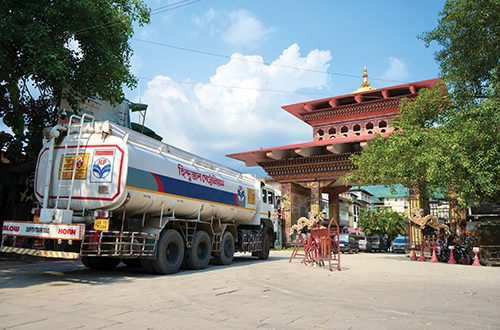
Following last week’s story by The Bhutanese on how Bhutan could be overcharged by state- owned Indian Oil Marketing Companies (OMCs) and a lack of invoice break up, this paper put up questions to the Ministry of Industry, Commerce and Employment (MoICE) on the issue.
MoICE said that its technical officials have engaged with the Public Sector Undertaking (PSUs) OMCs to understand the drivers behind the recent increase in fuel prices.
IPP
The MoICE said that in addition to global market volatility, including the ongoing geopolitical tensions in the Middle East, the PSUs have informally indicated that Bhutan’s fuel pricing is based on the Import Parity Price (IPP) methodology.
The ministry said that under the IPP framework, fuel prices are not derived solely from international crude oil prices or direct product price conversions. Instead, they reflect the estimated “landed cost” of importing refined petroleum products into the destination market.
This typically includes reference benchmark prices such as international gasoline prices for MS (petrol) and gasoil prices for HSD (diesel) along with associated logistics and supply chain costs.
In line with international IPP practices, the key pricing components generally include international benchmark product price (FOB basis), ocean freight, insurance, port handling and related charges, inland transportation and distribution costs and supplier (PSU) margins.
MoICE said that several of these components are variable and subject to fluctuations based on global shipping conditions, freight markets, and supply chain dynamics.
On lack of an invoice break up despite the MoU allowing for it, MoICE said that it is important to note that seeking detailed fuel invoice breakup that includes the OMCs/PSUs profit margins, while desirable, is difficult since certain commercial details are not disclosed, which is also understandable.
MoICE said the government has attempted, in the past, to obtain detailed invoice breakup of fuel invoices, especially during times of exorbitant fuel escalation to understand the components that are leading to the exorbitant escalation.
The above confirmation by OMCs that it is charging Bhutan with the IPP methodology is important, as this shows that Bhutan is being treated like any other commercial market like Europe, etc.
This also confirms earlier reporting by the paper that the diesel price to Bhutan is based on the Arab Gulf Gasoil, which is the price of actual diesel after being refined and loaded at Gulf ports for export, and petrol price is based on 2 RON Singapore Gasoline’, which is again finished petrol product loading in Singapore’s ports.
Huge profits for OMCs
This means that fuel sold to Bhutan is not based on the value of international crude oil and then refining costs and other margins for OMCs, but on speculation based international benchmarks of refined oil and then adding costs to it.
While India buys crude oil at steep discounts including Russian Urals, it does not pass these savings onto Bhutan.
Indian refiners price their final refined exports to Bhutan at full, un-discounted global market values of refined products. By buying cheap inputs and selling finished products at top-tier global benchmark rates to Bhutan, Indian refiners pocket the expanded difference as pure corporate profit
Profit margins for Indian refiners exporting diesel and petrol are currently at extraordinary, historic highs, driven by systemic global supply constraints and conflict-induced crude bottlenecks.
As an example, in normal times the price difference between a barrel of crude oil and 2 RON Singapore Gasoline is around USD 4 to 5 per barrel usually as a refining cost, but the difference has now rocketed to around USD 30 per barrel.
In the case of diesel, the difference is around USD 46 per barrel.
So, it is clear that Bhutan is paying much higher for fuel, not due to increased crude costs of OMCs and refining, transportation and margin charges, but due to speculation based international benchmarks.
Big hit for Bhutan
This hits especially hard since fuel is Bhutan’s single largest import item, and is eating into both government revenue and our Rupee reserves. In 2025 Bhutan imported Nu 13.595 billion (bn) worth of diesel and Nu 5.221 bn worth of petrol and aviation fuel coming to Nu 18.816 bn in total fuel imports.
While the pricing mechanism maybe in line with international norms, in terms of global commodity trading rules and opportunity costs, it is geopolitically and economically harsh. It leaves vulnerable, landlocked economies, like Bhutan, entirely exposed to international energy shocks, forcing Bhutan to implement a Nu 36.94 per liter diesel price support that can drain the national exchequer just to keep local transport affordable.
The Finance Minister Lekey Dorji said that Bhutan has already spent Nu 1 bn from the ESP for fuel price support and allocated another Nu 1.5 bn which has been reprioritized from the budget taking the total to Nu 2.5 bn for fuel price support. This is an unprecedented amount for Bhutan and money that Bhutan cannot afford to spend.
Fixed tariff or cost plus solution
Given the above issue, it maybe time for Bhutan to ask India for a fixed tariff or cost plus model for fuel, like Bhutan prices its hydropower exports to Bhutan.
This could simply be the cost of crude, domestic processing cost for Indian refiners, a premium for the refiners and then transportation cost.
Instead of pegging monthly invoices to highly volatile global benchmarks, India would charge its Bhutan a price based on the actual domestic cost of production at its nearest regional refineries (like Digboi or Bongaigaon in Assam), plus a fixed, predictable processing markup.
Bhutan would secure long-term price stability, protecting its macroeconomy from external energy shocks. In exchange, India would secure guaranteed long-term off-take volumes and strengthen its strategic regional relationship with Bhutan.
There is also a precedent for this tariff based system in other parts of the world. The most famous global equivalent of a non-market, fixed-formula pricing system exists between Russia and Belarus.
Under the Eurasian Economic Union agreements, Russia has historically supplied crude oil and natural gas to Belarus. Instead of charging international European exchange prices, Russia calculates the price based on its own domestic production costs plus a small, fixed pipeline transit markup.
This protects Belarusian refineries from global price swings. It allows them to refine cheap Russian crude at near-domestic rates and export the final products to international markets at full global prices, capturing a massive windfall for their national economy.
Bhutan does not need the benefit at the level of Belarus, but a cost plus model would be good.
Launched by Venezuela, the Petrocaribe alliance established a highly structured, non-benchmark payment framework for over a dozen Caribbean and Central American nations (including Cuba, Jamaica, and Haiti).
Instead of forcing small island economies to pay 100 percent of international market values upfront during price spikes, Venezuela instituted a sliding-scale financing model.
When global oil prices rose above a certain threshold (e.g USD 100/barrel), member nations paid a fixed, lower portion immediately. The remaining balance was converted into long-term loans (1 percent to 2 percent interest over 25 years), or paid for directly using domestic bartered goods like sugar, medical personnel, or agricultural products.
Landlocked Central Asian nations like Kazakhstan, Uzbekistan, and Turkmenistan routinely bypass global maritime benchmarks for regional fuel trade.
Instead of evaluating what a barrel of diesel is worth on the Singapore or Arab Gulf spot markets, the nations’ execute crude-for-product swaps. Uzbekistan might deliver a fixed volume of natural gas or electricity to a border region in exchange for a set, un-indexed volume of refined gasoline from a Kazakh refinery, neutralizing international crack spread volatility entirely.
A fixed-tariff or cost-plus pricing model can technically and legally apply between India and Bhutan. The two nations share a unique, deeply integrated geopolitical relationship that mirrors the conditions where these non-market systems succeed.
MoICE said with regard to further engagement with GoI on the issue, they are very appreciative that GoI has ensured uninterrupted supply of POL products to Bhutan during these difficult times. They also appreciate that GoI has not applied excise duties on export of POL products.
The MoICE said it will continue to pursue the matter with the PSUs and, where necessary, will also take up with the GoI through appropriate channels.