The Bhutanese Leading the way.
On 20th May 2026 The Bhutanese sent questions to the Ministry of Finance media focal asking for the amount spent on the Goods and Services Tax (GST) so far, and the manpower allotted for GST implementation so far.
The media focal said that the ministry is extremely tied up with the Parliament session and won’t be able to respond to any media questions.
This reporter told the media focal this should be easy to answer but with no response coming, the questions on GST was put up by this reporter on 31st May 2026 for the 5th June meet-the-press giving a full week to the ministry to respond.
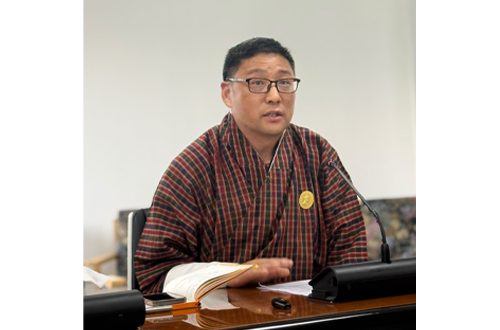
However, yesterday during the meet-the-press the representative of the Finance Ministry and Commissioner of the GST and BITS project, Kuenzang Thinley, did not provide the figures for the amount spent on GST, the additional manpower deployed and their pay (contract).
He claimed to have given the figures earlier to this paper which is not true. He went off the script of the written answers provided by the ministry, and used certain adjectives and insinuations against the questions of the reporter which will not be reflected in this article.
The reporter responded saying the data asked for has not been provided and it is due to issues like this that is impacting Bhutan’s press freedom ranking.
The reporter had pointed out that the GST tax system collection so far is lower than the MoF/DRC internal target and also the BST for the same period last year and there are increasing complaints of compliance burden from businesses.
In the above context the paper had asked the MoF on the amount spent on GST system so far and its components and manpower allotted for GST implementation so far and wages paid to them?
The point of GST when most of the tax is collected at the entry point and the logic of monthly filing and can it not be reduced?
Why is the government collecting less tax under GST than under the earlier tax?
By what metric is the success of GST being measured and please share it here and will the government do a rethink on GST given the various problems?
As per the written answer from the MoF which was read in part by Kuenzang, it said GST represents a major structural reform aimed at modernizing Bhutan’s tax system and aligning it with internationally accepted principles of transparency, neutrality, efficiency, and long-term revenue sustainability.
“Like similar reforms undertaken around the world, GST is expected to deliver benefits over time and should be assessed through a broad set of indicators rather than short-term revenue collections alone.”
On resources devoted to GST implementation the MoF without giving any figures said the implementation of GST has been undertaken within the framework of approved Government budgets and authorized human resource allocations with investment on digital systems, institutional capacity, taxpayer education, stakeholder outreach, and strengthening tax administration.
It said such investments are consistent with international experience, where modernization of tax systems requires upfront expenditure to generate long-term improvements in efficiency, transparency, and compliance.
MoF said while a significant portion of GST is collected at the point of importation, the purpose of GST extends beyond revenue collection at the border.
“GST is designed to establish a comprehensive value-added tax system that promotes transparency across the supply chain, eliminates cascading taxes through input tax credits, creates a level playing field between imported and domestically produced goods, encourages formalization of economic activity, and strengthens tax administration.”
It said import-stage collection serves primarily as an efficient collection mechanism and does not diminish the broader economic and administrative objectives of the reform.
MoF said the monthly filing is widely practiced in GST and VAT systems internationally as it facilitates timely verification of transactions, efficient processing of input tax credits, and effective compliance management.
“At the same time, the Government recognizes the importance of balancing administrative effectiveness with taxpayer convenience. Accordingly, implementation experiences and stakeholder feedback are being closely monitored, and opportunities for further simplification and proportionality, particularly for smaller businesses, will continue to be assessed.”
On the revenue performance under GST MoF said that as GST remains in the early stages of implementation, short-term comparisons with the previous tax regime should be interpreted with caution.
“International experience demonstrates that major tax reforms often involve transitional adjustments as businesses adapt to new processes and systems. Revenue performance remains an important indicator. However, the Government’s focus is on achieving sustainable improvements in compliance, efficiency, and long-term revenue stability rather than evaluating the reform solely on the basis of initial collection trends.”
On measuring the success of GST MoF said that consistent with international best practices, the success of GST is assessed through multiple dimensions, including taxpayer participation and compliance, improvements in transparency and record-keeping, reduction of cascading taxes, administrative efficiency, growth in the formal economy, and long-term revenue sustainability.
It said revenue collection is therefore one important measure among several indicators used to evaluate the effectiveness of the reform.
MoF said the government remains fully committed to the objectives of GST as a modern and internationally accepted tax system.
“At the same time, implementation challenges are neither unexpected nor unique to Bhutan. Many countries have experienced similar adjustment periods and have subsequently refined their systems based on practical experience and stakeholder feedback.”
It said that accordingly, the Government will continue to review implementation experiences, engage with businesses and taxpayers, and introduce improvements where necessary to simplify compliance, strengthen taxpayer services, and enhance system performance. The focus, therefore, is on continuous improvement and refinement rather than reversal of the reform.
On the assessment GST the MoF said major reforms such as GST are best evaluated through objective, evidence-based, and balanced assessment.
“International experience demonstrates that such reforms should be judged over an appropriate time horizon and against their broader objectives, including transparency, fairness, efficiency, and long-term sustainability.’
It said that constructive feedback and public scrutiny are essential to the success of any reform. “Equally important is ensuring that assessments are comprehensive and proportionate, taking into account both implementation challenges and the longer-term benefits that such reforms are intended to deliver.”
MoF said the government remains committed to working collaboratively with taxpayers, businesses, the media, and all stakeholders to ensure that GST evolves into a system that is fair, efficient, and supportive of Bhutan’s economic development.