The Bhutanese Leading the way.
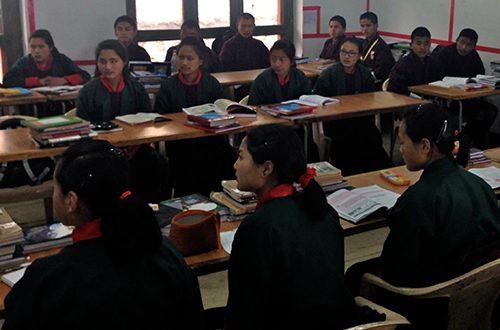
Bhutan stands out as one of the very few countries in the world with three must pass subjects of Dzongkha, English and Math from class 4 to 10 and then Dzongkha and English as a must pass in class 10 and 12.
At a time when education systems are evolving around the world, including in Bhutan, the rigid pass system that penalizes students for weakness in any of the above subjects is facing increasing scrutiny. School principals, who have seen the impact of this policy firsthand, are among its strongest critics.
This paper talked to principals across the country and found that remote schools and schools in dzongkhags do well in Dzongkha but struggle in Math and some even in English, while the opposite is true in urban areas where students struggle with Dzongkha and do better in English and Math. There are also regional variations with schools in southern dzongkhags struggling with Dzongkha.
There were many instances in schools across the country where bright students with high marks in other subjects have been unable to get promotion just due to poor grades in one of the must pass subjects.
A Principal from a government school in Mongar said that he has noticed that the downside of this policy in his school. He said once his students do not do well in one of the three core subjects, the students assume they will not get promotion, and so they give up and do not put any effort in the other subjects too.
He said most of the students in his school are children of civil servants, and so there is generally no problem in English and Dzongkha too, but the main challenge is in Math. He hopes that things will improve from this year with a change in the assessment system whereby 80 percent is based on examinations and 20 percent is from continuous assessment (CA).
Druk School (Thimphu) Principal Phuentsho Tashi said Dzongkha remains the greatest challenge among the three compulsory pass subjects, particularly in urban schools. He said that regardless of their background, many students struggle with the subject and are often denied promotion despite performing well in other areas.
He said recently he had two cases of two very bright students who had 80 percent plus marks in all subjects and were in the top 10 in the class both failing the class 8 board exams due to Dzongkha.
He said children did not want to repeat the class in the same school, and so the parents pulled them out and they have probably been sent to schools outside Bhutan with no Dzongkha to finish their studies.
The Principal said such bright students failing due to one subject is a loss for the country. He said students should be given a chance to re-sit the exams.
The Ministry of Education and Skills Development announced in January that they are exploring allowing students to re-sit for exams with certain criteria, but the idea seems to have been given a quiet burial.
The Principal said that he has noticed that the Dzongkha papers being set for the board exams from class 6 onwards are very tough, and the introduction of Chokey from class 9 has made matters worse.
“Dzongkha is only till class 12 and there is no Dzongkha in college, and for the last 26 years I have not had to use the Dzongkha I learnt in school like writing, and people practically forget it. It should be okay as long as people can speak and read the language.”
The Principal of Tashithang MSS (Samtse) Sonam Rinchen said that most of his students who fail to get promotion is due to Dzongkha. He said the second problem subject is Math but English is not a problem.
Sonam said that last year a very good student of his who scored high marks in all subjects was not given promotion in her class 8 board exams due to Dzongkha, and has had to repeat her class. He said that the weak subject for his students is generally Dzongkha, given that the school is in a southern district. He said if the ministry does a policy change he would support English as a must pass as it is the medium of instruction and Dzongkha as the national language, but not for Math as not everybody has the aptitude for it. He gave his own example saying he was not good in Math but he could still make it as a Principal.
Dr Tobgyel School (Thimphu) Principal Bir Bdr Bhattarai said that in his school like other Thromde schools, students get held back usually due to Dzongkha. He said that a BCSEA study also concluded the same based on marks. He said the Dzongkha toppers nationally are from rural areas.
He said that Dzongkha is taught for only one period and the Dzongkha in the board exams are of a very high standard, and so children are unable to get marks.
He said students doing well in other subjects and not getting marks in Dzongkha discourages them and the parents. He said he knows of parents sending their children to India and Thailand for this reason.
He said he is in favor of the ministry revisiting its policy on must pass subjects and there should be other options.
He said the failure rate went up after the requirement to get 40 percent in both written and CA and he hopes that now with new 80 percent exams and 20 percent CA system things will improve.
Unlike many schools in other dzongkhags, Sakteng Middle Secondary School in Trashigang does not face Math as its weakest subject. In fact, students generally perform well in the subject.
Principal Sonam Jigme attributed this to the presence of a strong Math teacher until recently. He said children in the area learn trading and selling goods from an early age, which helps develop their mathematical skills.
He added that students also perform well in Dzongkha because their local dialect shares similarities with it. However, they tend to struggle with English compared to students in other schools due to limited exposure to the language.
According to the principal, unlike children in urban areas, many of his students are involved in farm work after school and have fewer opportunities to practise English.
Principal Sonam Jigme said he does not support the requirement to pass all three subjects. He argued that students have different strengths and abilities. A student may excel in Math or Science and have the potential to become a doctor, but could still fail to gain promotion after falling short by one or two marks in another subject.
The Laya Middle Secondary School (Gasa) Principal Kinley Dorji said that his students are good in Dzongkha due to the prayers taught to them at an early age, and they manage in English too, but they struggle and get held back due to Math. The Principal also said he would support a reform in removing must pass subjects as the child could be intelligent in other subjects but gets held back due to one subject.
He said when a child fails due to this, they are reluctant to come back to school again.
The Radhi (Trashigang) Higher Secondary School Principal Duba said he students get held back due to Dzongkha and Math. He said he would support the removal of must pass subjects.
The Damphu Central School (Tsirang) Principal Bhuwan Ghalley said his students struggle in Math and Dzongkha. He said Math is a logical subject and there is no scope to get marks by writing something unlike in English or Dzongkha. He said compared to schools in the east, his students struggle in Dzongkha. He said his students suffer with Dzongkha because the local dialects and sub-dialects are quite different.
He said he would support a relook at the must pass subjects as a student who is very good in languages could fail due to Math and vice-versa. He said holding back children has quite an impact on them and their parents.
The Chumey Central School (Bumthang) Principal Sonam Gyeltshen said the main must pass subject that holds back children is Math. He said there have been a few cases in his school where bright students good in most subjects have been held back due to a single must pass subject. He said there should be flexibility given whereby a child is allowed to fail in any one must pass subject and still be given promotion.
The Lango Higher Secondary School (Paro) Principal Namgay Tshering said his students can manage in English and Dzongkha, but Math really pulls them down. Taking a different stance from all the Principals above he said he is in favor of the current must pass for three subjects as allowing students to pass just like that can compromise quality.
While Dzongkha and English have been must pass subjects for a long time, Math was introduced as one from 2023 onwards.
The Education Minister, Yeezang De Thapa, said there are specific reasons why Math and Dzongkha are designated as must-pass subjects.
She said Dzongkha is included because it is the national language and a key carrier of Bhutan’s culture and heritage. Math, she said, is considered essential in the context of rapidly evolving information and communication technology, artificial intelligence, and broader technological advancement, making it important for students to perform well both nationally and internationally.
The Minister said that in response to growing feedback on the must-pass policy, the ministry conducted a survey among students, parents and teachers. One of the key suggestions was to revise the assessment structure from the current 40 marks continuous assessment and 40 marks exams to a more balanced model of 80 percent exams and 20 percent CA. She said this has been done now.
She said the ministry would monitor continuous assessment to ensure genuine and fair marking. The revised approach, she added, would also make it less likely for students to fail the three must-pass subjects.
The Minister said the objective of the new Cambridge system is to move away from rote learning and instead focus on assessing and improving students’ competencies.