The Bhutanese Leading the way.

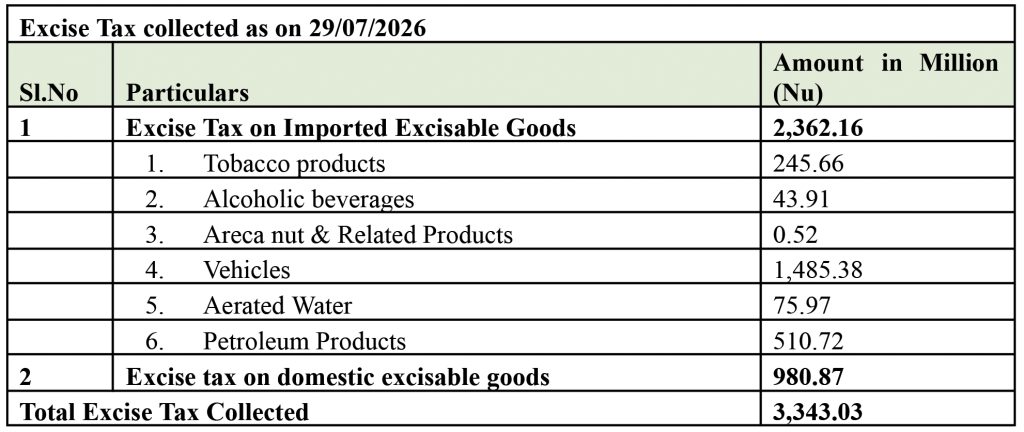
As of 29 July 2026, the total Excise Tax collected amounts to Nu 3.343 billion (bn). This comprises excise tax collected on both imported excisable goods and domestically manufactured excisable goods.
Excise tax on imported goods amounts to Nu 2.362 bn, which constitutes about 70.65% of the total collection, whereas excise tax on domestically manufactured goods amounts to Nu 980.87 million (mn), constituting about 29.34% of the total collection.
Excise Tax is separate from Goods and Services Tax and is accounted for independently. Excise tax is widely considered a sin and luxury tax. It is considered a sin tax when applied to goods like alcohol, tobacco, and areca nuts to reduce consumption, and a luxury tax when applied to vehicles and aerated goods.
The highest collection of excise tax is from vehicles at Nu 1.485 bn, followed by Nu 510.72 mn on petroleum products.
Imported tobacco products paid Nu 245.66 mn in excise taxes, while imported alcoholic beverages paid Nu 43.91 mn. Imported aerated water paid Nu 75.97 mn.
Excise tax on domestically manufactured goods amounting to Nu 980.87 mn covers locally manufactured alcohol, aerated water, and areca nuts.
Since Excise Tax was introduced only on 1 January 2026, its impact cannot be assessed by comparing Excise Tax collections with those of earlier years. A more objective assessment requires a comparison of the quantity and customs value of the same excisable goods during corresponding periods before and after its introduction.
The preliminary data indicates a mixed impact across product categories. While imports of certain excisable goods declined in both quantity and value, others increased or recorded divergent movements between import quantity and customs value. These variations suggest that the observed changes cannot be attributed solely to Excise Tax.
The tax may have influenced consumer demand, import decisions, and product substitution by increasing the final cost of designated goods. However, import trends are also shaped by wider economic and market conditions.
An increase in customs value does not necessarily indicate a corresponding increase in import volume or consumption. It may instead reflect higher international prices, increased freight and insurance costs, exchange-rate movements, or supply disruptions arising from geopolitical developments, including tensions in West Asia. Similarly, a decline in imports may be influenced by supply conditions, inventory adjustments, market availability, changes in purchasing power, and shifts in domestic demand.
Accordingly, it would be premature to conclude that the Excise Tax has uniformly reduced the importation of luxury and sin goods.
The available data provides an early indication that the tax may have moderated imports in certain areas. However, a more conclusive assessment will require a longer time series and detailed analysis at the HS-code level, taking into account relevant economic, market, and policy developments.