The Bhutanese Leading the way.
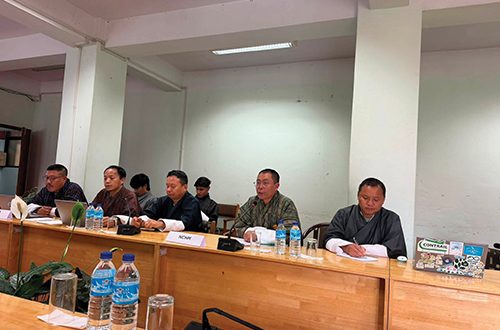
The National Centre for Hydrology and Meteorology (NCHM) has announced that El Niño conditions have officially developed over the tropical Pacific Ocean. This came during the press briefing held by NCHM with the media on 9th July, 2026.
The Centre predicts that there is now an 85% chance of a “Super El Niño” that might peak particularly in the post-monsoon period (September to October) this year.
Pema Syldon from the Meteorological Service Division of NCHM shared that the El Niño phenomenon may hit key economic sectors such as agriculture, hydropower and tourism.
“Since autumn is the time for farmers to harvest and as it is also the season of high energy generation and tourist arrivals, if there is lesser rainfall, then these sectors may be affected and relevant departments and sectors must be prepared to tackle them,” she said.
These conditions are expected to strengthen and last through the winter of 2026-2027. While the phenomenon begins thousands of kilometres away, it significantly influences Bhutan’s climate through changes in atmospheric circulation.
The climate driver interacts with the Southwest Summer Monsoon and the country’s unique mountainous terrain.
According to the NCHM outlook for June to September 2026, monsoon rainfall is predicted to be normal to slightly below normal. However, both maximum and minimum temperatures across the country are expected to be above normal.
“The Southwest Summer Monsoon officially arrived in Bhutan on 9 June 2026. This onset fell within the normal period. Bhutan is currently experiencing the active phase of the monsoon season,” said Ugyen Chophel, an official from the Meteorological Service Division.
Rainfall recorded during June 2026 has generally stayed within the normal range. There are notable regional differences in these observations. Southern parts of Bhutan received above-normal rainfall. In contrast, some areas in the north and east saw slightly below-normal rainfall. These variations are typical for the monsoon and are driven by local topography.
Temperature observations are already showing a consistent trend. Bhutan is experiencing warmer-than-normal conditions across the country. This trend matches the expected regional influence of the El Niño phenomenon. While El Niño is often linked to weaker monsoons in South Asia, its impact on the Himalayan region is not always direct or consistent.
Historical records show that some El Niño years have actually seen above-normal rainfall. Other years have received below-normal amounts. This highlights the influence of various climate drivers and Bhutan’s complex geography. The country has faced major disasters during past El Niño years.
The Director General of NCHM, Karma Dupchu, shared that since El Niño has arrived during a time of already warming temperatures, there are risks of Glacial Lake Outburst Floods (GLOFs) in the highlands.
The Centre also remains cautious about other extreme weather events that may occur due to shifting ocean temperatures and unprecedented weather shifts.
These include the widespread flooding from Cyclone Aila in 2009 and the 2015 Gasa Lemthang Tsho glacial lake outburst. More recently, the 2023 Ungar flash flood also occurred during an El Niño period.
NCHM officials noted that these past disasters were caused by a combination of factors. These include the Indian Ocean Dipole and local weather systems. The current outlook is meant to improve seasonal awareness and general preparedness.
It is not a warning for any specific weather event. The NCHM will continue to monitor the evolution of El Niño and other climate drivers.
“While we cannot definitely say that El Niño will affect rainfall and temperature patterns, we must be ready for anything,” said Ugyen Chophel.
After the post-monsoon season, Pema Syldon said that they also have to check the conditions of the winter season.
“El Niño will still be there but since the Indian Ocean Dipole (IOD) is shifting from neutral to positive, it is expected there will be more rainfall. If the IOD and sea surface temperatures correlate, then we might also forecast snowfall in Thimphu, which it hasn’t received in a while,” she said.
The public is encouraged to follow official weather forecasts and advisories. These updates are available through the media, the NCHM Facebook page and other official communication channels.
Seasonal conditions may still evolve, making continued monitoring essential for the nation. The Centre also urges the public to remain aware of their environments and settlements as they are best placed to know their areas and to be alert for any erratic weather phenomena and risks.
The NCHM said it is not just important to forecast, but all stakeholders must ensure that they have the capacity to act on the information to save lives and property.