The Bhutanese Leading the way.
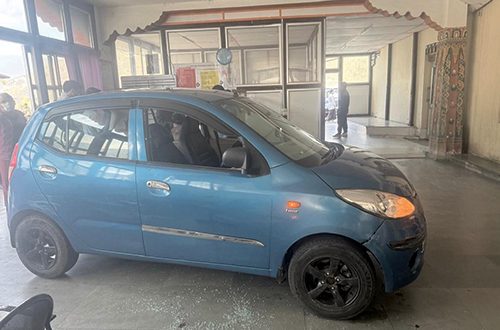
Earlier this year, around 2 pm on March 5, a person drove in wildly with his Hyundai i10 car, entered the triage area of the Emergency Department at the Jigme Dorji Wangchuk National Referral Hospital (JDWNRH), nearly hitting a nurse.
After stopping the vehicle, he broke the car window using the handle (hilt) of a Dozom (dagger) he was carrying and exited the vehicle. The individual then moved into the Acute Medical Care area of the Emergency Department, where emergency patients are kept in beds, while holding the Dozom. He appeared disoriented, had visible self-inflicted injuries on his left hand, and continuously waved the dagger in an uncontrolled manner.
Due to the potential risk posed by the weapon, emergency staff were unable to approach him, as his behavior presented a danger to both himself and others in the vicinity. The Nurse-in-Charge promptly contacted 113. In addition, Heruka security personnel, the ADM officer, and the Head of Department (HoD) were notified of the situation. Traffic police arrived at the scene at approximately 2:16 pm. They engaged with the individual and persuaded him to surrender the weapon.
Given the high risk to himself and others, physical restraint was applied and he was sedated. He was treated and a blood test for drugs was done along with a psychiatric evaluation.
The man had reportedly banged into some vehicles while coming to the hospital.
Recently, while a schizophrenic patient’s attendant was fast asleep in the psychiatric ward, the patient got up at night, took off his clothes, and ran out stark naked. A male nurse tried to grab him, but the patient landed a blow on his nose, giving the nurse a bloody nose. Then a security guard also tried to catch the patient, but the patient grabbed an iron rod and struck the guard on the head, injuring him enough to warrant treatment.
53 incidents
The Jigme Dorji Wangchuk National Referral Hospital (JDWNRH) may appear serene on the outside, but given the large numbers of patients and visitors, there are also various problems that crop up, from patients absconding to aggression against staff to medical carelessness.
The hospital has documented cases like these and others in the ‘Annual Incident Report Analysis’ report for July 2025 to June 2026 by the Quality Assurance Services Division (QAS).
The report has documented 53 incidents of varying nature. The knife incident was not recorded among the 53 as it was a criminal case.
The Psychiatry Department accounted for 34 of the 53 incidents, or 64.2%, but the report says the high share may partly reflect a more consistent reporting habit in that department. It says under-reporting from other departments cannot be ruled out, and this is a finding in its own right.
When one looks at the incidents, there were 11 cases of patients absconding or eloping, 10 cases of verbal abuse and harassment of staff, 7 cases of inter-patient physical violence or aggression, 4 cases of self-harm and suicide attempts, 4 cases of patients falling, 3 cases of surgical gauze being retained in the patient after delivery, 3 cases of infrastructure or environmental hazard, 2 cases of missing and damaged hospital property, 2 cases of security lapses by staff on duty, 2 surgical events, 2 diagnostic or lab service delays, 1 contraband incident, 1 medication error, and one OPD service-delay complaint.
When one looks at the above data, it is clear that safety is an area of concern at the JDWNRH.
Clinical issues and patient care
Another issue, however, is patient safety and medical practices.
The report says that the wrong patient was given bladder irrigation in the ENT (Ear, Nose, Throat) Ward. A verbal order intended for one bed was carried out on the adjacent bed after the bed number was misheard by staff, and the written order in ePIS was not updated to catch the error. The patient developed minor urethral bleeding. This falls under the Bhutan Healthcare Standard for Quality Assurance (BHSQA) Annex 02 surgical-event category for a wrong procedure performed on the wrong patient.
There were three post-delivery cases (natural delivery) where surgical gauze was left inside the patients. Two developed infections (fever, foul-smelling discharge, perineal tear infection). The report said the three occurrences within the same care pathway point to a gap in the swab or gauze count protocol at delivery, and cannot be seen as three unrelated lapses.
A patient undergoing minor nasal-polyp surgery developed an iatrogenic cerebrospinal fluid (CSF) leak. A further invasive procedure was then carried out without documented consent, and the patient was later referred for advanced care outside the country. The report said the case raises questions on the consent process and inter-departmental accountability that a formal review should address directly.
A cerebrospinal fluid (CSF) leak is an escape of the fluid cushioning the brain and spinal cord, caused by a tear in the outer membrane (dura mater). It triggers severe “positional” headaches that worsen when standing and improve when lying down.
Severe, untreated leaks risk dangerous brain infections like meningitis, brain sagging, or subdural hematomas, which are life-threatening collections of blood between the brain and the outermost protective layer (the dura mater).
There was also an unattended patient death in the Emergency Department on 8 December 2025. A homeless individual known to the department was allowed to remain on a trolley overnight without ePIS registration or medical assessment, in line with informal past practice for the same individual. He was found deceased the following morning, in rigor mortis. This falls under the BHSQA Annex 02 category of environmental or patient-protection sentinel events. The department has since made ePIS registration and duty-doctor assessment mandatory for anyone occupying an ED trolley.
In terms of the clinical cases above, an official from the Quality Assurance Services Division said all the cases were accounted for, looked into, and the necessary corrective action were taken.
The official said the aim of the report is not to penalize medical professionals but to find out if there are any systemic issues and resolve them in a systemic manner. Even when medical errors occur legitimate factors like high patient load, technical issues, and other systemic constraints are taken into account.
At the same time, if a medical professional is intoxicated or there is willful negligence, then accountability is fixed.
Violence, abuse and safety
The report’s primary concern is more the safety aspect and non-clinical issues, especially around the emergency department and the psychiatric ward.
The report said that the security guard on duty was found intoxicated while an aggressive patient was being admitted to the Psychiatric Ward. This left the nurse on duty to manage the admission largely alone.
In terms of the key findings, absconding is the largest single risk pattern, almost all in the Psychiatric Ward. It says the current physical security and observation staffing are not containing flight-risk patients reliably.
Verbal abuse and harassment of staff are directed mostly at nurses by patient attendants. It says a formal staff-protection protocol and de-escalation training would address this directly.
A doctor at the emergency ward said that security needs to be improved. She said when the knife-wielding incident happened, the first people to flee were the private security guards of Heruka.
JDWNRH has written to the Chief of Police to place a uniformed police person at the emergency ward.
The doctor said that before COVID, with gang fights, whole gangs used to turn up at the Emergency Department with their friends, and this posed a security risk. She said once the police person was posted there, then it calmed things down.
The doctor said that verbal abuse is common and two years ago a patient attendant even attempted to throw a stool at a male nurse in the emergency.
The doctor said the private security there are mostly women and they do not have any self-defense equipment on them like a stick, etc.
The doctor said a common issue is that patients and their attendants don’t understand triage at the emergency, which is to check how serious a patient is and accordingly prioritize them, and this is where verbal abuse comes in, with a common refrain being that they are paying tax but not getting service.
A QAS official said that workplace violence and verbal abuse are demotivating staff and so this needs to be addressed.
A male nurse at the emergency said that there is overcrowding of patients and a staff shortage, and this is where frustration comes out as abuse. He said that when patients and attendants are in pain and a frustrated state, even normal instructions sound harsh to them and so they react, but he also acknowledged that perhaps medical staff also need to be more diplomatic in some cases.
The male nurse recounted incidents where patients name-dropped ministers and senior officials to intimidate them.
He said in the case of female nurses, sometimes they get pursued by patient attendants asking for their number and propositioning them, mistaking the professionalism of nurses in explaining or doing things nicely as something else.
In terms of unsuitable surroundings and property damage, the incidents were mainly from the psychiatric ward, which an official said is not suitable and adequate for the patients there.
The report said that for non-clinical incidents (violence and abuse), zero Corrective Action and Preventive Action reports (CAPA) were submitted by the administration within the stipulated timeline.
Reporting needs to improve
The report says that reporting volume is uneven across departments. Surgery, Medicine, and OPD have almost no submissions outside the two isolated events captured here, which points to under-reporting rather than an absence of incidents in those areas.
The report says the notification form itself is a data-quality problem as missing dates, blank department fields, and misaligned entries limit what this register can support in terms of trend analysis, and should be corrected before the next reporting cycle.
Recommendations
The report has given two critical recommendations, two major recommendations, and two minor recommendations.
One critical recommendation is to review physical security, door and exit control, and observation protocols in the Psychiatric Ward to reduce absconding incidents.
Another critical recommendation is to reinforce the mandatory swab or gauze count and documentation protocol at delivery, and ensure audit compliance monthly for three months following the three PNC retained-gauze cases.
A major recommendation is to redesign the incident notification form with mandatory structured fields (department dropdown, date picker, standardized incident type list) to close the gaps in Section Two.
One more major recommendation is to introduce a staff code-of-conduct and de-escalation training programme, prioritising Psychiatry, Emergency, and OPD staff.
The two minor recommendations are to run a targeted drive to raise incident-reporting rates in departments with low or no submissions (Surgery, Medicine, OPD), and add the incident register to the standing agenda of the Hospital Management Committee or highest committee on a quarterly basis, with department-wise trend tracking.