The Bhutanese Leading the way.
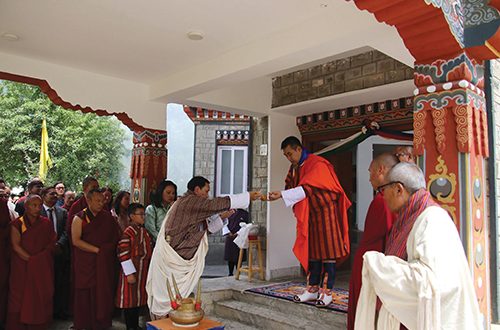
The newly appointed minister of the Ministry of Energy and Natural Resources (MoENR), Lyonpo Sonam Tashi, has outlined his immediate focus to ensure the ministry delivers on Bhutan’s energy security while laying the groundwork for long-term economic transformation through sustainable development of the country’s natural resources.
Acknowledging that he is still familiarizing himself with the ministry’s work, Lyonpo Sonam Tashi said his first priority has been to understand the status of ongoing programmes, engage with officials and identify areas requiring immediate attention.
He said the ministry’s work will be guided by practical solutions, collaboration and timely implementation.
Addressing immediate challenges
Among the minister’s immediate priorities are strengthening Bhutan’s energy security, addressing winter electricity shortages, accelerating delayed hydropower projects and ensuring efficient implementation of ongoing programmes.
He said reliable energy remains central to Bhutan’s economic development, and improving the pace of project delivery will be one of the ministry’s key areas of focus.
The minister also stressed the importance of balancing development with environmental sustainability, noting that responsible management of Bhutan’s natural resources will remain a guiding principle.
“We must develop our natural resources responsibly and create more opportunities for Bhutanese, especially our youth. These are not separate goals. Reliable energy, responsible resource development, and skilled people must advance together to support lasting economic growth,” he said.
Hydropower remains the backbone
While outlining the ministry’s direction, Lyonpo Sonam Tashi reaffirmed that hydropower will remain the backbone of Bhutan’s economy and a major contributor to national revenue.
He said completing delayed hydropower projects, particularly Punatsangchhu-I, remains a priority. According to the minister, work on the project has resumed and progress is being made following technical interventions, although safety considerations will continue to guide implementation.
Lyonpo said, “Hydropower remains a cornerstone of our economy and of our plan to reach 25 GW by 2040 (20 GW from hydropower and 5 GW from solar). At Punatsangchhu-I, dam construction resumed on 10th April 2026, with a scheduled construction period of 48 months.”
“Some matters concerning the right-bank slope are in the final stages of resolution. My role is to maintain close oversight, ensure timely coordination and help clear decisions that require government attention. We must make progress, but we must never compromise safety, technical integrity, or quality simply to move faster,” he added.
He said the experience from delayed projects have reinforced the importance of stronger project planning, risk management and timely execution for future hydropower developments.
Diversifying Bhutan’s energy future
While reaffirming the importance of hydropower, the MoENR minister acknowledged that Bhutan can no longer rely on a single source of electricity to meet future demand.
He said the ministry is pursuing a more diversified energy portfolio by expanding renewable energy sources such as solar while exploring energy storage systems and pumped storage projects.
According to the minister, diversification is essential not only to improve domestic energy security during winter but also to support economic growth.
He said building a resilient and flexible energy system will better position Bhutan to meet increasing electricity demand in the years ahead.
Preparing for Gelephu Mindfulness City
Lyonpo Sonam Tashi said planning for Gelephu Mindfulness City (GMC) is closely linked to the country’s long-term energy strategy.
He said the scale of development envisioned for GMC will require a reliable and diversified electricity supply supported by modern energy infrastructure.
Beyond hydropower, the ministry is considering greater integration of solar power, energy storage solutions and smart grid technologies to ensure the city’s future energy needs can be met sustainably.
He said preparations are already underway to ensure the country’s energy infrastructure keeps pace with one of Bhutan’s most ambitious development initiatives.
Responsible mineral development
On the country’s mineral resources, Lyonpo Sonam Tashi said Bhutan has significant potential, including deposits of rare earth elements, copper and tungsten.
However, he said any future development would proceed cautiously and be guided by scientific assessment, environmental safeguards and long-term national interest.
“The reported prospects for tungsten, copper and rare earth elements may offer important opportunities, but we should not rush ahead of the evidence,” he said.
The minister said comprehensive geological surveys and careful evaluation would precede any major extraction activities to ensure that economic benefits are balanced with environmental protection.
He added that responsible resource development could contribute to economic diversification while creating opportunities for investment and employment.
“If development is found to be viable, the process should be transparent, competitive and supported by strong safeguards for forests, watersheds and communities. The objective should not simply be extraction. It should be lasting national value, local benefits and meaningful participation by Bhutanese professionals and businesses,” Lyonpo said.
Leadership through collaboration
Reflecting on his seven days in office, Lyonpo Sonam Tashi said his immediate approach has been to listen, learn and work closely with ministry officials before introducing major policy changes.
He said that a change in leadership should not interrupt programs or projects that serve the country.
“I have been in office for seven days, and my first task is to listen and understand the issues. But I take up this responsibility with determination and a sincere commitment to serve.”
He said effective governance depends on teamwork, evidence-based decision-making and accountability, adding that successful implementation requires close coordination across departments and agencies.
“We are already midway through the 13th Five-Year Plan, and a great deal of work is under way. I do not intend to come in and start everything again. My responsibility is to build on the foundation laid by my predecessor and our officials, identify where implementation can be improved, and bring fresh energy where it is useful.”
“I also want more young Bhutanese to see real career and business opportunities in energy, mining, forestry, and the environment.”
The minister also emphasised the importance of maintaining public trust by ensuring transparency, professionalism and efficient service delivery.
Additionally, he said that his experience as a Member of Parliament taught him that a good plan has value only when it produces results.
Lyonpo said, “Implementation improves when people understand the purpose of their work and feel ownership of it. I have also learned to listen before making decisions. Officials and communities closest to a problem often understand its practical realities best.”
Challenges and way forward
Lyonpo said the main challenge is to pursue Bhutan’s economic ambitions without weakening its environmental integrity and carbon-neutral commitment.
“We want to develop more energy and make responsible use of our resources, but how we do it matters as much as what we develop,” he added.
He said Bhutan also faces a capacity challenge, adding, “We need more Bhutanese engineers, geologists, foresters, environmental specialists, and technicians to carry this work forward. That is why developing and retaining our people, especially young professionals, is not a separate priority. It is central to achieving everything else.”
He said delays remain a major concern, including delays in major projects, addressing winter energy shortages and properly assessing mineral opportunities.
The minister said, “Delay has real costs in revenue, economic activity, and public confidence. At the same time, urgency must not lead to poor technical or environmental decisions.”
He said Bhutan’s reputation for environmental stewardship was built over generations.
He added, “My concern, and my responsibility, is to help the MoENR move with greater urgency while maintaining technical discipline, transparency and environmental responsibility.”
“I would like to leave behind a ministry that is more efficient, responsive, and trusted, a ministry that follows through on what it starts. I would also like more young Bhutanese to see energy, mining, forestry and the environment as sectors in which they can build meaningful careers and businesses,” Lyonpo said.
“If, by the end of the term, we have strengthened important projects, improved public confidence, and created opportunities for our people without compromising environmental stewardship, I would consider that a meaningful contribution,” he added.
He pointed out that the next generation should not simply inherit this progress. They should have the skills and opportunities to build it themselves.