The Bhutanese Leading the way.

The Prime Minister recently announced the formation of the Seventh Pay Commission, leading to a lot of discussion and debate online.
When one looks at the pay and allowance figures post democracy, and one tracks its rise, it makes for some interesting figures.
The Data
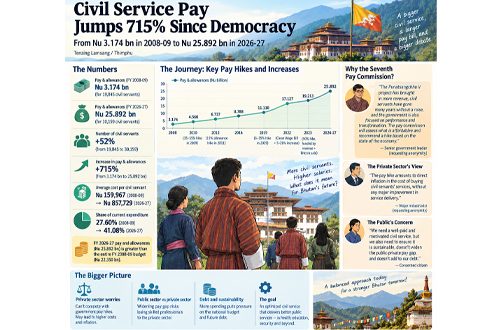
In Financial Year (FY) 2008-09, the first budget after the transition to democracy, pay and allowances totalled Nu 3.174 billion (bn) for 19,845 civil servants. Today, they total Nu 25.892 bn for 30,159 civil servants.
Over the 18 years since democracy, the number of civil servants has risen by 52 percent, while pay and allowances have risen by 715 percent.
The FY 2026-27 provision of Nu 25.892 bn for pay and allowances is greater than the entire budget outlay of FY 2008-09, which was Nu 22.350 bn.
In FY 2008-09, an average civil servant cost the government Nu 159,967 a year in pay and allowances. Today, the same civil servant costs Nu 857,729 a year.
Another notable data point is the growing share of pay and allowances in the current expenditure budget, which has risen from 27.60 percent in FY 2008-09 to 41.08 percent in FY 2026-27.
Every elected government has made it a point to give a pay hike to civil servants and with some even giving it twice.
The first hike was in 2009 when a 35 to 55 percent hike was given with the higher amount at the lowest levels and most getting around 35 percent.
As a result, the Nu 3.174 bn pay of 2008 and allowances jumped to Nu 4.560 bn by 2010.
In 2011 there was a 15 percent allowance hike and so by 2012 the pay jumped to Nu 6.737 bn.
Then in 2014 a 19 to 25 percent hike was given with most civil servants around the 25 percent mark.
In 2016 the pay of civil servants had become Nu 8.788 bn.
In 2017 there was an increase in various allowances for teachers, health workers and local government leaders.
By 2019 the civil service pay touched Nu 11.110 bn.
In 2019 there was a 6 to 35 percent pay increase with 6 percent at the highest levels and 35 percent at the lowest levels.
By 2022 the civil service pay bill was Nu 17.127 bn.
Then in 2022, the Clean Wage Bill reform came in increasing pay by around 5 to 26 percent with most getting 5 percent and the lowest levels getting 26 percent.
By 2023 the civil service pay was Nu 19.213 bn.
Then in 2023, the big hike of 50 percent came in costing Nu 6 bn per year of which Nu 2 bn was funded from government revenue and Nu 4 bn from the sale of Bitcoins for two years.
As of today, the total pay of the civil service stands at Nu 25.892 bn.
This is not counting a separate pay or emolument of Nu 827 million for lower level temporary staff, local government officials, Non-Formal Education instructors, cultural performers, etc.
The Government Rationale
While the announcement of the Seventh Pay Commission has been welcomed by civil servants, there is no clarity on the rationale behind it.
The Bhutanese spoke to a senior government leader, who requested anonymity, about the thinking behind the move.
The leader said the Punatsangchhu II hydropower project coming online has brought a good increase in revenue, and that civil servants have gone a number of years without a raise. The other motivation, the leader said, is the ongoing civil service transformation, in which performance is one aspect and adequate remuneration is another. Ultimately, the pay commission will assess what is affordable and recommend a hike based on the state of the economy.
When asked about the private sector’s concern that it cannot afford a similar hike, the leader said that, as a matter of principle, people should not want the government in business. The role of the government is to set rules and regulations and let market forces decide.
The leader added that some private enterprises can afford to pay very high salaries, and that the government has lost skilled people, such as engineers and technical staff, to the private sector. The leader said that at the same time the aim of the government is not to blow up revenue without considering what is best for the country.
“The whole purpose is to increase or set salaries to such an extent that public service is optimized,” the senior leader said.
“It is also about ensuring the best public services, health care through health professionals, education through teachers, and law and order, etc.”
On the private sector’s concerns, the leader said the government cannot raise the minimum wage and force private companies to pay more, nor can it subsidize private sector salaries. Neither, the leader said, is desirable.
On the private sector’s worries about inflation, the leader said that while the government monitors prices, many Bhutanese are not discerning customers and pay whatever is asked. The leader compared Bhutanese shoppers at the Thimphu Kaja Throm with Indian labourers, who bargain.
What the Private Sector Feels
A major industrialist, who also requested anonymity, said the pay hike amounts to direct inflation in the cost of buying civil servants’ services, without any major improvement in quality of services.
He said it is now clear that the entire revenue and benefits of Bhutan’s hydropower projects are being absorbed by around 30,000 civil servants, who make up only about 3.85 percent of the population.
“They are ravenously consuming every project like Chukha, Tala, Mangdechhu and now Punatsangchhu-II. What about the rest of us?” he asked. “They should at least move out of the way and let us move ahead, but they place restrictions on everything,” he added.
A hike that benefits only civil servants, he said, will trigger another spike in migration, because the private sector will be unable to match the pay and, with inflation added, many youths will seek a future abroad. He noted that a 50 percent hike was already given in 2023 without much impact on service delivery, while a lot of infrastructure, such as potholed roads, still needs attention.
He expects the civil service hike to be followed by hikes at DHI companies and state-owned enterprises (SOEs), and some major private companies may also raise pay to retain staff. The vast majority of the private sector, however, is in no condition to do so.
Former Secretary-General of the Bhutan Chamber of Commerce and Industry (BCCI) Chandra B. Chhetri said civil servants need to be compensated properly, but the private sector is still recovering from the pandemic. The hike will therefore be a burden on it, he said, as prices of essential commodities and services will rise and landlords will start increasing rents.
Chandra B. Chhetri said that while certain CEOs, heads of financial institutions and professionals in the private sector are paid well, the mass of the private sector is not, and it will be the most affected.
He said, “I don’t think the private sector has the capacity in general to hike salaries or keep employees happy,” he said. Shops are not doing well, he added, and current tax laws limit the salary a shopkeeper can deduct for himself or herself.
He said hydropower projects are currently benefiting only civil servants, and it remains to be seen how they will benefit private citizens. Even for the Nu 15 bn Economic Stimulus Program (ESP), he said, the majority was spent on government schemes, programs and pledges, with very little reaching the private sector.
Domestic consumption and demand are weak, Chandra said, and the large-scale migration of youth has made the problem worse. The business sector is also overcrowded, a problem compounded by a lack of innovation and the rise of unlicensed online businesses that pay neither tax nor rent. The private sector pays taxes and generates employment, and one private sector employee supports around five people, including school-going children. “How will they benefit from such a hike?” he asked.
Hotel and Restaurant Association of Bhutan (HRAB) Chairman, Ugyen Tenzin, said that, given the state of the industry, most hotels will be unable to raise pay, though some higher-end ones that are doing well may not have an issue. He said hotel employees earn mostly through service charges and tips, which have fallen for most because many hotels are empty even in peak season. From the employees’ perspective, he said, they should get a hike even if owners cannot afford it, simply to retain them.
Traders Association head Tshering Tobgay welcomed the announcement, saying any pay hike will indirectly help traders and shopkeepers because people will spend the money.
Executive Director of the Construction Association of Bhutan (CAB), Sonam Wangchuk, said that as a former civil servant he is not worried about the impact on the private sector. He expects the hike to be modest, perhaps 20 percent, and said the private sector would be affected only by a major hike of 60 or 70 percent, which will not happen.
Chairman of the Association of Bhutanese Education Consultancies (ABEC), Palden Tshering, said he is not hiring for now and pays his current staff based on performance, so his company will not be affected much. However, he said, many staff at other consultancies compare their pay with the government’s, so the impact may be felt there. If the government goes ahead with the hike, he said, the greatest help it can give the private sector is to clear its bills on time.
A businessman who spoke about the “trickle-down effect” of a civil service pay hike said the proof is in the 2023 hike. The injection of Nu 6 bn a year was expected to boost business, he said, but this was not seen because the beneficiaries are only 30,000 civil servants. Even if each supports five people, that is only 150,000 people, leaving out the remaining 550,000 Bhutanese who do not benefit financially.
MoICE Minister on Pay Hike
Minister for Industry, Commerce and Employment, Namgyal Dorji, said he has seen the various views expressed on social media about the pay hike, particularly the concerns from the private sector.
Lyonpo said the Pay Commission will certainly consider the ripple effects on the private sector, but that there is also a positive impact. When the government introduced six months of maternity leave for civil servants, he said, the private sector criticised the move, yet many private companies now offer longer maternity leave, though not necessarily on the same terms. A government pay hike, he said, will likewise raise the bar and encourage private companies to follow.
On the charge that hydropower benefits go only to civil servants, Lyonpo Namgyal Dorji said the same project revenue is what enables the government to offer the private sector incentives and various tax waivers and cuts.
He said one of the motivations for the hike is to retain talent, as the civil service has been losing people.
On inflation, he said the government will monitor prices, but some prices are also coming down because of tax changes.
Lyonpo said one charge is that the government is crowding out the private sector in the credit market. However, data from the Royal Monetary Authority (RMA) shows there is more than enough liquidity and banks are lending.