The Bhutanese Leading the way.
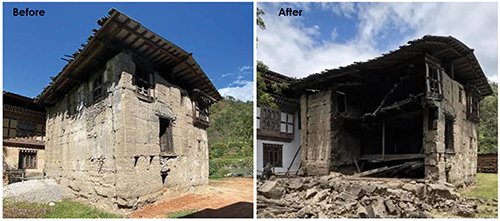
Editor’s Note: The article was published on Friday evening and a major section of the house collapsed on Saturday.
The Department of Culture (DOC) under the Home Ministry, responded below to some questions by The Bhutanese (TB) on the status of the Changyul Galem house in Punakha which is Bhutan’s version of Romeo and Juliet.
TB: What is the current status of the Changyul Bum Galem house renovation project?
DOC: The project is active and progressing through the international funding approval process. The Department of Culture and Dzongkha Development, and Punakha Dzongkhag, is currently working on a revised proposal fulfilling all updated criteria to be submitted to Pro Bhutan, Germany, for onward submission to the German Federal Foreign Office. Following the funding decision, the Punakha Dzongkhag Administration will proceed immediately with contractor procurement, followed by physical works.
TB: Has the government officially decided to discontinue the renovation project? If so, why?
DOC: No. The government has not discontinued the project. The Department of Culture and Dzongkha Development and the Punakha Dzongkhag Administration remain fully committed to its restoration. The delays experienced were driven entirely by external factors — contractor pricing, funding cycle constraints, and revisions required to the proposal — none of which reflect a change in the government’s intent or commitment to preserve this heritage building.
TB: How much budget was allocated or earmarked for the renovation, and how much has been utilized so far?
DOC: Earlier a total of €130,000 (approximately Nu. 10 million) was in the process of being sought through Pro Bhutan, Germany. Unfortunately, because this is a private property, it is difficult to get the funding processed. Therefore, no funds have been disbursed or utilised to date. In the event this budget comes through, the Punakha Dzongkhag Administration was working on committing any additional cost that exceeds the Pro Bhutan contribution. No Royal Government budget has been separately earmarked for this project at this stage, given the commitment in place from the international partner.
TB: Has the government conducted any recent assessment of the house following the earthquake that struck Punakha?
DOC: The Department is aware of the earthquake and its potential impact on heritage structures in the Punakha area, including Galem’s House. A rapid assessment of the building’s condition following the earthquake is being coordinated through the Punakha Dzongkhag Administration and the Department’s technical team. We will be in a position to share the findings once the assessment is complete. Heritage structures in seismically active zones require careful post-event documentation, and the Department treats this as a priority.
TB: What additional damage was caused to the house by the recent earthquake, and what measures are being taken to prevent further deterioration?
DOC: A detailed structural assessment is currently being carried out to determine the extent of earthquake-related damage. Prior to the earthquake, the building’s rammed earth walls were assessed as structurally sound, with the primary deterioration being concentrated in the roof and upper portions. Protective fencing is already in place around the structure. Depending on the findings of the post-earthquake assessment, the Department and Punakha Dzongkhag Administration will consider immediate stabilisation measures where structurally necessary and permissible under the international funding agreement. The Department will ensure that any emergency works are clearly documented and distinguished from the main restoration scope.
TB: Given the cultural and historical significance of the house, does the government still intend to preserve it? If yes, what is the timeline?
DOC: Absolutely. Changyuel Galem’s House is one of the most culturally significant privately owned heritage structures in Bhutan — predating the arrival of Zhabdrung Ngawang Namgyal, linked to the legend of Gasa Lamai Singye and Changyuel Bum Galem, and central to the Punakha Dromchoe. Its preservation is a government priority and has been the subject of a Cabinet directive. Subject to the German Federal Foreign Office’s funding approval, physical restoration works are targeted to begin immediately, with the building thereafter opened as a public heritage museum jointly managed by the Punakha Dzongkhag Administration and the house owner. However, the timeline will entirely depend on the funding commitment from the external donor.
TB: What were the main challenges that prevented the renovation project from progressing despite earlier commitments?
DOC: Several factors converged to cause the delays. First, when the project was tendered under FY 2024–25, contractor rates came in significantly above the initial cost estimates, and the time taken to negotiate and adjus the scope pushed the project into the German Federal Foreign Office’s financial year closing period, making fund release impossible within the remaining time. Second, German Federal Foreign Office budget rules prohibit commencing any works before formal approval of the funding application — this legal constraint meant construction could not begin even while negotiations continued. Third, a revised proposal became necessary following new requirements raised by the German FO, requiring formal agreements to be put in place between the Punakha Dzongkhag Administration and the house owner. Fourth, the German parliamentary elections of February 2025 and pressures on Germany’s federal budget from the Russia-Ukraine conflict delayed funding decisions. With all of these factors addressed, the revised proposal will be submitted soon.
TB: How many other heritage houses or sites were identified for renovation alongside the Changyuel Bum Galem house, and what is their current status?
DOC: Changyuel Galem’s House is part of a broader initiative by the Department to identify and develop heritage-based revenue-generating conservation models for privately owned heritage properties. Several heritage buildings across Bhutan have been identified for similar treatment, with assessments conducted at varying stages. However, Galem’s House is at the most advanced stage in terms of secured international partnership funding and a formal management agreement. The Department is not in a position to disclose the full list at this stage, as assessments and consultations with owners are ongoing, but we will be able to share a consolidated update in due course.
TB: Have any of the other identified houses received renovation support, and if so, which ones?
DOC: The Department has been supporting the conservation of heritage structures — both governmentowned and privately held — across all 20 Dzongkhags through its regular approval and technical assistance processes. For the specific category of privately owned heritage houses with national cultural significance, Changyuel Galem’s House remains the most advanced case in terms of an internationally funded, structured conservation model. The Department will make information available on other cases as they reach appropriate stages of formalisation.
TB: What long-term strategy does the government have for preserving privately owned heritage properties that hold national cultural significance?
DOC: The Changyuel Galem’s House project is itself a deliberate policy model that the Department intends to replicate. It demonstrates that privately owned heritage buildings can be conserved through a shared-responsibility framework — combining international partnership funding, formal management agreements between the Dzongkhag Administration and the owner, public museum access, and a revenue-sharing model that incentivises the owner to maintain the building. This approach does not require the government to acquire the property, and it creates a self-sustaining model for long-term maintenance.
At the policy level, the Department is also working on updated guidelines for privately owned heritage structures, building on the existing Guidelines for Seeking Clearances for Works Related to Heritage Sites (2025).
The long-term strategy encompasses three pillars: documentation and registration of significant privately owned heritage buildings across all Dzongkhags; technical and financial facilitation through partnerships with international conservation organisations; and adaptive use models — such as heritage museums, homestays, and cultural tourism integration — that make conservation economically viable for private owners. The Galem House project, once complete, will serve as a replicable reference case for this national strategy