The Bhutanese Leading the way.

Bhutan has formally integrated human-wildlife conflict management (HWCM) into its Gyalsung National Service training program to address the increasing frequency of human-wildlife conflicts. The initiative is being led by the Department of Forests and Park Services (DoFPS) with support from WWF-Bhutan under the IKI Living Landscape Project, which focuses on building ecosystem resilience through land use planning, community engagement, and institutional strengthening.
The HWCM training module was developed by DoFPS in 2023. To implement it, a Training of Trainers was conducted in May 2023 for 23 forestry officials. The trainers were selected to prepare for instruction at the two designated Gyalsung academies located in Pemathang and Khotokha. A comprehensive teaching manual was developed alongside the module to provide consistent instruction materials and practical guidelines for delivering the course.
The HWCM module is designed as part of the community security skilling component of Gyalsung, with DoFPS tasked with leading training in both forest firefighting and HWCM. The module content covers conflict identification, response strategies, wildlife behavior, mitigation tools, and case documentation methods. It also includes lessons on field safety, rapid response, and coordination with local communities.
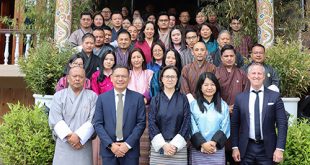
The first cohort of Gyalsung cadets began their one-year national service on 5 September 2024. Prior to this, a five-day HWCM master trainer workshop was conducted at the Ugyen Wangchuck Institute for Forest Research and Training (UWIFoRT) in Bumthang from 26 February to 1 March 2025. The workshop was facilitated by 11 master trainers and attended by instructors from DoFPS and the Nature Conservation Division. It aimed to finalize course content, train lead instructors, and test practical components of the module.
The development and training are part of Bhutan’s long-term approach to prepare youth for active participation in conservation and community security. Gyalsung, Bhutan’s national service program, is a national initiative aimed at equipping all 18-year-olds with skills in military training, disaster response, environment, and civic service.
The HWCM module is Bhutan’s first formal attempt to institutionalize human-wildlife conflict management as a youth training subject. It reflects the country’s Constitutional requirement to maintain a minimum of 60 percent forest cover, and aligns with the national goal to balance conservation with rural livelihood protection.
The training is also supported by the IKI Living Landscape Project’s broader goal to strengthen environmental governance, which includes curriculum development, capacity building, and field-level conservation efforts across Bhutan.