The Bhutanese Leading the way.
Govt says no investigation planned with focus instead on national safety standards and restoring permanent access
The Ministry of Infrastructure and Transport (MoIT) has acknowledged major gaps in the regulation of ropeway transport following the deaths of three people in Denchukha, saying Bhutan had no technical standards or approval process for passenger ropeways because such systems were rarely used for public transport.
The ministry expressed condolences to the families of the victims and said the tragedy exposed a systemic shortcoming rather than the failure of any single individual. It said ropeways in Bhutan have traditionally been used to transport construction materials instead of passengers and the government’s focus had remained on roads and bridges.
According to the MoIT, the absence of clear standards and an approval authority will now be addressed through the World Bank-supported ACCESS Project, under which a Multimodal Transport Masterplan is being prepared to establish technical standards, operational requirements and approval procedures for ropeways and other cable-based transport systems.
The ministry said it was unaware that residents were using the ropeway to transport people after the temporary Bailey bridge was washed away. It added that no formal technical, operational or safety standards currently exist for such transport systems and noted that responsibility for alternative modes of transport was assigned to the Department of Surface Transport only after the 2023 Civil Service Transformation.
The Bailey bridge, constructed in November 2025 after an earlier bridge was destroyed in October 2025, was intended as a temporary measure until a permanent bridge could be completed. The ministry said no practical alternative route existed at the time and the bridge remained the only means of maintaining access to Denchukha Gewog.
The temporary bridge was washed away on 28th June 2026 after unprecedented rainfall caused the Amochu River to swell and carry large volumes of water and debris. The ministry said the original Bailey suspension bridge had been built with sufficient clearance above the river but an unusual buildup of debris raised the riverbed and flood level, causing the bridge to be swept away.
It also stated that upstream disturbances, including overburden material associated with mining activity, may have contributed to the debris flow. The ministry said the temporary bridge had originally been scheduled for removal before the monsoon. However, delays caused by difficult site conditions and early monsoon rainfall meant it remained the only access route to the gewog. Engineers carried out repeated repairs and reinforcement to keep it operational.
The ministry said it found no engineering or design shortcomings in the bridge, maintaining that it had fulfilled its intended temporary purpose under difficult circumstances.
The ministry said it does not plan to conduct an independent investigation into the tragedy.
Instead, it will focus on developing clear safety standards, approval procedures and accountability mechanisms for ropeways and other temporary transport systems.
Construction of the permanent bridge has reached about 75 percent completion. Completed works include the abutments, river protection works, the Dorokha side pier and mobilization of bridge components. However, the remaining pier lies within the active river channel, making construction impossible during the monsoon.
The ministry now expects the bridge to be completed by December 2026. It said the project had originally been scheduled for completion by July 2026 but unusually heavy rainfall from March onwards prevented foundation work from progressing.
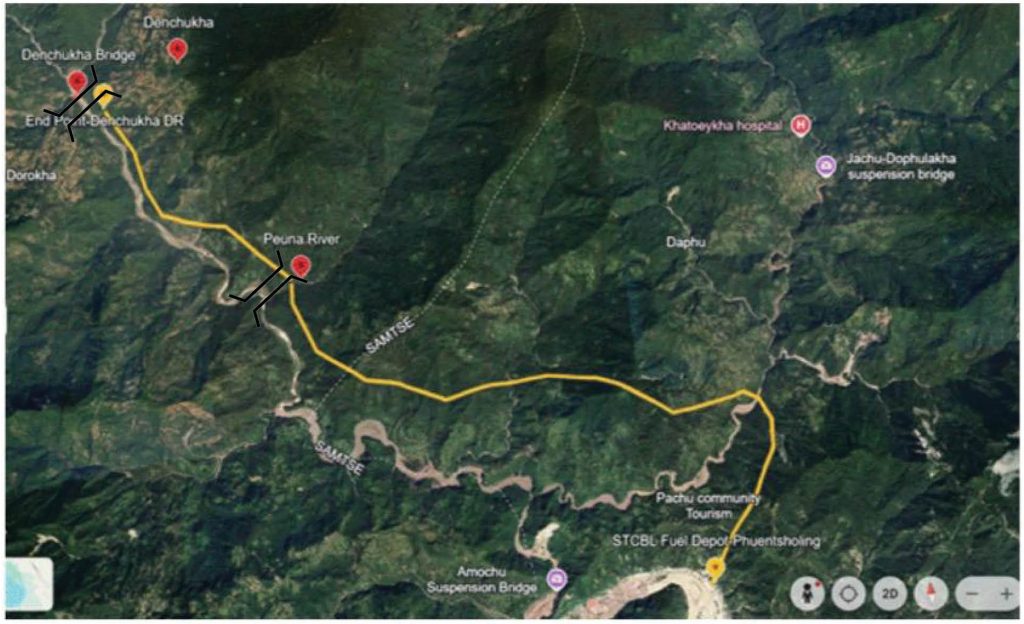
While permanent access is being restored, the ministry is assessing an alternative route through Phuentsholing Gewog. It said missing road sections have now been completed and road clearance is underway. The remaining challenge is constructing a temporary crossing over the Peuna River, which is currently being assessed.
The ministry said recent extreme weather has highlighted the need for more climate-resilient transport infrastructure. Future projects will incorporate improved flood protection measures, larger waterway openings, stronger river training works and better contingency planning, including alternative access routes and prepositioned emergency bridge materials.
It also said disaster management and contingency plans are regularly reviewed in collaboration with local governments and relevant agencies. Vulnerable communities receive disaster preparedness training and emergency response teams have been established in several chiwogs. Following the disruption in Denchukha, a joint assessment identified road restoration priorities and proposed a Bailey bridge over the Peuna Khola as a long-term measure to improve connectivity during future monsoon seasons. To support residents until permanent access is restored, the ministry, Samtse Dzongkhag and local authorities have mobilized heavy machinery to clear landslides and reopen roads. Officials said residents would be advised to stock essential supplies once access resumes, while helicopter cargo support has also been requested to transport livestock feed and other necessities if road access remains cut off.
Reflecting on the tragedy, the MoIT said the incident has reinforced the need to strengthen climate resilient infrastructure, improve disaster preparedness and closely monitor community-built transport systems. It added that future planning will place greater emphasis on safe temporary connectivity, long term accessibility and adapting infrastructure design to increasingly unpredictable weather patterns driven by climate change.