The Bhutanese Leading the way.
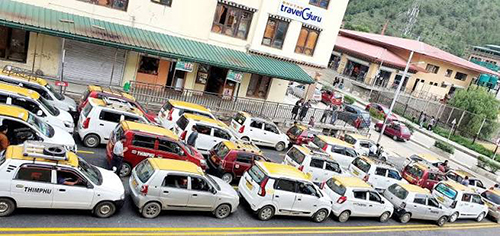
Official rules from the Bhutan Construction and Transport Authority (BCTA) are clear: overcharging passengers carries strict penalties, from fines to license cancellations.
But away from the rulebooks, the daily reality on Thimphu’s streets reveals a more complex narrative where commuters face shifting fare expectations, and drivers are grappling with the unpredictable risks of the night shift.
There are reports that some taxi drivers are overcharging their passengers.
Choden, a resident of Thimphu said, “I was charged Nu 200 for a ride from Simtokha one time. Usually, the fare is only Nu 150 when I commute from the same route.”
Another resident, Sangay shared, “There were times when I encountered some arrogant drivers that demanded more than what I pay every day.”
A taxi driver in Thimphu said, “There are incidents like that we hear about but I think it’s rare. If you look at the drivers here, at the main taxi parking, we don’t take extra fares from them. Sometimes we hear that there are new drivers and they overcharge because they do not know the rules and the fare charges.”
There is also confusion among the public on the rate of Nu 120 and Nu 150, charged by taxi drivers differently.
“While I haven’t been overcharged by the taxi drivers since I always go on fare sharing, I have been confused with the rates at times. If I go local, sometimes I get charged Nu 150 for a location I usually pay Nu 120 for,” said a middle-aged male Thimphu resident.
“Often I go from Changangkha to Bebena at a rate of Nu 120 but now the taxi drivers are charging me Nu 150 which is unclear,” said Jigme Choden, another resident.
For most commuters, this has created confusion as to whether they owe Nu 120 or Nu 150 to the drivers when reserving a taxi.
Pema, a taxi driver explained to this reporter that Nu 120 is the fare for going local in short distances or if the passenger wishes to go to a specific place within an area.
“For example, if a passenger from Olakha bridge wishes to go to a corner area which is still in Olakha, then it’s Nu 120. If the passenger wants to go somewhere further, like if he wants to go to town from Olakha by reserving the taxi, then it goes to Nu 150,” she said.
To clear up these gray areas, transport authorities emphasize that fare structures are strictly regulated.
An official from the BCTA said that the drivers will be penalized if they were caught charging inflated fares to their customers, given that the complainant shows concrete evidence.
“According to the rules, drivers will be told to refund the overcharged amount back to the customer. Plus, they will be charged a Nu 1,000 penalty, and a demerit point will be given to the driver,” said the official.
Additionally, Chapter VII of the Road Safety and Transport Rules & Regulations 2026 says that a person operating a taxi shall not charge excess fare beyond the fare prescribed by the Authority.
The person who charges excess fares shall refund the excess fare and be liable to a penalty of Nu 1,000 for the first instance, and demerit point for the second instance and cancel professional driving license on the third instance.
An official said that the taxi drivers can only be penalized if there is concrete evidence.
“Most complainants do not come with concrete proof. Some only come with the picture of the license plate, which lacks the proof that they were overcharged. However, those who do complain with proper proof, we ensure that they are refunded and the penalties carried out,” said the official.
While passengers navigate the daily confusion of shifting fare rates, drivers face their own set of challenges, ranging from misunderstandings with new colleagues to late-night safety risks.
The earlier mentioned taxi driver said that sometimes there are events when passengers don’t pay and cause trouble for the drivers.
There are different incidents observed by the taxi drivers at the main taxi parking. Trouble mostly erupts during the late hours. During one of the times, a taxi driver and a passenger got into a fight.
He said, “One time, a drunk passenger got into the backseat of the taxi and allegedly started hitting the driver due to unknown reasons. The driver apparently hit back at him and it led to a jaw dislocation of the passenger.”
According to him, the driver was then penalized with a fine of around Nu 7,000.
Tshering Dorji, another taxi driver, recalls a time when he drove at night. “It’s mostly passengers who have been partying and clubbing during late hours. Some of them are drunk senseless and don’t even pay. Some are also high from drugs and even refuse to get out of the car.”
“There are times when passengers don’t have enough fare to pay. Oftentimes I just take what I get, thinking that at least it’s something,” he added.
Ultimately, bridging the gap between Thimphu’s commuters and taxi drivers will require clearer communication on fares and greater empathy on both sides of the passenger seat.