The Bhutanese Leading the way.

During the public hearing on the implementation of the Economic Stimulus Program (ESP), held on May 16 and conducted by the Economic and Finance Committee (EFC) of the National Assembly, several concerns related to the program were raised and discussed by committee members and witnesses.
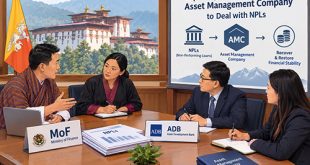
One of the issues raised by the Gangzur-Minjey MP was the volume of non-performing loans (NPLs) in the banking sector. He noted that there is currently Nu 8 billion in active NPLs and Nu 13 billion in charged-off loans, totaling Nu 21 billion. In addition, deferred loans currently amount to Nu 34 billion, bringing the total to around Nu 55 billion.
In response to a question the President of the Bhutan Chamber of Commerce and Industry pointed out that the ESP is a short-term program designed to stimulate the economy. However, out of the Nu 15 billion allocated for the ESP, only Nu 5.3 billion is earmarked for short-term programs like loans, while Nu 9.7 billion is set aside for long-term initiatives.
He also expressed concern about limited sectoral inclusion, stating that the program currently focuses only on three sectors: agriculture, production, and manufacturing.
Responding to this, the Secretary of the Ministry of Finance said that while the trade sector is important, the three sectors prioritized under the ESP are significant for job creation and production.
The Mongar MP questioned the need for Nu 9.7 billion in long-term ESP funding, given that the 13th Five Year Plan already allocates Nu 80 billion for economic programs.
The committee Chair said the Nu 9.7 bn is duplicating the economic programs already in the 13th plan.
In response, Director Chencho from the Prime Minister’s Office explained that the government is using the long-term funds to support affected sectors, such as the hotel and tourism industry, by implementing programs aimed at attracting more visitors to the country. He also said that the Nu 9.7 bn would support things like a craft bazar for artisans and it would create the right eco-system for those taking the loans.
Mr. Sangay Dorji from Wangduephodrang, who started a mushroom business at home, shared his experience of having his ESP loan application rejected. He said that although he had support from the Dzongkhag and evaluators who visited his business, the loan was declined after more than two months of waiting by BDBL, and he still does not know the reason.
In contrast, Mr. Chencho Norbu, founder of Norgu Lights—a business that manufactures LED lights, floodlights, and other types of bulbs—had his loan approved after three months. He said he was earning Nu 2 million a month before the loan, and he provided his bank statements as assurance, and underwent a bank assessment of his income and repayment capacity.
The Radhi-Sakteng MP raised concerns about the level of public awareness regarding the ESP and suggested that low financial literacy may be one reason why nearly 26,000 farmers are unable to repay their loans. In response, the ESP Steering Committee stated that 90 percent of gewogs in the country have applied for ESP loans. The Governor of the Royal Monetary Authority also said that the RMA is fully committed to working with the government to raise awareness across the country.
A question was raised also by the MP on why certain Dzongkhags were getting more allocations than others and here the BDBL CEO answered that loans are not given based on people or regions but the number of applications. She said the agricultural focused Dzongkhags would apply for smaller quantum loans where as Dzongkhags like Samtse and Chukha with various production units would apply for larger quantum loans.
The ESP steering committee was asked if there would be another round of lending. The committee said that it would happen when the money is paid back but there are no plans right now.
There were Nu 11 bn in applications for Nu 3.3 bn in ESP loans.
Concerns were also raised by MPs on the looming NPLs and here the RMA Governor assured that discussions are going on with Financial Institutions and they have been told to understand the situation of business entities genuinely impacted by the post pandemic situation.
The EFC Committee will deliberate the findings and present a formal report to the house in the third session of the fourth Parliament.