The Bhutanese Leading the way.
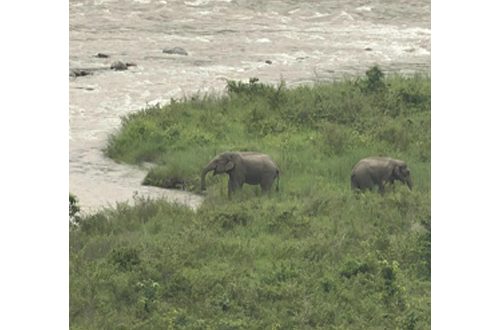
Villages in Samtse are slowly declining as there is no effective long-term solution to the elephant problem that has haunted residents for decades. Despite trying a wide range of mitigation measures, none have succeeded in stopping wild elephants from entering fields and threatening livelihoods.
A resident of Tashicholing Gewog, Dhanapathi Sharma, said the problem has been extremely persistent, with elephants destroying crops and even endangering human lives.
The situation has become more severe for farmers, forcing some to abandon farming and other agricultural activities in the area.
He recalled one incident in which a farmer had to cut down his entire maize crop to protect his home, fearing that elephants would encircle his house and threaten his family’s safety.
“This problem has been particularly persistent in the village. Villagers always live in fear and must remain alert at all times,” said Dhanapathi.
He said more than 18 to 20 mitigation measures have been tried by the Forestry Division, but none have worked effectively so far, raising concerns about the long-term safety of the village.
Implemented measures include chain-link fencing, internationally funded solar fencing, trench digging, and the construction of boulder walls at entry points to block elephant movement.
He said the reality of encountering elephants is even more dangerous, as they are highly destructive and unpredictable.
“These are large wild elephants that are highly sensitive and aggressive,” he said, adding that they usually appear late at night and roam until around 4–5 am. The danger also extends to nearby areas, including the Gyalsung Academy.
The problem also led to the death of a man in May, who encountered an elephant early in the morning while leaving the village.
Over the years, chain-link and solar fencing have been introduced as solutions, but they have failed to effectively stop elephants from entering villages and destroying property.
The solar fencing, installed with international funding at a cost of over Nu 1.5 million, also failed within a month of installation.
Digging trenches was another attempt to deter elephants. However, elephants often push debris, wood, and rocks into the trenches over time, allowing them to cross and continue into villages.
“We acknowledge the efforts of the Forestry Division, as they are trying their best. However, a more holistic approach is needed from multiple perspectives,” he said.
The Forestry Division has been working extensively on the issue by implementing key projects, identifying elephant corridors and entry points, and tracking elephant movement.
According to another resident, Nir Kumar Puri, forestry officials and local authorities continue to work tirelessly despite limited resources.
“The Forest Division often lacks adequate equipment and vehicles to respond quickly when elephants are reported near settlements. During emergencies, the Gewog Administration and BPC often support them with logistics and transport,” he said.
Dhanapathi added that several factors contribute to the problem.
First, the summer season attracts large numbers of elephants to Bhutan’s fertile fields, especially when fruit-bearing trees begin to mature.
This year, an unusually high number of elephants were observed. Forestry officials noted that many were not part of previously tracked groups fitted with GPS tags, suggesting the arrival of new herds in larger numbers.
Second, elephants also migrate from India into Singyegang Gewog, which has become a major entry point.
He said this may be linked to stricter deterrent measures used across the border, including electric fencing and, in some cases, forceful methods such as shooting arrows to drive elephants away.
As a result, elephants are pushed toward Bhutan, where deterrent measures are comparatively less aggressive due to conservation considerations.
Bhutan does not use harsh deterrents such as electric fencing, making it more challenging to find a balanced “middle path” between conservation and protection of livelihoods.
According to him, some agricultural land has been abandoned for years due to the problem.
Tashicholing Member of Parliament (MP) Sangay Khandu said the issue has been raised repeatedly, including during the previous government’s tenure.
“After trying a series of methods, the most effective solution has been boulder wall construction with cement reinforcement,” he said.
He added that this method was implemented in 2017 and was highly effective at the time, but the structures later weakened due to lack of reinforcement. He noted that it is a relatively cost-effective solution and well-suited to the local terrain.
However, Dhanapathi pointed out that while boulder barriers can be effective, farmers often need access to grazing land located beyond these barriers.
As a result, they sometimes dismantle sections of the walls to allow cattle to pass, creating new vulnerabilities.
MP Sangay Khandu said that persistent elephants eventually find alternative routes and, once they enter villages, are extremely difficult to drive out.
Plans are being discussed to construct additional barriers along rivers, develop fisheries, and plant pineapple and lemon trees as natural deterrents, as elephants tend to avoid steep or difficult terrain and strong citrus plants.
He also said efforts will be made to reinstate reinforced boulder barriers and expand subsidised solar fencing for households as an alternative measure.
For farmers in Tashicholing, major cash crops include areca nuts, ginger, rice, and millet. However, the constant threat of elephant raids discourages cultivation.
“Agricultural crops including bananas and betel nuts have been repeatedly damaged, and many farmers have stopped paddy cultivation due to the constant threat from elephants. The situation has affected both livelihoods and food production in the community,” said Nir Kumar Puri.
As a result, agricultural activity has declined significantly, with many villagers living in fear. The problem is further compounded by wild boars and bird infestations, which also damage crops and kitchen gardens.
Dhanapathi said this situation is forcing some farmers to migrate to urban areas and start small businesses.
“Many families have no option but to leave farming and look for alternative livelihoods,” he said.
Residents are now urging the government and relevant stakeholders to urgently find a sustainable long-term solution to the recurring human–wildlife conflict.