 The Bhutanese Leading the way.
The debate on must-pass subjects goes to the heart of a larger question about the purpose of education.
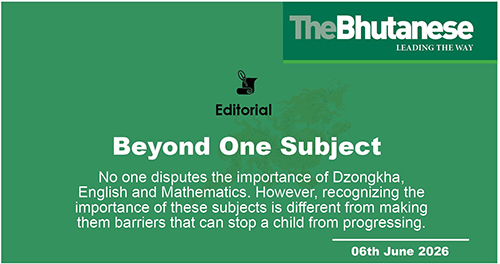
No one disputes the importance of Dzongkha, English and Mathematics. Dzongkha is central to our identity and culture. English remains the language of instruction and a gateway to higher education and global opportunities. Mathematics is increasingly important in a world driven by technology and data.
However, recognizing the importance of these subjects is different from making them barriers that can stop a child from progressing.
The experiences shared by principals across the country reveal a troubling pattern. Bright students who excel in most subjects are being held back because they fall short in one compulsory subject. The impact is not merely academic. Students lose confidence, parents become frustrated, and in some cases families choose to send their children abroad. Bhutan ultimately loses talent.
What is striking is that there is no single weak subject nationwide. Rural schools often struggle with English, urban schools with Dzongkha, while many schools report Mathematics as the main obstacle. Geography, language environment and social circumstances all play a role. This suggests the issue lies less with student ability and more with the rigidity of a one-size-fits-all policy.
The concern that removing must-pass subjects could lower standards is a valid one. Standards matter. Yet quality should be ensured through strong teaching, meaningful assessments and targeted support for struggling students, not by forcing capable students to repeat an entire academic year.
A more balanced approach would be to allow progression as long as the overall performance meets the mark, and to identify the strengths of the child with remedial classes for weak subjects.
Education should identify and nurture potential, not narrow it. When a student excelling in six subjects is defined solely by failure in one, the system risks measuring the wrong thing.
Reforming the must-pass policy is not about lowering expectations but it is about applying them more wisely.
“Education is not about memorizing facts, but about understanding how to think.” – Albert Einstein