The Bhutanese Leading the way.
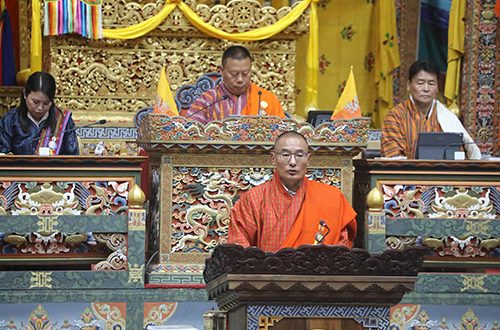
The government has announced a wide-ranging set of initiatives aimed at strengthening socio-cultural resilience and community vitality through enhanced digital governance, decentralized development, cultural preservation, and disaster preparedness measures.
The initiatives were outlined in the Third Annual Report on the State of the Nation (SOTN) presented to the Joint Sitting of Parliament on 16th June 2026 by Prime Minister DashoTshering Tobgay.
Digital Governance and Border Service Reforms
According to the SOTN, as part of efforts to modernize public service delivery, the government will roll out the Bhutan Digital Arrival Card system to streamline immigration processes and improve efficiency at entry points.
A digital payment system will also be introduced at all ports of entry for the collection of immigration-related fees, including the Sustainable Development Fee (SDF), aimed at enhancing transparency and reducing manual transactions.
In addition, a Regional Immigration Office will be constructed in Nganglam and Pemagatshel, to strengthen service delivery and improve border management operations.
The National Digital Identity system will be integrated with civil registration and census services, enabling improved coordination of national databases and more efficient delivery of public services.
Social Development And Decentralized Governance
Development financing has been strengthened through external support, with the Government of India (GoI) providing funding for High Impact Community Development Projects equally across all 205 Gewogs, 20 Dzongkhags and 4 Thromdes.
The Local Governments (LGs) remain central to social development, with continued decentralization supported through budgetary grants to Gewog Administrations, Dzongkhag Administrations and Thromdes.
Additional support from development partners, including the European Union and the United Nations, has also been channeled to LGs.
Urban development efforts are also being advanced to make cities safer, greener and more liveable.
The Phuentsholing Thromde Enhancement Program has been launched to revitalise urban economic activity and improve services.
In Thimphu, major revitalization works are underway covering water supply, roads, parks, drainage systems and footpaths.
Major renovation of the Babesa Expressway is also scheduled to begin this year.
Additionally, the report stated that Her Majesty The Gyaltsuen has emphasised that Thimphu, as the capital city, should be like an ornament of Bhutan.
In line with this vision, the One Thimphu Project has been initiated to enhance the capital’s overall environment and aesthetics.
On the social protection front, government is preparing a comprehensive strategy covering citizens from birth to death, while the Rural Life Insurance scheme is set to be launched this year.
Cultural Development And Heritage Preservation
The SOTN described religion and culture continue as the core identity and life-force of Bhutan’s sovereignty.
Over the past two years, Sarpang Dzong has been completed, alongside the construction of 53 temples and monasteries and the renovation of 81 others.
In addition, 88 chortens have been constructed and 69 renovated, while 23 new mandhirs have been built and six renovated.
Bhutan’s religious and cultural presence has also been extended internationally with the construction of a Buddhist monastery in Rajgir, India.
Plans are also underway to establish monasteries in Lumbini, Nepal, and Varanasi, India.
The Royal Academy of Performing Arts is to be strengthened as it preserves and promotes traditional mask dances and songs, safeguarding Bhutan’s intangible cultural heritage.
The Global Peace Prayer Festival, held last year, contributed to the continued flourishing of the Buddha Dharma.
His Holiness the Je Khenpo continues to confer Moenlam Chenmo, empowerments, oral transmissions and teachings across the country.
On 15th June 2026, His Holiness also began granting the Kathrid Empowerment and Kyilchog Dorji Threngwa empowerments.
Similarly, Hindu pandits’ continued prayers and rituals have been acknowledged as contributing to sustained peace and harmony in the country.
Disaster Preparedness And Environmental Risk Management
As per the report, 200 primary responders will be trained in search and rescue operations, while 60 DeSuups will receive Basic First Aid training to enhance emergency response capacity.
Search and rescue equipment will also be procured for both domestic and international deployment, strengthening Bhutan’s operational readiness.
In addition, vulnerable streams and rivers will be mapped and debris cleared to reduce the risk of artificial lake formation and associated flood hazards.