The Bhutanese Leading the way.
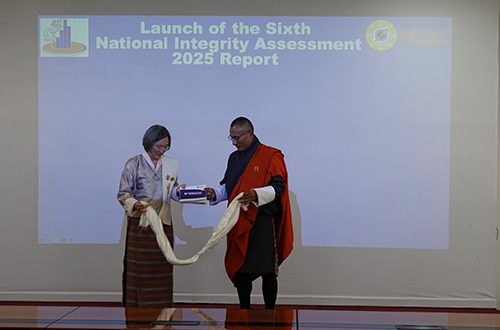
National Integrity Score reaches 8.16 showing strong public sector performance
Prime Minister Tshering Tobgay launched the National Integrity Assessment (NIA) 2025 Report on 26th June, reaffirming Bhutan’s commitment to strengthening transparency, accountability, and integrity in governance. The NIA 2025, the sixth assessment since its inception in 2009, is the most comprehensive nationwide evaluation of integrity in public service delivery. It assessed 381 consolidated public services delivered by 99 agencies across 13 institutional categories, drawing on responses from 17,896 respondents, including service users, service providers, parliamentarians, and voters.
The assessment recorded an overall National Integrity Score of 8.16 out of 10, reflecting a good level of integrity and the second-highest score since the assessment began. The Public Sector Integrity Score reached 8.41, indicating a very good level of performance, while reported experiences of direct corruption across public institutions remained exceptionally low.
Although the findings were broadly encouraging, the report identified areas requiring continued attention, particularly ethical leadership, which scored 7.62. It also highlighted a persistent gap between citizens’ actual experiences and their perceptions of fairness, including concerns about favoritism and unequal treatment.
The Prime Minister said, “Trust is the foundation of a prosperous society and integrity is what sustains that trust.” He stressed that integrity goes beyond the absence of corruption. It is about doing the right thing, serving the public interest, and upholding fairness, professionalism, and accountability in every aspect of governance.
The Parliamentarians’ Integrity Index (PII) measures the integrity of Parliamentarians as evaluated by both voters and Parliamentarians themselves. It comprises key components, including representation, oversight, legislation, transparency, accountability, integrity, and corruption.
For the PII, all Members of Parliament (MPs) from the National Assembly (NA) and the National Council (NC), were included in the survey. The PII questionnaire link was shared with all 46 MPs of the NA, including the Cabinet, and all 25 MPs of the NC, including the five Eminent Members. Of the 71 Parliamentarians contacted, 42 responded to the survey. However, three responses were excluded from the analysis because they were incomplete or blank. Consequently, the effective response rate for the computer-assisted web interviewing survey was 54.9 percent.
To sample voters and general citizens, a structured sampling strategy was adopted to ensure adequate geographic representation and analytical robustness. For the NA, a minimum of 20 respondents was selected from each constituency. This minimum threshold was established to balance statistical sufficiency with operational feasibility across constituencies with differing population sizes.
For the NC, sampling was conducted at the dzongkhag level, with a minimum of 20 and a maximum of 25 respondents selected from each dzongkhag. In total, 1,466 respondents were included in the PII voter and general citizen category.
Simple random sampling was employed within each constituency and dzongkhag to reduce selection bias and improve sample representativeness. While the use of fixed minimum thresholds may limit the extent to which population heterogeneity is fully captured in constituencies or dzongkhags with substantially larger or smaller populations, the adopted methodology represents a pragmatic balance between methodological rigor and practical constraints, enabling comprehensive national coverage and comparability across administrative units.
A comparison of integrity scores across categories of public agencies has identified the level of integrity and areas for promoting transparency, accountability, and efficient public service delivery. The assessment compares the integrity levels of ministries, constitutional offices, dzongkhags, thromdes, gewogs, corporations, autonomous agencies, the judiciary, financial institutions, schools, CSOs, and hospitals against the National Integrity Score. The National Score, excluding the PII score, stands at 8.29.
Among all categories, gewogs recorded the highest integrity score of 8.59, followed closely by CSOs with 8.58. Both achieved a very good level of integrity. Financial institutions recorded the lowest score at 8.12, although the category still falls within the good level. The report states that the higher scores achieved by gewogs and CSOs were largely driven by their very good performance in external integrity. In comparison, the relatively lower score of financial institutions is attributed to their external integrity being rated at the good level.
A recent study on public agencies has revealed encouraging results, with several institutions recording high scores in both external and internal integrity. According to the report, gewog and CSOs achieved the highest external integrity score of 8.72, indicating a good level of integrity. The study attributes these high scores to their strong performance in service delivery, transparency, fairness, accountability, and effective dissemination of information to the public. In contrast, financial institutions recorded the lowest external integrity score of 8.20, although this still falls within the good performance category. The report recommends that financial institutions continue strengthening transparency, accountability, and anti-corruption measures to improve public trust.
The study also examined internal integrity across different categories of public agencies. The Judiciary ranked highest with a score of 8.51, classified as very good. The report highlights that the Judiciary demonstrated a particularly strong performance in budget execution, scoring 9.49, which reflects a low level of budget misuse by officials and employees. Meanwhile, RUB colleges recorded the lowest internal integrity score of 7.42, placing them in the satisfactory category. The findings suggest that these institutions should enhance internal governance, accountability, and ethical practices to improve their integrity standards.
Prime Minister urged all institutions to use the NIA 2025 as a roadmap rather than a scorecard. He called on agencies and public servants to reflect on the findings, embrace continuous improvement, and strengthen public trust through transparent, ethical, and citizen-centered service delivery.