The Bhutanese Leading the way.
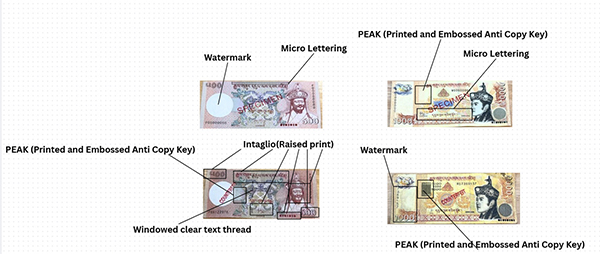
With counterfeit Nu.500 and Nu.1,000 notes detected in recent years, RMA highlights security features of current and new generation banknotes designed to strengthen protection against counterfeiting
While counterfeit Bhutanese currency cases remain limited, counterfeit Nu.500 and Nu.1,000 notes have been detected in circulation, prompting renewed awareness on how the public can identify genuine banknotes.
The Royal Monetary Authority (RMA) has highlighted the security features incorporated in Bhutanese banknotes, including the current series and the newly introduced generation of polymer banknotes, to help distinguish genuine notes from counterfeits.
So far, only counterfeit Nu.500 and Nu.1,000 denominations have been detected in Bhutan. Most of these cases are suspected to have entered through the southern borders.
The latest known seizures include counterfeit Nu.500 notes amounting to Nu.14,000 on 3rd June, 2025, and one counterfeit Nu.1,000 note seized on 9th October, 2025.
According to RMA, the new generation banknotes were introduced with enhanced security features to strengthen protection against counterfeiting. The new notes incorporate multiple security elements designed to make duplication extremely difficult.
For the public, RMA recommends checking banknotes using simple methods.
Looking, tilting, feeling and checking the security features.
Checking current Bhutanese banknotes
One of the primary features to check is the watermark, which can be seen when the note is held against light.
Watermark can be seen in all the denomination except Nu.1 and Nu. 5.
The watermark is a portrait of 5th Druk Gyalpo which can be seen in denomination of Nu. 50 and Nu. 1000 and in the rest denominations a portrait of the 4th Druk Gyalpo.
Genuine notes contain a clear watermark image integrated into the paper, along with other security features that are difficult to reproduce.
The security thread embedded within the note is another feature that can be checked by holding the banknote against light.
It is different for each denomination. On the Nu.100, Nu.500 and Nu.1000 notes the inscription ‘RMA’ and numerical value of the banknote appear in a repeated sequence.
Genuine notes also contain micro-lettering, which appears as fine text that cannot be easily replicated through ordinary printing methods. The words ‘ROYAL MONETARY AUTHORITY OF BHUTAN’ are printed extremely small which can be read only with a magnifying glass.
It is located on the right and left sides, and at the top center of the banknote in all denominations.
The current series banknotes also include tactile features through raised intaglio printing.
These raised prints allow users to feel certain elements on the note, while also assisting visually impaired individuals in identifying denominations. Some of the examples are the denomination figures, motif and micro letterings.
Other security features include the PEAK feature, optically variable effects, and iridescent elements that become visible and change when the banknote is viewed from different angles or tilted.
New generation banknotes with enhanced security features
The new generation banknotes, including Nu.100, Nu.500 and Nu.1,000 denominations, use polymer substrate instead of traditional paper.
Unlike paper notes, polymer banknotes contain features such as transparent windows, which are integrated into the design and are difficult to reproduce.
The Nu.500 and Nu.1,000 polymer notes also include holographic stripes with visual effects that change when the note is tilted.
Other features include tactile embossing, an X letter on Nu.1000 note, an L on Nu.500 and triangle shape on Nu.100.
Further, colour-shifting effects and illumination features that become visible under certain viewing conditions such as tilt and rotate.
The new designs also incorporate elements representing Bhutan’s heritage and national identity while adding modern security features.
RMA has advised the public to familiarize themselves with these features and check notes carefully before accepting cash, particularly when receiving money through private transactions outside regular banking channels.
RMA advises people who come across a suspected counterfeit note not to return it to the person who provided it.
Instead, individuals should record details about the circumstances, including information about the person who tendered the note where possible.
Businesses are advised to issue a receipt when retaining a suspected counterfeit note.
The suspected note should then be submitted to RMA for verification.
If the same individual repeatedly presents suspicious notes or provides multiple suspected counterfeit notes, the matter should be reported to the police.