The Bhutanese Leading the way.
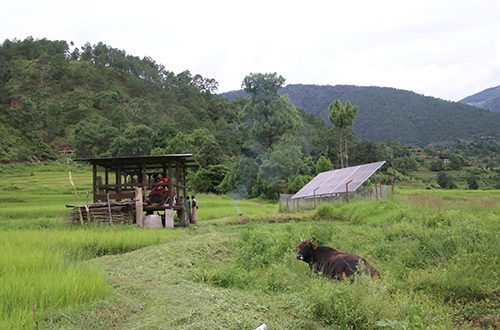
The Ministry of Energy and Natural Resources (MoENR) is pushing forward with ambitious plans to expand renewable energy-powered lift irrigation systems across the country. Aimed at tackling water scarcity in highland farming communities, the initiative bridges clean energy and agricultural productivity.
Renewable energy (RE) solar lift irrigation refers to an eco-friendly system that uses solar panels to generate electricity, powering pumps that lift water from rivers or lower elevations up to dry farmlands, directly benefiting rural livelihoods by providing reliable, low-cost irrigation to boost agricultural productivity and crop yields without adding financial burdens on farmers.
Following key pilot launches and strategic frameworks, the ministry is shifting from site identification to active project implementation.
From pilots to project pipelines
The push for solar and renewable-powered irrigation gathered momentum following a high-level dialogue in July 2025. Recently, on 17th August 2026, pilot solar-powered lift irrigation systems were inaugurated at Tempakha and Humpatang in Chhubu Gewog, Punakha, under the Women Empowered Renewable Lift Irrigation System (WERELIS-Bhutan) project supported by ICIMOD.
“These pilot systems will serve as demonstration projects and provide practical lessons on system design, operation, maintenance, institutional arrangements and community engagement, which can inform future replication and scaling-up,” an official from MoENR noted.
Detailed Feasibility Studies (DFS) for seven potential sites across Paro, Wangdue, and Punakha were completed in 2025, with two of those sites currently under implementation backed by Government of India-Project Tied Assistance (GoI-PTA). Furthermore, feasibility studies for an additional 10 sites are underway, signaling a rapidly growing project pipeline.
Streamlining planning with advanced tools
To select the most viable locations out of a massive theoretical potential to irrigate an additional 62,000 acres of farmland, the ministry is utilizing data-driven tools.
Planners are leveraging a satellite-based platform known as the PURE Platform alongside a Multi-Criteria Assessment (MCA) Framework to screen and prioritize potential zones before conducting field verifications. An upgraded version of the PURE tool is currently in development to improve data integration and user-friendliness for regional administrators.
Additionally, a standardized Detailed Feasibility Study Framework, finalized following stakeholder consultations, is slated for an official launch in the first week of October 2026.
Financing and long-term sustainability
A major hurdle for farming cooperatives remains the high upfront capital cost of decentralized renewable energy technology. Rather than depending on a single subsidy, the ministry is utilizing a blend of government investment, development partner support, and project-based financing.
To ensure these systems remain operational over the long haul, local Water User Groups are being put in charge of day-to-day management.
“O&M training has already been provided to the system users, covering routine operation, preventive maintenance, basic troubleshooting and safe use of the systems,” an official from MoENR explained regarding community custodianship.
Cross-sector coordination and women’s empowerment
Because these projects intersect energy, agriculture, and water management, MoENR is working closely with the Ministry of Agriculture and Livestock, the Department of Water, local dzongkhags, and gewogs to align water-use rights and cropping patterns.
The ministry is also tracking gender-disaggregated data to evaluate how solar irrigation reduces physical labor and drives time-use savings and income opportunities for women farmers.
While challenges such as complex regulatory requirements, large water-lifting heads, and funding constraints still exist, the ministry is steadily building a systematic framework to transform rural agriculture through clean energy.