The Bhutanese Leading the way.
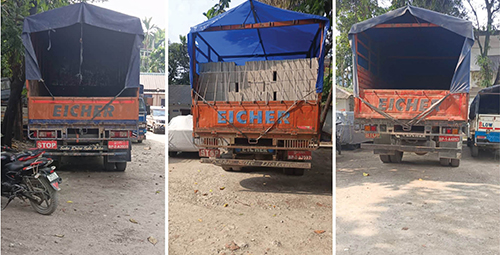
Pema Dorji (23) was driving his truck loaded with hollow blocks into Bhutan through the Bow Bazar gate in Jaigaon on 28th September when he was stopped by the Sashastra Seema Bal (SSB).
The SSB soldiers said he had been carrying scrap a few days earlier from Phuentsholing and was supposed to go to Gomtu, as stated in the customs documents, but the SSB in Gomtu had not recorded his entry and exit there.
They asked where he had unloaded the scrap, and Pema said he had transhipped it to another truck but did not remember the truck number.
The SSB then took him to the customs office along with another Bhutanese driver, Sherab Thaye (35), whose empty truck had also been detained under a similar allegation.
At the customs office, an SSB soldier asked Pema and Sherab to sign a document, but they refused.
Pema said, “The SSB soldier slapped me twice in front of everyone, forced me to sign documents and then seized my truck.”
Sherab and several traders and others present in the customs office witnessed the incident, according to Pema.
Sherab said the SSB soldiers then threatened him and also forced him to sign the document before seizing his empty truck.
A third Bhutanese truck, driven by Jigme Tenzing (35), had also been seized a day earlier after he was accused of carrying scrap into Jaigaon instead of taking it from Phuentsholing to Gomtu as stated in the customs documents.
The three truck drivers said that while their trucks were being seized, the same SSB soldier allowed three Indian trucks to pass even though the trucks were also supposed to transport scrap from Phuentsholing to Gomtu but had allegedly unloaded it in Jaigaon.
They said the SSB was not enforcing its rules uniformly and was unfairly targeting Bhutanese trucks.
Online monitoring system
The SSB soldiers told the three Bhutanese truckers that SSB personnel are stationed at every entry point into Bhutan and monitor and record every license plate in an online system. They said the system would show whether a Bhutanese truck had reached its declared destination.
The SSB’s statements and actions essentially mean that, going forward, Bhutanese trucks may no longer be able to take scrap into Jaigaon and unload it there without facing the risk of seizure.
The development presents another major challenge for Bhutan’s waste recycling and scrap export business, whose main market is India, particularly Jaigaon.
Before the pandemic
Before the pandemic, scrap from across Bhutan would come to Phuentsholing, from where it could be exported to Jaigaon relatively easily.
From May 2022 onward, however, restrictions were imposed and the practice was declared illegal, although, in practice, only the export of raw plastic scrap into India was banned, while pelletized and processed forms were allowed.
A Nu 4,000-per-truck “Gunda Tax” was charged and paid by importers in Jaigaon to facilitate the entry of the scrap. The amount was deducted from payments to Bhutanese exporters.
This was not a formal or legal arrangement, but it operated in the absence of a formalized scrap trade.
New Gunda Tax
In mid-August, however, politically connected individuals approached three Bhutanese trucks unloading in Jaigaon and allegedly demanded Nu 50,000 from each truck, saying that the export of scrap to Jaigaon was illegal and that the vehicles could be impounded.
According to sources, the individuals also used two SSB soldiers to threaten the Bhutanese scrap owners and truck drivers.
The development brought the scrap business to a complete halt.
Some Jaigaon scrap importers subsequently approached the group and negotiated what they described as a Gunda Tax of Nu 10,000 per truck. This was considered too high because it would bring the total Gunda Tax to Nu 14,000 per truck.
Except for a few trucks, movement subsequently stopped.
Sources alleged that the group was also paying off law enforcement personnel and other senior officials.
This newspaper reported on the Gunda Tax, following which Jaigaon police arrested five people on 12th September.
They were Bharatiya Janata Mazdoor Sangh (BJMS) leader Safikul Alam, Bal Bahadur Tamang, also known as Polay, Jalaluddin, also known as Jarnal, Mahabool Alam and Ansarool Sheikh, also known as Gelgulu.
Of the five arrested, four, namely Bal Bahadur Tamang, Jalaluddin, Mahabool Alam and Ansarool Sheikh, were detained for seven days.
Safikul Alam was also recently released on bail.
Big players still at large
However, sources in Jaigaon said police had not arrested a key alleged mastermind who, according to the sources, coordinated with key officials.
The individual was described by the sources as a well-known local figure with strong connections to the new local political power structure.
Several sources in Phuentsholing and Jaigaon said such a level of alleged extortion would not be possible without significant political backing.
According to several sources, following recent elections in West Bengal and the formation of a new state government, the local political power structure in Jaigaon underwent a significant change.
According to Bhutanese and Indian sources, one indication cited was that Bal Bahadur Tamang, or “Polay,” who was arrested by the police is close to the brother of a senior political leader from the area who is also a minister in the new West Bengal government.
Coverage by this newspaper of the alleged new Gunda Tax embarrassed local authorities and senior political figures, according to sources, following which the arrests were made.
The sources, however, said that the SSB has now begun targeting Bhutanese scrap trucks while allowing some Indian trucks to pass.
A source in Jaigaon said the SSB could be acting after receiving instructions from senior officials. The same source, however, said it could not be ruled out that the alleged extortion group was retaliating against Bhutanese scrap traders.
The source claimed that the same SSB personnel were allowing trucks belonging to certain well-connected scrap dealers in Jaigaon to pass without action.
Meanwhile, the livelihoods of the three Bhutanese truckers are at stake. All three have wives and young children to support, as well as loans and other payments to make.
They have been enquiring with customs officials about when their trucks will be released but said they had received no assurances.
All three said they had taken the scrap after being assured that arrangements had been made with officials in India. They said this, however, did not happen.
They said Bhutanese scrap exporters had told them that they would receive assistance from Indian scrap dealers. The Indian scrap dealers, however, allegedly criticized them for signing the documents that they said they had been forced to sign by the SSB and told them they could no longer assist them.
A letter to the Prime Minister
Meanwhile, the Bhutan Waste Management and Recycling Association (BWMRA) wrote to the Prime Minister on 1st October seeking government support on the issue.
The letter said that before 2021, Bhutanese waste handlers were able to transport recovered materials to Jaigaon and sell them to buyers and recycling industries in India.
It said this cross-border recycling activity was not only a source of income for waste handlers but was also an important part of Bhutan’s waste-management system.
“It allowed valuable materials to be recovered from our communities and sent for recycling instead of ending up in our dumping yards,” the letter said.
“However, around May 2022, following the COVID-19 period, the movement of these recovered materials was restricted. At that time, many waste handlers believed that the restriction was a temporary measure related to the pandemic. Sadly, what was expected to be temporary has continued for several years.”
The association said many waste handlers had suffered as a result.
“Some have faced vehicle seizures, fines and penalties at the border. Many have invested their life savings in trucks, machinery, warehouses and collection businesses. Today, they are struggling to find a market for the materials they collect,” the letter said.
“Your Excellency, behind every truck carrying recovered materials is a Bhutanese family. Behind every bale of plastic, cardboard, cans, rubber or tires is the hard work of Bhutanese workers who are trying to earn an honest livelihood while keeping our country clean.”
The letter said waste handlers purchase recyclable materials from communities, collect discarded materials, sort them, separate them by type, compact and bale them, and prepare them for recycling.
“Through this work, they help keep our Dzongkhags and Gewogs cleaner and reduce the amount of waste going to our dumping yards,” the letter said.
The association said BWMRA now has more than 120 members across Bhutan, supporting approximately 500 young people and around 1,200 families through direct and indirect employment.
However, it said Bhutan currently has no domestic recycling industry capable of processing materials such as cardboard, cans, plastics, rubber, tires and other recovered materials.
The letter said the association understood that India has regulations governing the import of different categories of recovered waste, recyclable materials and scrap.
“We fully respect the laws, environmental requirements and customs procedures of the Government of India. We are not asking to bypass these requirements,” the letter said.
“Our humble request is for the Royal Government of Bhutan to kindly engage with the Government of India at the highest appropriate government-to-government level and seek a clear, lawful and practical pathway for eligible recovered materials from Bhutan to reach authorized buyers and recycling industries in India.”
The association said it was ready to comply with all requirements and that waste handlers could properly sort, compact, bale and prepare materials according to the requirements of Indian authorities and recycling industries.
Waste challenge and more
BWMRA General Secretary Leki Dawa said Thimphu alone produces 250 tons of non-degradable waste a day and that sending all of it to the landfill would cause the landfill to fill up quickly.
Currently, much of the scrap is removed from the streets and collection centers because of its value, but the shutdown of cross-border trade since late August is leading to a decline in the value of scrap, according to the association.
The situation is also likely to affect government agencies that auction scrap, including Bhutan Power Corporation’s auctions of copper wire and other materials.
The issue extends beyond scrap, as the reported increase in Gunda Tax and allegations of political and official involvement could also affect other sectors of Bhutan’s exports through Jaigaon.
Already, lower-grade ferrosilicon exported to Jaigaon is reportedly being charged a Gunda Tax of Nu 15,000 per truck.