The Bhutanese Leading the way.
What the deliberations behind the Tsirang Consensus taught us about the transformative potential of primary health care
By Gayadhara Dendup
Somewhere in a remote village, an elderly man is suffering from a chronic health condition which requires him to visit a hospital on a regular basis. His eldest son left home years ago and his daughter is pursuing her undergraduate degree far away from home, while his better half is too frail to care for him.
The nearest hospital is a long day’s journey away, and he does not want to be a burden. He has never heard the words “universal health coverage.” But it is for individuals like him those words were curated, and cases like his are no longer rare in our country.
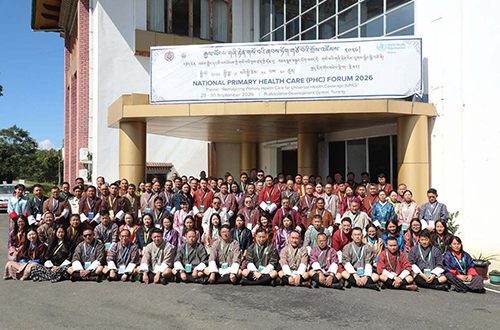
During three enriching days in Tsirang this September, health workers who have, over the years, walked for hours to reach their patients; local health administrators who know every household in their districts; doctors who can identify each of their chronic patients by name; and policymakers who carry the weight of an entire system on their shoulders came together to reflect on a shared question—how can we leverage and reimagine primary health care so that every Bhutanese can enjoy universal health coverage?
Primary health care is not an office, a building or a program. It is a system.
It is a promise that health care will meet you where you live. At its simplest, it is a health worker who knows your family and its history. It is a local health center that understands the real needs of its community. It is a gentle reminder to check your blood pressure and keep it under control, and timely advice to cut down on salt and go easy on your favorite drink. It is a compassionate visit when you are too sick to travel, and a caring hand that holds yours at the end of life.
Around the world, this humble idea has proven to be the strongest foundation a nation can build on. WHO estimates that 90 percent of the essential services needed for universal health coverage can be delivered through primary health care. Yet, globally, the gap remains, and it is pretty significant. The most recent global monitoring report found that 4.6 billion people still lack access to essential health services.
Bhutan has been spared much of that hardship. Free health care, carefully crafted into our Constitution, is a precious gift from our Golden Throne that many nations can only dream of. But free care is not the same as care that arrives. A clinic with an open door means little to the farmer whose diabetes goes unnoticed for years, the young person carrying an unusual sorrow too heavy to name, or the family nursing a dying parent with nothing but love and helplessness.
The consensus achieved in Tsirang emerged from a collective thought that was founded in a simple truth, the health sector cannot do this alone. Health is not the sole responsibility of the health sector. It is shaped every day in our classrooms and communities, on our playgrounds, in our offices and homes, in the decisions made at local government convenings, and, most importantly, through the informed choices each of us makes in our daily lives.
Rightly so, the Tsirang Forum called for every part of government and society, and above all communities themselves, to share ownership. It urged that local leaders bring health into their development plans, and that newly committed local health resources be spent where they matter most, on the people, from all walks of life regardless of their dwelling.
It asked our primary health workers to return to the work that defines them like visiting homes and talking to people, preventing illness before it begins, and noticing the quiet signs that others miss. It called for doctors and clinical staff to support busier facilities so that primary health workers have the leeway to engage with the community. It discussed intervention space for the mounting challenges that plague our health system, namely cardiovascular diseases, chronic kidney disease, and mental health disorders. And it asked that no Bhutanese should die in pain or alone, recommending that every district have someone dedicated to end of life care, working alongside families and drawing on the power and comfort of our own traditional medicine.
None of this will be easy. Acknowledgements and convergences are only words until someone carries them up the treacherous path. There will be shortages of manpower, of finances and of urgent programmatic remedies. There will be the temptation to keep doing things the way they have always been done, the ‘business as usual’ syndrome. But the congregation in Tsirang helped underscore a critical element, it told us that the will is there. We saw it in the palliative care doctor who spoke about a patient she had followed for years, and in the local leader who asked, simply, “What can my community do differently?” We saw it in the primary healthcare worker who used everyday household tasks to help physically challenged individuals regain mobility, and in the policy maker who acknowledged the practical ground level challenges and committed to act.
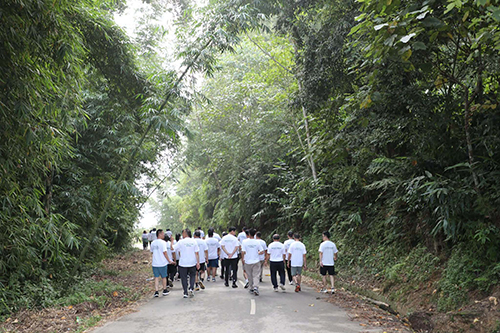
Forty-eight years ago, the world gathered at Alma-Ata and promised health for all. Bhutan took that promise to heart early, under the stewardship of our compassionate Druk Gyalpos, carrying basic care into some of the most difficult terrain on earth, from Laya and Lunana to Jomotshangkha and from the Doyas to the Merakpas. Now is our chance to renew it for a new generation, one with longer lives, varying illnesses and higher hopes.
The true measure of our success will not be found in what’s recorded, written or said. It will be found in our remote villages, on the night when the old man and others like him, finally tell someone about their pain, and someone is there to listen, and most importantly, provide timely essential care.
7tandin@gmail.com