The Bhutanese Leading the way.
Why reform is needed: A Cambridge International assessment found that the curriculum is broadly aligned with international standards up to Class VIII. At the higher secondary level, however, it identified repetition, limited progression and a breadth of content approximately half that of the equivalent Cambridge programme.
What the reform covers: The reform goes beyond textbooks. It addresses curriculum and syllabus development, teaching, assessment, learning materials, teacher professional development and the systems needed for effective implementation. Cambridge is helping benchmark the national school curriculum against international standards; it is not replacing it.
Where the reform stands: The revised curriculum is being piloted in Classes IX and XI before wider implementation. Although initially planned for three months, the pilot has continued through the academic year to allow a more meaningful assessment of classroom implementation and to identify areas requiring further refinement.
Early results: The 2026 midterm pass rates are the highest in five years: 91.3% in Class IX and 97.4% in Class XI. These results are encouraging and provide an early indication of progress during the pilot. Continued monitoring will help build a clearer understanding of how the reform is contribution to student learning over time.
Issues identified: Monitoring has highlighted several implementation challenges, including uneven access to learning materials, limited guidance on coursework and grading, concerns about lesson time, difficulties with continuous assessment in large classes, connectivity constraints and staffing challenges. These issues are being addressed as part of the ongoing pilot and refinement process.
Timeline of the reform: The agreement with Cambridge International was signed in February 2025. Curriculum framework alignment began in March 2025 and was completed by October 2025, following an eight-month exercise. In December 2025, work began on curating and revising school textbook across the curriculum, with priority given to Classes IX and XI in preparation for the 2026 pilot.
The overall reform is expected to take three to five years accordingly to Cambridge assessment. This reflects the breadth and interconnected nature of the work, which involves not only revising the curriculum content but also strengthening teaching and assessment practices, preparing teachers and establishing the systems needed for effective implementation. These changes require time for development, piloting, evaluation and refinement before wider implementation.
Why the reform is needed
The work to reform the national school curriculum is guided by the Royal Kasho on Education Reform. As part of this effort, Cambridge International was invited to assess the national school curriculum across ten Dzongkhags and benchmark it against international standards. The assessment found that the curriculum up to the Class VIII is broadly aligned with Cambridge standards. At the higher secondary level, however, it identified repetition across years, limited progression in learning, and a breadth of content that is approximately 50% of the equivalent Cambridge programme.
These findings point to the need for a curriculum with clearer progression from one class to the next, greater depth and breadth of learning, and a stronger foundation in knowledge, critical thinking, problem-solving and practical competencies.
The reform is therefore not simply about producing new textbooks. It seeks to strengthen what students learn, how they learn, how their learning is assessed, and how teachers are prepared to support them. Its scope includes curriculum and syllabus development, teaching approaches, assessment and examinations, learning materials, teacher professional development, pre-service teacher education, and the systems required for effective implementation.
Cambridge’s role is to help benchmark the national curriculum against international standards, not to replace it with a foreign curriculum. Bhutan’s national identity, values, culture, history, languages and development priorities remain central to the reform.
Scope and implementation of the reform
The reform is being implemented in phases, with selected components piloted in schools before wider implementation. This allows the Ministry to assess how the revised curriculum teaching approaches, assessment practices and learning materials work under actual classroom conditions, identity gaps and make necessary adjustments.
The approach recognises that curriculum reform involves changes to interconnected aspects of education, and that their effectiveness must be tested in practice. Feedback and lessons from implementation are therefore being used to refine the reform as it progresses, rather than assuming that every component will function as intended from the outset.
The Classes IX and XI pilot
Why Classes IX and XI were selected
Under the Cambridge-aligned programme structure, Classes IX and X constitute Key Stage 4, while Classes XI and XII constitute Key Stage 5. Each key stage follows a structured two-year programme leading to the respective national board examination at the end of Class X and XII.
This differs from the previous curriculum structure, in which each academic year had a separate syllabus and the annual examination determined progression to the next class. The revised approach places greater emphasis on continuity and progression across the two years, with learning in the first year building towards the intended outcomes of the second year rather than treating each academic year as a separate programme.
Purpose of the pilot
The pilot provides an opportunity to examine how the revised curriculum works in actual classrooms, gather feedback from teachers and students, and refine learning materials, teaching approaches and assessment practices. The pilot is limited to Classes IX and XI. All other classes continue to follow the existing curriculum, with no disruption to their teaching and learning. The current cohorts of Classes X and XII will sit their national Board Examinations based on the existing curriculum.
Students currently in Classes IX and XI are expected to progress to Classes X and XII, respectively, as planned. The transition arrangements are intended to maintain continuity in learning and ensure that students participating in the pilot are not placed at an unnecessary disadvantage.
Duration of the pilot
The pilot was initially planned as a three-month exercise to begin implementation and gather early feedback. As implementation progressed, it became clear that a longer period of classroom experience was needed to assess content coverage, teaching pace, student understanding, the suitability of learning materials, assessment practices and the support teachers require. The pilot has therefore continued through the academic year. This has provided more time to observe implementation under normal classroom condition, identify practical challenges and make informed adjustments before wider rollout.
Learning materials and classroom implementation
Printed textbooks remain important learning resources, particularly for regular classroom use, revision and independent study. The practical difficulties some teachers and students have faced in accessing complete printed materials must therefore be taken seriously.
During the pilot, schools received digital copies of the revised textbooks, along with chapter-wise printed materials, teacher-prepared notes and other resources. Where relevant, content from existing textbooks also continued to support teaching and learning. These interim arrangements allowed teachers and students to work with the revised curriculum while the textbooks were being tested, reviewed and refined before final printing. However, access to these materials and the ease of using them have varied across schools. Addressing these gaps remains an important implementation priority.
The development and delivery of revised textbooks involves more than writing manuscripts. It includes curriculum mapping, instructional design, authorship, review, revision, editing, design, validation, approval, printing and distribution, alongside preparation for classroom implementation. While some activities can proceed in parallel, others depend on the completion of earlier stages. Coordinating these processes is essential to ensure that the final materials are accurate, aligned with the revised curriculum and available for classroom use.
Classroom experience has also helped identify areas requiring clarification, errors in the materials and opportunities to improve content and usability. Feedback from teachers and students is being used to strengthen the final textbooks before wider printing and distribution. In this way, the pilot serves not only to test the revised curriculum and learning materials but also to identify improvements needed before extending the reform to other classes.
The initial implementation has provided useful feedback on teacher preparedness, the availability and usability of learning materials, professional development and logistical support. A period of adjustment is to be expected when curriculum content, teaching approaches, learning materials and assessment are changing at the same time. The immediate priority is to address the gaps identified, complete the review and printing of revised textbooks, and ensure that schools and teachers receive the support they need to implement the curriculum effectively.
2026 Midterm examination results – early findings from the pilot
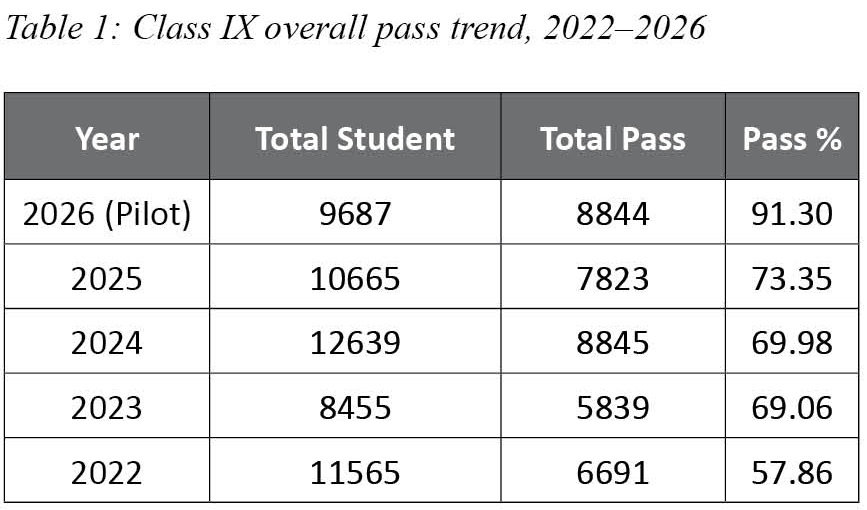
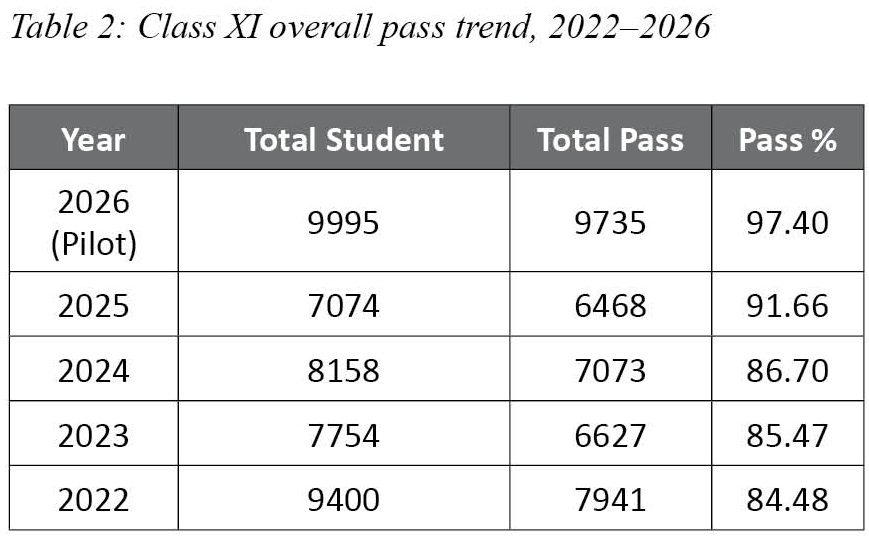
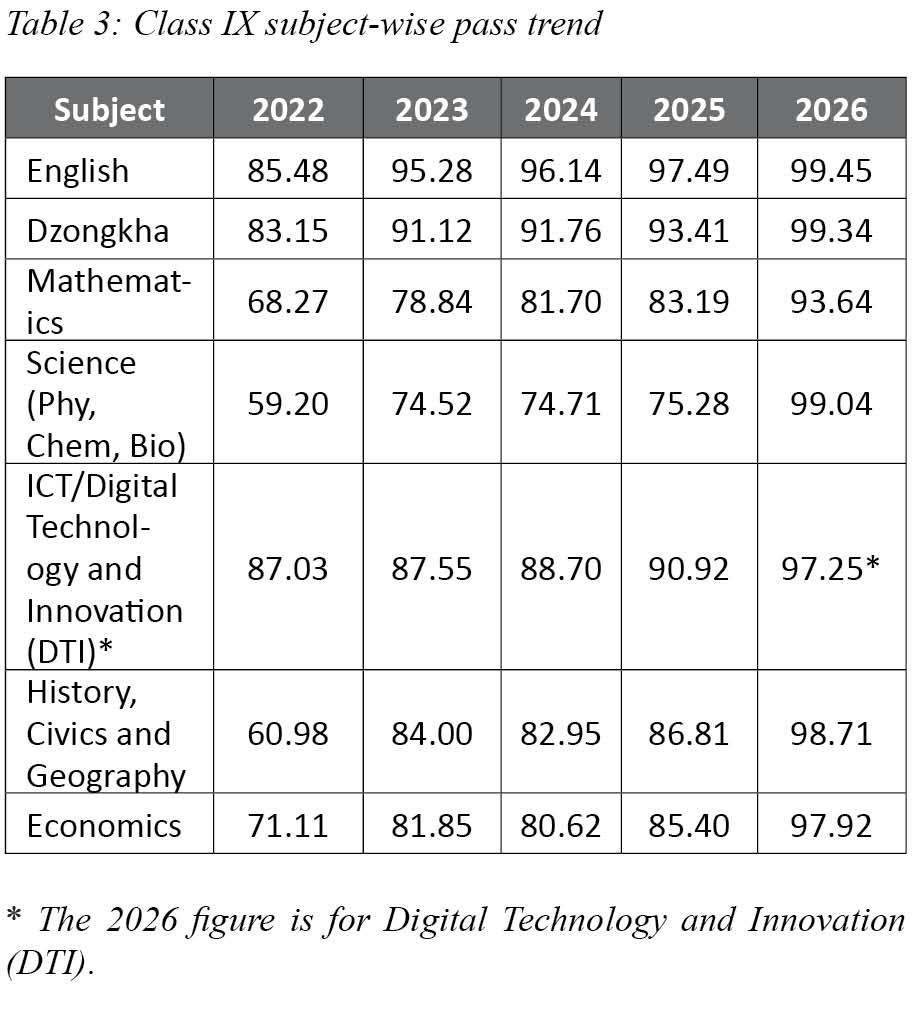
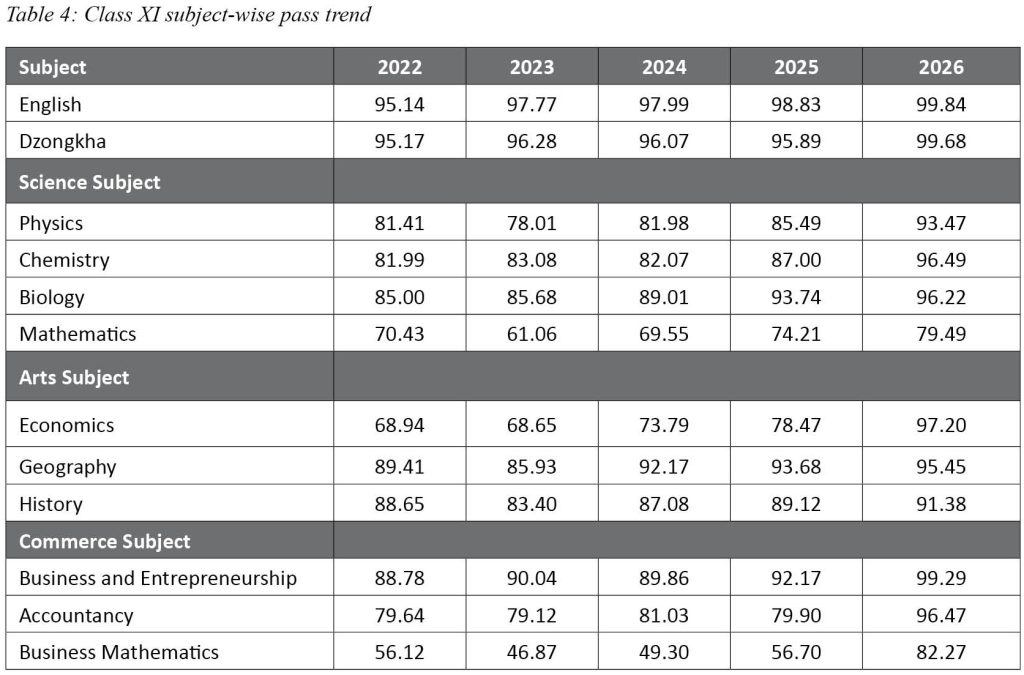
The pass rates of 91.3% in Class IX and 97.4% in Class XI are the highest recorded in the five-year period from 2022 to 2026. Subject-wise pass rates in 2026 are also the highest during this period.
These results provide an encouraging early indication of how students and teachers are engaging with the revised curriculum. Considered alongside classroom observations, teacher and student feedback and continued monitoring of learning outcomes, they will provide a more complete understanding of how the reform is contributing to student learning.
Several developments during the pilot phase may have contributed to these results.
Teacher preparation and professional development: Teacher orientation on outcome-based instruction, learner-centred pedagogy and constructive assessment, alongside an immersion programme involving over 4,000 teachers in Cambridge-aligned institutions in India over the past two years, has helped strengthen teaching and assessment practices. Curriculum reform cannot succeed through revised content alone. Teachers need sustained support to translate the intended curriculum into meaningful learning experiences. Professional development is therefore continuing alongside implementation, recognising that teacher confidence and competency develop through classroom practice, mentoring, feedback and sustained support.
Clearer assessment expectations: The publication of assessment syllabuses by the Bhutan Council for School Examinations and Assessment (BCSEA) may have provided teachers with greater clarity on assessment objectives, expected competencies and the scope of assessment. This could have helped teachers align classroom instruction and student preparation more closely with assessment expectations.
Continuity of teaching and learning: From the beginning of the pilot, schools continued teaching through digital textbook copies, chapter-wise printed materials, teacher-prepared notes and other available resources from the beginning of the pilot. Where appropriate, existing textbooks also continued to support teaching and learning. These arrangements helped sustain classroom instruction while the revised textbooks underwent review and refinement.
Revised assessment approaches: The revised midterm assessments placed greater emphasis on conceptual understanding and the application of knowledge, in line with the intended direction of the curriculum. Greater alignment between teaching and assessment can help students explain their reasoning, analyse concepts and apply knowledge in different contexts. It can also encourage teachers to look beyond the textbook and focus more closely on the learning outcomes set out in the syllabus.
Learning beyond the textbook: Textbooks provide essential content and structure, but learning also depends on the quality of teaching, the questions students are encouraged to explore, their opportunities to apply knowledge, and how their understanding is assessed. Feedback gathered during the pilot suggests that students are responding positively to inquiry-based approaches that encourage analysis, critical thinking and problem-solving rather than relying predominantly on memorisation. Students have identified clear teaching as an important source of support and described a shift in the role of teachers towards facilitating learning, with students taking greater responsibility for finding information rather than relying entirely on the teacher. Their feedback also suggests that inquiry-based approaches are stimulating curiosity and helping them better understand themselves and the world around them. These observations reinforce the importance of effective teaching and purposeful learning experiences alongside access to appropriate learning materials. They do not diminish the importance of printed textbooks – rather, they recognise that learning outcomes depend on how resources are used within the wider process of teaching and learning.
Taken together, these factors offer plausible explanations for the encouraging results, but do not establish the contribution of any individual intervention or prove a causal relationship. Continued monitoring and evaluation will be essential to understand what is driving the results, identify areas requiring further support and determine whether the improvements can be sustained across schools over time. The pilot should therefore be viewed as an ongoing process of implementation, learning and refinement, rather than as a final judgment on the success or failure of the reform.
Monitoring, evaluation and learning
Cambridge conducts periodic monitoring and evaluation visits as part of the implementation process. Visits conducted in March–April, July–August and October 2026 have provided feedback on teacher readiness, classroom practices, access to learning materials and assessment.
The purpose is to identify what is working well and what requires further attention while the pilot is underway. This enables timely, evidence-based adjustments rather than premature conclusions about long-term outcomes or impact.
Classroom observations and teacher feedback have highlighted efforts to adapt to revised teaching and assessment approaches. Observations also indicated student engagement in learning activities, while feedback suggests that students are beginning to develop greater independence in learning and confidence in using digital resources. Teachers have found that clearly stated learning objectives provide useful guidance for lesson planning and help them focus on the intended learning outcomes. These findings are encouraging, although further monitoring is needed to establish the extent to which such practices are improving learning outcomes.
The visits have also identified areas requiring further support, including access to printed textbooks; clearer guidance on coursework and grading; concerns about lesson time and curriculum coverage; access to digital learning resources; and the challenges of conducting continuous assessment in classrooms with high student–teacher ratios.
Other issues, including connectivity constraints, staffing and class size, require continued attention and, in some cases, wider operational and resource-related responses.
The value of this monitoring process lies in its ability in identifying issues while implementation is ongoing. Its findings provide a basis for refining guidance, strengthening teacher support, improving learning materials and making necessary adjustments as the reform progresses. The purpose is not to suggest that every aspect of implementation is working as intended, but to identify gaps, learn from experience and respond to emerging needs.
The way forward
Public scrutiny, independent assessments and constructive criticism are essential to improving public education. Textbook availability, teacher readiness, equitable access to learning materials and the practical difficulties faced by schools deserve serious attention. These concerns must be acknowledged and addressed, not dismissed.
The immediate priorities are to:
- address the gaps identified through the pilot and monitoring visits;
- complete the review and printing of the revised textbooks;
- ensure that schools and teachers receive the support they need, including continued professional development; and
- strengthen ongoing monitoring and evaluation to understand what is contributing to the results, identify areas for improvements and determine whether gains in learning are sustained.
The foremost concern remains the learning, well-being and academic progression of every student. This reform is being undertaken for the benefit of our children and the nation as a whole. Its purpose is to build a strong, relevant and future-ready education system that equips every Bhutanese child with the knowledge, skills and values needed to contribute meaningfully to society and the country’s future.
The Royal Kasho on Education Reform provides the vision and direction. The responsibility now is to translate that vision into better classrooms, stronger teaching and improved learning outcomes. This will require sustained commitment, honest assessment, continuous improvement and the collective resolve to carry this long-term national reform through its intended outcome; a stronger education system for a stronger Bhutan.
By Ministry of Education and Skills Development