The Bhutanese Leading the way.
LG leaders cite alleged administrative, financial and governance irregularities
The fact-finding is underway following a petition by local government leaders of Zhemgang seeking the transfer of the Dzongda and an independent inquiry into what they allege are administrative, financial, procurement, technical and governance irregularities in the dzongkhag.
The five-member fact-finding team from DLGDM, Prime Minister’s Office and Finance recently visited Zhemgang, and its findings are awaited.
The allegations have triggered differing views among the Dzongkhag people, with some supporting the Dzongda’s work while others have raised concerns similar to those outlined in the petition.
The petition submitted on 10th August, 2026, sought the immediate transfer of the Dzongda and an independent inquiry into what they described as recurring administrative, financial, procurement, technical and governance irregularities in the dzongkhag.
It alleged that these have severely disrupted the working relationship between the Dzongkhag Administration and elected LG leaders, compromising public service delivery and undermining the spirit of decentralization.
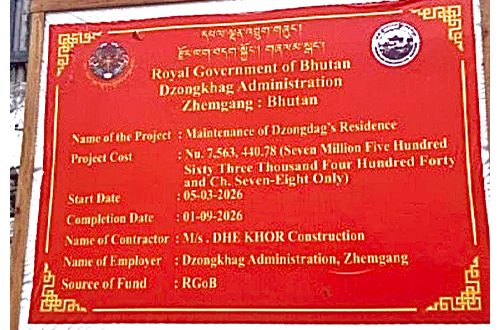
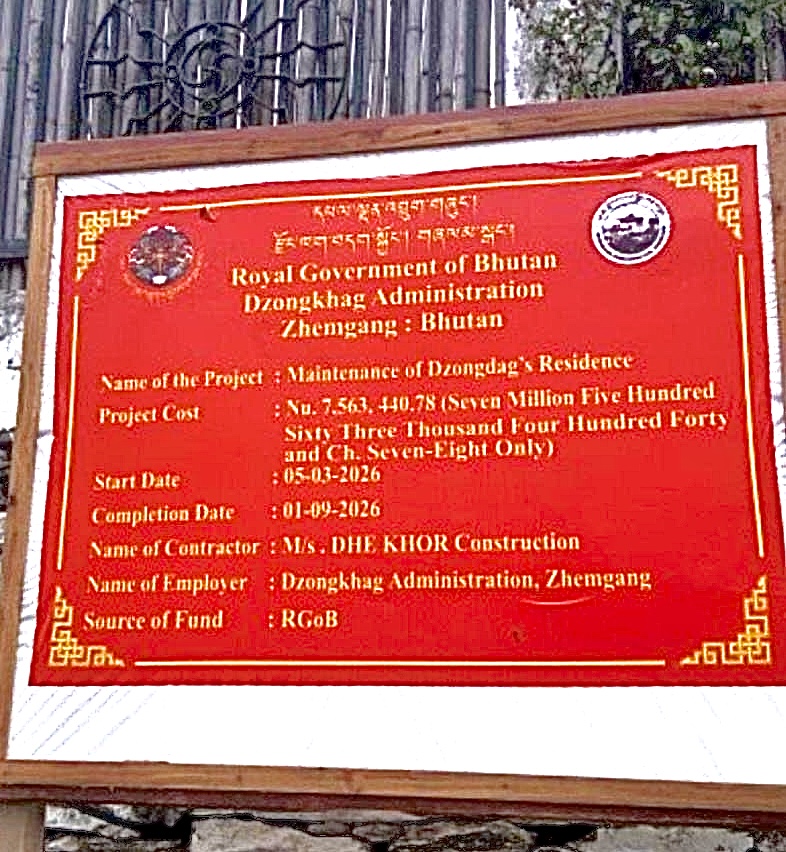
One of the major issues raised was the reconstruction of the Dzongda’s residence.
The LG leaders claimed that during the 7th Dzongkhag Tshogdu (DT), they had endorsed the work only as renovation and maintenance, but the scope was subsequently changed to new construction by the Dzongkhag Administration, violating both the DT resolution and the budget approved by the Ministry of Finance (MoF).
They alleged that the reconstruction continued despite a MoF notification directing the immediate suspension of the unauthorised reconstruction.
The petitioners further alleged that when the Ministry later sought ex-post facto endorsement of the revised scope from the DT, the matter was not included in the DT agenda. They also alleged that funds were reallocated without DT approval and that the DT Thrizin was asked to sign the budget reappropriation but declined.
The LG leaders also questioned what they described as double standards in the enforcement of regulations, citing the cases of two private residents who they said were fined Nu 200,000 for construction-related regulatory non-compliance while alleging that the Dzongda’s residence reconstruction proceeded unauthorised despite clear administrative warnings.
Beyond the residence issue, the petition alleged that the DT has repeatedly been compromised, with resolutions passed by the DT routinely ignored or unilaterally altered during implementation without consultation or seeking necessary approval from the DT. The petition said that this has eroded institutional trust and accountability.
The petition also raised concerns over mismanagement and under-utilisation of funds for major capital projects funded by the Royal Government and the Government of India.
The petition claimed that blacktopping works on the Boewa-Trisa and Wombogang-Tshokiling roads remained incomplete after two years despite funds being released during the 2024-25 and 2025-26 financial years.
They also alleged that the Nu 54 million Duemang Tshachu Amenities Project, budgeted for 2025-26, remained unawarded and unspent.
The petition further cited an alleged lack of technical support for the Tsheldang Zampa Farm Bridge and claimed that the Dzongda had not conducted supervisory site visits during the execution of key local projects.
Concerns were also raised over the resource misallocation and imprudent investment of the Berti Ecolodge.
The petition alleged that the destruction of the lodge’s swimming pool during the monsoon raised questions about the site’s suitability and the technical assessment of the investment. They also claimed that Dzongkhag-owned heavy machinery and technical personnel, including an excavator and site engineer, had repeatedly been prioritised for the site, depriving Gewog-level public works of essential equipment and oversight.
The petitioners further alleged that the financial burden for DT proceedings and Dzongkhag-level coordination meetings had been shifted from the Dzongkhag Administration to Gewog administrations. They claimed that requiring Gewogs to meet travel and daily allowance expenses for DT members from their operational budgets was contrary to financial norms and reduced funds available for local development activities.
Procurement during the Bhutan Bird Festival in Tingtibi in 2024 was another concern raised in the petition. The LG leaders alleged that an earlier agreement to use eco-friendly and locally sourced materials was bypassed and that private suppliers, including Druk Event Tents, were hired on the Dzongda’s direction, resulting in what they described as unnecessary public expenditure.
They also alleged that elected LG leaders and the DT Chairperson were excluded from some post-event exposure visits, including the Hornbill Festival in Nagaland, as well as official functions such as a dinner with the RCSC Chairperson. Instead, priority was given to administrative staff. The petition further alleged that local media personnel who reported on procurement concerns were subjected to verbal abuse by the Dzongda.
On human resource management, the petition alleged that a qualified Principal Chief Engineer seeking transfer to Zhemgang was not appointed, while an Officiating District Engineer who they claimed was a close relative of the Dzongda was retained and appointed instead. They alleged that this raised concerns over conflict of interest and engineering oversight in the dzongkhag.
The petition also cited requests from Gewogs for technical support that had not been addressed. These included an example of a request from Shingkhar Gewog for replacement of an engineer over alleged performance concerns and a request for urgent land survey support in Buli Bacho following court verdicts.
The petition described the issues as more than isolated administrative disagreements and alleged that they reflected a wider breakdown in institutional governance, operational transparency, and financial integrity within Zhemgang Dzongkhag. They claimed that unilateral decision-making, alleged non-compliance with MoF regulations, disregard for DT resolutions and repeated exclusion of elected leaders had affected institutional harmony and public service delivery.
The petition sought immediate transfer of the Dzongda and called for an independent inquiry and Royal Audit Authority review into the alleged financial non-compliance, budget reappropriation, procurement irregularities and delays in project implementation.
However, views among people interviewed by The Bhutanese were mixed.
Some residents spoke positively about the Dzongda’s work and said they had not experienced the administrative problems alleged by the LG leaders, while others raised concerns about the way decisions were being made and implemented.
A businessman from Tingtibi, Zhemgang, who has lived in the area for more than 35 years, said that based on his observations, the former and current Dzongdas have brought many developmental activities to the area.
He said these included widening roads leading to the Dzong and developing recreational areas.
He also said the annual Bird Festival in Tingtibi has witnessed significant improvements too.
Rather than appreciating those who are doing well and bringing development to the dzongkhag, he said, people were trying to drive such leaders out.
He added that he had never personally interacted with the Dzongda, and that his views were based on the developmental activities he had witnessed and plans he had heard about.
However, he said he was not much aware of the work carried out by the Dzongda in other Gewogs, but was more than satisfied with the developments in his own Gewog.
Meanwhile, residents who requested anonymity shared both positive and negative views about the Dzongda.
A resident of Trong Gewog said the Dzongda had been helpful, particularly by providing constant support to the community eco-lodge.
The resident said Berti Ecolodge had benefited the community by generating employment opportunities for young people and opening the community to visitors from outside.
The resident also said the Dzongkhag Administration under the Dzongda had prioritised road improvement works in the community despite limited Gewog budgets.
Regarding the challenges faced by the eco-lodge during the monsoon, including flooding of the swimming pool, the resident said the support provided by the Dzongkhag could be understood as a result of the lodge being prioritised because it had become a popular destination for both domestic and international tourists visiting Zhemgang and generated revenue for the community.
However, another resident who requested anonymity said the main issue in the dzongkhag was what the person described as the Dzongda’s tendency to make decisions independently without consulting the Local Government or the Dzongkhag Tshogdu.
The resident said that during the termination of a road contract, the Dzongda had claimed that local government officials had been consulted before the termination. However, the resident said no such consultation had taken place and that the decision had been made solely by the Dzongda.
The resident also claimed that the contractor still had more than five months remaining on the contract period, which the resident said had been ignored in the decision.
The resident also supported the petition’s allegation regarding a potential conflict of interest in the assignment of an engineer and the awarding of contracts to people known to the Dzongda.
Further, the resident said that after the current Dzongda joined the dzongkhag, he insisted on discontinuing the long-followed practice of having all Dzongkhag, DT and LG officials attend the three Tsechu events together.
The resident said officials traditionally gathered as early as 3am as part of the practice.
The resident claimed that after the Dzongda divided officials into groups to attend on different days, an unusual incident that was perceived as a sign that the local deity was angered was witnessed.
The resident said officials subsequently held a meeting and agreed by majority to restore the old tradition, but the Dzongda later reverted to his original plan of dividing attendance among different days.
Another resident who supported the Dzongda’s transfer said some of the development activities being carried out within the Dzongkhag premises, which people appreciate, are being undertaken every year and are unnecessary.
The resident said this was depleting funds allocated to the dzongkhag without addressing priority areas.
The resident also alleged that the initially approved budget of Nu 5 million for the Dzongda’s residence maintenance was increased to Nu 7.5 million without the knowledge of the Dzongkhag Tshogdu.
The resident claimed that the additional Nu 2.5 million was redirected by the Dzongda from funds allocated for another project and toward reconstruction of the residence, although the work had originally been approved as maintenance.
The resident also said the project signboard at the site clearly reflected the work as maintenance rather than reconstruction and so the budget of 7.5 million was invalid.
Regarding Berti Ecolodge, the resident said deploying a Dzongkhag engineer and excavator every monsoon was not a sustainable approach. If the eco-lodge was to be prioritised, the resident said, a long-term solution should be put in place rather than deploying manpower and equipment every year.
Other residents said the main issue was not that the Dzongda was incapable as a whole, but rather what they described as an individual approach to decision-making. They said working with what they perceived as an individual agenda was not working well and would not work well for the overall wellbeing of the dzongkhag.
Meanwhile, the Dzongda refused to make any comments on the allegations and said that the ministry’s response would suffice.
The Home Ministry said the report and findings from the investigation team have not yet been presented and so, the final decisions are awaited.