The Bhutanese Leading the way.
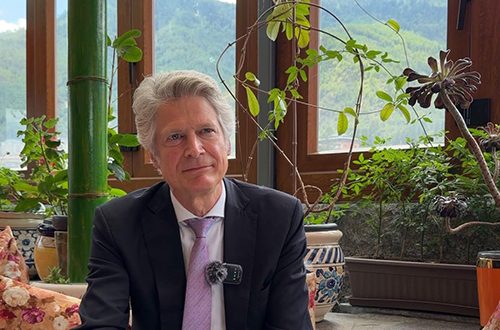
TB: What are your main priorities for strengthening Germany-Bhutan relations during your tenure?
Ambassador Wieck: Bhutan and Germany established diplomatic relations six years ago and we are only at the beginning of the relationship and have to tap the full potential of it. Before we had formal diplomatic relations, we had relations with civil society and non-governmental organizations and trade and investment relations. There’s a lot of potential and we have a lot of commonalities. Both of our countries are democracies and are attached to the rules-based international order. We are very grateful to Bhutan for its principled approach to what is happening in the UN.
We have huge potential for the protection of the environment and climate and that is a big commonality. Both countries have huge areas of forests and preserving nature is very important because the wellbeing of our people depends on a balanced ecosystem that is around us.
Bhutan and Germany established diplomatic relations six years ago, and we must tap the full potential of our shared democratic values and rules-based international outlook. We have huge potential for environmental and climate cooperation; preserving nature is vital because human wellbeing depends on a balanced ecosystem.
TB: What are your initial impressions of Gelephu Mindfulness City and do you see opportunities for German companies or institutions to engage with GMC?
Ambassador: It is a very strategic project and is in the making and I have heard it is promising and the focus of the project—clean energy, technology, education, training and other topics—they fit more or less well with what we offer from the German ecosystem and what is in our portfolio. From what I have to say, Germany has a private-sector-driven economy, so it’s a question of whether companies decide to invest in it or not, but from the Embassy side, we will be ready to assist in matchmaking and bringing companies to the country to make their own assessments of the project and decide according to their business cases, but I’m sure that the Gelephu Mindfulness City will keep us busy in the years ahead.
TB: Bhutan is moving towards a more private-sector and investment-driven economy. How can Germany support this transition beyond traditional development assistance? Bhutan wants to attract European investment, but its small market and distance from Europe are obvious challenges. What would make a German company seriously consider investing in Bhutan?
Ambassador: Bhutan has considerable comparative advantages. As a small country, you are much more agile in shaping the environment for foreign investments. You are a very stable country domestically, which is always important for businesses, and you have in your ecosystem and habitat flowers, trees, habitats that we do not have. For example, there is already a company which produces essential oil for therapy purposes and they are using what is grown in Bhutan which is not grown in Germany and have set up subsidiary companies and we are visiting them tomorrow and I can be much more eloquent about their experience. But my impression is that they are very satisfied with the overall environment and the ease of doing business and this is an example that must be followed by other companies. For us, it is very important that economic development is in sync and in harmony with the preservation of nature and since Bhutan has set high standards, which resonates with our ears, because we also want this harmony to be ensured and I think we will have very good matches for more investments from German companies in Bhutan.
TB: Germany is supporting Bhutan through the Living Landscapes and White-bellied Heron projects. What other areas of environmental and climate cooperation do you see developing?
Ambassador: We are very satisfied with these two projects. One is about the conservation of the White-bellied Heron and restoration of about 50 hectares of habitats to give this species the chance to survive and the other one is about solidarity between people living upstream and downstream in the same river, helping each other and avoiding people downstream from suffering from what the upstream people are doing. Both projects are a success and are an encouragement to do more in the framework of our international climate initiative and the next project we have in mind is set to kickstart soon, which is on solarization.
You have hydropower currently, which plays a very important role. We are ready to partner with UNDP and EU to assist Bhutan to set up an ecosystem for solar energy which is market-based. So it’s not the state and the government which sets solar power stations that would be really expensive, but we have a system that we have in mind which we adopt in Germany that will be private enterprise companies who will have their own solar roofs and solar energy generation, as houses in Germany have solar energy. When they have more than they need, they feed it into the overall system so that other people can benefit from it. It’s much more cost-effective and decentralized and we want to share this experience in Bhutan.
TB: There are Bhutanese students and professionals interested in Germany. Can Germany expand opportunities for Bhutanese students, scholarships, vocational training and research?
Ambassador: In the past, around 60 scholars from Bhutan have come to Germany to study and do research and when they come back, they can feed a lot of expertise and knowledge they have gained in Germany and we are ready to pursue that path in the future and these are scholars that have had scholarships from the German Academic Services. On top of that, we also invite young Bhutanese to study in Germany at their own expense. Tuition fees are much less compared to other countries and we are happy to host these young students who can gain a lot of important knowledge and bring that back into the society and economy of Bhutan and I very much recommend young students who are interested in doing that to connect with the DRRD and DAAD, the German Academic Exchange Service, who can give them a lot of valuable advice. We are aware that there are occasional education consultancies that have no official status and make money out of the interests of young students who wish to study abroad and some of them are not very conducive. Be aware of these educational consultants and recommend focusing on DAAD that does not only award scholarships but also provides very important pieces of advice for those who are interested.
TB: What opportunities do you see for German investment and technology in Bhutan, particularly in areas such as renewable energy, technology and sustainable development?
Ambassador: A lot of potential for investment because these are key sectors that our economy and our ecosystem can offer. We were much earlier than other countries in taking strategic decisions towards renewable energy and we are heading for a climate-neutral economy in the years to come. Bhutan is carbon-negative and you are a role model in that regard but since you are interested in eco-friendly energy generation, I think German companies can offer a lot in that respect. But in the end, it’s always a question whether they can make a business case; whether it is sustainable for them financially and therefore, more structured questions are involved in making investments in that regard.
On the other hand, in the digital economy, Germany has leading companies, such as SAP, for example, which is very active in India and they might also very well fit into the economy of Bhutan. There are many companies that have a very specific input and added value in what you want to set up in Bhutan, be it in GMC or the overall development in Bhutan.
TB: Germany has considerable expertise in vocational education and skills development. Is this an area where you see greater cooperation with Bhutan?
Ambassador: In the first instance, I see potential for greater cooperation within your own ecosystem because what is the trick of vocational training? It is bringing together the private sector, the companies, enterprises and the educational training institutions. Because vocational training is, in fact, a combination of training in theory at universities and institutions and practical training in companies.
How does this match come together? And here in Germany, we have made the experience that our chambers of commerce and our network all over Germany have played a very crucial and beneficial role in bringing both sides together in order to have generations of young people. We have theoretical and practical skills. What we can do and what we have done is to consult you to build your own ecosystem on education and vocational training because we cannot replace your companies and your universities. In Bhutan, you have to join the efforts in order to give the younger generation the best possible education to make them fit for your economy and economic development.
TB: Germany is increasingly engaged in the Indo-Pacific and South Asia. Where does Bhutan fit into Germany’s broader regional outlook and reassessment?
Ambassador: We have adopted an Indo-Pacific strategy in 2020 and this strategy says that after several decades of a clear focus on China and our economy, we have created dependencies and supply chain monopolies on the Chinese side which are not healthy for our economy because once there is a disruption, we’ll have huge problems in continuing our production, so diversification is the order of the day and in this diversification, we have big players such as India, Vietnam, and Philippines where German companies are investing in. But we also have countries like Bhutan which have their own comparative advantages in terms of agility, stability and democracy. Therefore, Bhutan perfectly fits into this strategy and with the investment policy by the leadership of Bhutan, being open for foreign investments, this is certainly a dynamic which opens a lot of opportunities and we will encourage the German private sector to use this opportunity.
The other focus of the Indo-Pacific strategy is that we stand up for a rule-based international order, also in reaction to those who violate international rules-based order and we consider Bhutan as a very staunch partner in defending the rules-based international order. During the war of aggression against Ukraine, it was remarkable and well-received and remarked by the Federal Government in Germany and adds a solid basis on which we develop our bilateral relations.
TB: Bhutan is highly vulnerable to climate change despite having very low emissions. Does Germany believe Bhutan should have greater access to international climate finance, and can Germany help make that happen?
Ambassador: We definitely believe in international climate finance and we are one of the three biggest donors for these international mechanisms. In our national framework we also implement these financial schemes, our international climate initiative IKI, Bhutan plays an important role. The accomplished Living Landscapes and White-bellied Heron conservation projects were already Germany committed investments of more than 10 million euros and we now have the pipeline extended.The programs we have already conducted are solarization and market-based solar energy strategy for Bhutan. We will invest even more than we have in previous programs.
We stand ready and committed to support and assist Bhutan in its efforts to mitigate the consequences of climate change and also to protect climate resilience and we all know it cannot be the solution as such, it has to be an international, global effort to protect our climate and here again Germany stands ready to take and pay its share in climate finance.
TB: If you return to Bhutan five years from now, what would you like to see that would tell you Germany-Bhutan relations have genuinely moved to another level?
Ambassador: What I can say is that it’s at an early stage and we have a very sound foundation. Yesterday I had the honour to celebrate the 40th anniversary of the German-Bhutan Himalaya Society and it was very heartwarming to see that Germans have been engaged in this relationship for decades despite having no diplomatic relations. So what I want to do is to build on this good foundation and tap the potential of two countries, who in their mentality, are so close to each other. Bhutan has a huge attraction for Germany because we see that the things we do exactly in Germany are also being done here. It’s like a reflection. In Bhutan you have a special attitude towards preservation of nature and forest. A lot of potential where we can act together. Organic food is a big thing in Germany and there are splendid possibilities to go in that direction. So after five years, I want to see these seeds blossom and let’s see where we stand after five years.