The Bhutanese Leading the way.
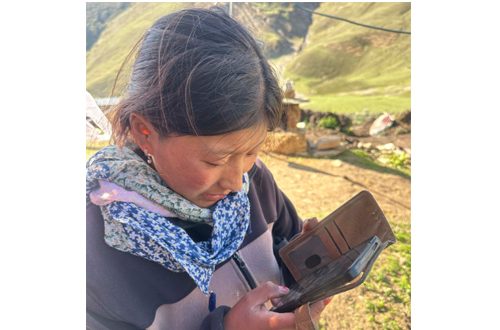
In the remote highlands of Nubri, when a Himalayan wolf preys on a livestock calf, 24-year-old Ugyen Lham no longer waits weeks to report it. With a quick tap on her phone using the NoteCam application, coordinates and time-stamped images of the incident are sent directly to the Paro Divisional Forest Office.
It is a small digital interaction, but it captures a nationwide shift detailed in WWF-Bhutan’s newly released Annual Report 2025–2026, Connected by Nature: People, Wildlife and Coexistence. Across the country, Bhutan is demonstrating that protecting endangered species and securing rural livelihoods are not competing goals, but two sides of the same coin.
“Bhutan continues to prove that safeguarding biodiversity and empowering local communities are shared goals, not competing ones,” says Chimi Rinzin, Country Director of WWF-Bhutan.
The past year has seen a convergence of ancestral stewardship, technologies such as artificial intelligence and environmental DNA (eDNA), and green financing mechanisms designed to protect the kingdom’s fragile ecosystems.
From reactive relief to proactive coexistence
At the heart of WWF-Bhutan’s strategic framework is the Conflict to Coexistence (C2C) strategy, piloted in gewogs such as Trong in Zhemgang and Nubri in Trongsa. Rather than relying solely on punitive laws or delayed compensation schemes, the approach tackles the root causes of friction between humans and wildlife.
In Zhemgang’s Trong gewog, a biodiversity hotspot with 93.89 percent forest cover, interventions went beyond basic fencing. Projects delivered clean drinking water tanks, revived drying lakes such as Manmatsho and Dabartsho, and installed multi-strand electric fencing using recycled plastic posts. For farmers who had abandoned fields due to wild boar and sambar encroachment, these measures have helped revive agriculture.
Similarly, in Nubri, women-led local networks have stepped up as frontline responders. Rather than viewing predators such as snow leopards with hostility, local herders express acceptance.
“We know we lose our yaks to wild animals, including snow leopards,” says Ap Rinchen, a local herder. “But because of them, we have also received support in the form of fencing and torches. We have never hated the snow leopard.”
High-tech conservation
Bhutan is increasingly pairing its traditional reverence for nature with conservation technology.
RiKhaNET and AI early warnings were launched under the Global Tiger Innovation Fund. The Realtime Integrated Knowledge on Habitat and Animals-Network (RiKhaNET) uses AI, real-time sensors and predictive analytics to map potential human-tiger conflicts before they occur.
eDNA mapping was introduced in 2025 as Bhutan inaugurated its first environmental DNA laboratory at the College of Natural Resources (CNR), in partnership with ETH Zurich. By analysing water and soil samples, scientists can inventory biodiversity and monitor ecosystem changes without invasive trapping.
Stronger border interdictions have helped combat regional wildlife trafficking through porous southern borders. The government deployed advanced X-ray scanning machines at key Integrated Check Posts (ICPs) in Samtse, Gelephu and Nganglam, supporting the newly permanent National Wildlife Crime Control Committee (NWCCC).
A nationwide musk deer survey completed across 17 districts deployed nearly 500 camera traps over 2,400 square kilometres, providing baseline data crucial for protecting the heavily poached species.
Green economy
Conservation in Bhutan is increasingly anchored in sustainable economic models. A landmark milestone this year was the Cabinet’s approval of the Nature-Based and Wildlife Tourism (NBWT) Concession Framework, opening curated, low-impact tourism corridors such as the Tergola Red Panda Trail in Haa and the Jomolhari Snow Leopard Heartland to directly benefit local communities.
Downstream water security is also receiving innovative backing. Under the Phuentsholing-Omchhu Payments for Ecosystem Services (PES) scheme, downstream municipal water users contribute an additional five percent of utility consumption to compensate upstream land stewards who protect the watershed.
Mindful citizenship
The spirit of collective ownership was displayed during Earth Hour 2026, hosted in the envisioned carbon-negative Gelephu Mindfulness City (GMC). More than 28,000 citizens contributed over 40,000 hours to nature-positive clean-ups, tree planting and sustainable living initiatives.