The Bhutanese Leading the way.
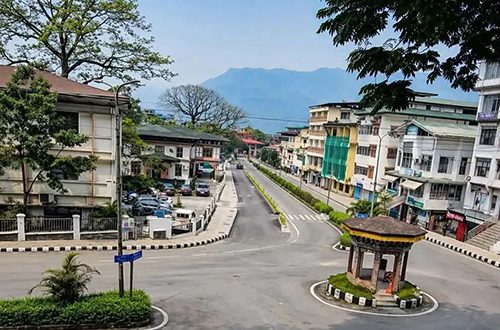
The Minister for Industry, Commerce and Employment, Namgyal Dorji, said the Government recognises the strategic importance of Bhutan’s border towns.
However, rather than applying one uniform economic package to all of them, the Government’s approach is to address the specific economic opportunities and constraints of each border town through targeted investments, infrastructure, trade facilitation, tourism and business development.
He said Phuentsholing is a good example. The Phuentsholing Township Enhancement Project, initiated under the Prime Minister’s Office, takes a coordinated approach to revitalising Bhutan’s principal commercial gateway by improving the town’s attractiveness for business, tourism, trade and investment, alongside better urban amenities and border facilitation. The town is already beginning to see renewed economic activity and confidence.
Samtse is also seeing significant economic expansion. Norbugang and Dhamdhum Industrial Parks are attracting industries and creating jobs. The proposed Banarhat–Samtse railway, the planned Export Processing Zone and improved road connectivity towards Haa will further strengthen Samtse as an industrial and trade hub. The town is already seeing growing demand for housing, commercial space, hotels and other services.
Gelephu, Sarpang and Lhamoizingkha now fall within the Gelephu Mindfulness City, which fundamentally changes their long-term economic prospects.
For Samdrup Jongkhar, the operationalisation of the Integrated Check Post and the opening of the entry and exit point for international tourists are already creating new opportunities. The Government also sees significant potential in tourism and the creative economy, particularly given its proximity to Assam.
A new movie theatre is expected to be completed by the end of this year, and the Department of Tourism is studying Samdrup Jongkhar Thromde’s proposal for a PPP-based local arts, crafts and cultural centre. Phuentsho Rabtenling Industrial Park is already contributing to economic activity, and the Ministry is also studying the feasibility of an additional industrial park nearby.
“At the national level, we are strengthening the infrastructure that makes our border towns competitive,” said Lyonpo.
The Pasakha and Nganglam Dry Ports are major investments in cargo handling, customs clearance, warehousing, storage and transshipment. Both are targeted to become fully operational by June 2027.
These are intended not simply as cargo facilities, but as economic hubs around which logistics, warehousing, value addition and other businesses can develop.
“We also recognise the competitive reality of being located next to much larger Indian markets.”
Lyonpo said Bhutanese border towns cannot compete simply by trying to offer everything more cheaply. He said they have to compete through efficiency, ease of doing business, better infrastructure and services, distinctive tourism and recreational offerings, and by becoming efficient gateways for trade and investment.
“So, while there is currently no single special tax or economic package exclusively for border towns, there is a clear and differentiated programme of investments and interventions already underway. Our objective is to make each border town economically viable by building on its particular comparative advantage rather than treating all border towns alike,” added Lyonpo.
MoF
Finance Minister Lekey Dorji said the Government recognises the economic challenges facing Bhutan’s traditional border towns, including Phuentsholing, Samdrup Jongkhar, Samtse and others.
“Their economic vitality is important not only for the communities that live there, but also for Bhutan’s broader economic resilience and connectivity with regional markets,” said Lyonpo Lekey.
“However, Bhutan should not enter a race that we cannot win. We cannot sustainably compete with much larger neighbouring markets simply on the basis of price. Differences in market size, economies of scale, supply chains and production costs make price-based competition neither realistic nor sustainable.”
“Lowering our standards or continually reducing taxes and other policy benchmarks simply to match prices across the border would risk creating a race to the bottom.”
Lyonpo said Bhutan instead needs to build an economic model around its own strengths and comparative advantages.
“His Majesty the King’s vision of a trust economy provides an important direction in this regard-an economy built on trust, integrity, quality, sustainability, good governance and the distinctive strengths of Bhutan.”
He said Bhutan’s border towns should therefore aspire to be places where people want to invest, do business, visit and live because they offer reliability, safety, quality, efficient services and distinctive Bhutanese experiences and products-not simply because they are cheaper.
He said this does not mean that the Government will ignore competitiveness or the concerns of businesses and consumers. Where Bhutan’s own policies, regulations, infrastructure or processes increase the cost or difficulty of doing business, these must be addressed. This includes improving border and customs processes, logistics and connectivity, commercial infrastructure, access to finance, business regulation and the ease of doing business.
The Government will also consider targeted and evidence-based incentives where these can generate sustainable investment, value addition and economic activity. However, blanket tax holidays or permanent concessions based solely on geographical location need to be assessed carefully against their fiscal cost and long-term effectiveness.
Similarly, tourism policy should seek to maximise sustainable economic value, rather than simply compete for visitor numbers through lower prices or lower standards.
Lyonpo said the longer-term objective should be to help each border town develop a distinct and sustainable economic proposition, drawing on its location, connectivity, tourism potential, trade opportunities, local production and other comparative advantages.
“Ultimately, revitalising our border towns cannot be achieved through government incentives alone. It will require the Government to provide the right enabling environment and infrastructure, while the private sector invests, innovates and takes a long-term view of the opportunities.”
Lyonpo said Bhutan should not try to win by becoming the cheapest. “We should build an economy that people trust, value and choose-and build strengths that endure well beyond the immediate competitive pressures at our borders.”