The Bhutanese Leading the way.
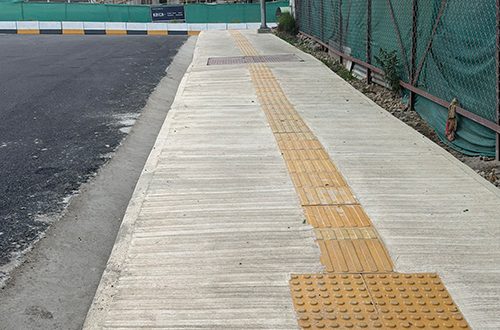
The lack of inclusive infrastructure in the capital city is a pressing concern for elderly citizens and persons with physical disabilities. While there have been efforts in maintaining footpaths and pavements for ease of passage, infrastructure in core areas, roads, and buildings lack inclusive design, making everyday life distressing for the elderly and persons with disabilities.
The Executive Director of the Disabled People’s Organization Bhutan (DPOB), Kinley Wangchuk, said that having an accessible design is not only for persons with physical disabilities. “We see a lot of elderly people and even children. It’s for everyone,” he pointed out.
Footpaths and sidewalks along particular areas in Norzin Lam, Doebum Lam, and in the Hong Kong market area still remain the same, with no extensions for people to walk comfortably and no breathing room for passing wheelchairs.
Some of them are also blocked with street light poles, often placed disturbingly within sidewalks. This makes it more difficult not only for people having difficulty but also for pedestrians.
“A person in a wheelchair can only imagine roaming Norzin Lam since most of it is only stairs, and without the help of three or four people then it becomes harder for them. This is why we are constantly advocating for universal design for accessibility,” said Kinley Wangchuk.
The presence of stairs also obstructs persons with mobility impairments to even use toilets. The public toilet located in the Clock Tower, the heart of the town, restricts wheelchair users from relieving themselves because of the stairs that are built between them.
On top of that, Kinley Wangchuk said that there is not a single priority parking space for persons with disabilities. These are a handful of observations that show the degree of accessibility in the capital city.
The lack of accessible infrastructure also means more risks for persons with visual and hearing impairments. A lack of tactile paving and unmonitored pedestrian crossings makes it difficult for people from all walks of life.
This calls for strategic government intervention in improving urban facilities and basic infrastructure to improve mobility, safety and accessibility for the collective population, not just the disabled and the elderly.
Thimphu Structure Plan: Specifics for an inclusive capital city
The Ministry of Infrastructure and Transport (MoIT) explains its plans in the Thimphu Structure Plan (TSP) 2023–2047 and its associated Design Code mandates a “Barrier-Free” urban environment by integrating universal design into the city’s “Good Growth” framework.
The MoIT said that the key benchmarks include standardized tactile paving for the visually impaired, kerb ramps with 1:12 gradients at all crossings, and level-entry accessible bus stops along a new low-emission transit spine. This would greatly ease movement and accessibility for visual and mobility-impaired people.
“Public buildings must now meet strict requirements for elevators and dual-handrail ramps to receive planning permits. These improvements are strategically concentrated along the North-South Corridor (Doebum Lam), the transformed Norzin Lam core, and the Wangchhu River Corridor, ensuring that essential services in neighborhood hubs like Babesa and Taba are reachable and inclusive for all residents,” said an official.
The ministry further points out that the transformation of Doebum Lam and Norzin Lam prioritizes a seamless, barrier-free urban experience by integrating universal design directly into the streetscape.
On Doebum Lam, the focus is on a high-capacity transit spine featuring level-entry boarding at bus stops to align with low-floor electric buses, alongside continuous directional tactile paving and mid-block pedestrian islands for safer, staged crossings.
Meanwhile, Norzin Lam is being reimagined as a pedestrian-first core with flush surfaces that eliminate traditional kerb heights, allowing wheelchair users and the elderly to move without obstruction.
This is supported by “Street Living” zones with ergonomic seating every 50 to 100 meters and enhanced wayfinding through high-contrast signage. For elderly citizens who find difficulty in walking long distances, they would be able to rest every 50-100 meters.
According to the MoIT, under the new Design Code, all buildings along these corridors must replace steep steps with integrated ramps and provide elevator access, ensuring that inclusivity extends from the sidewalk into every public and commercial space.
The TSP utilizes a mainstreaming strategy where the Thimphu Design Code makes these features a mandatory baseline for all capital expenditure, instead of separating it as an additional “inclusive” budget.
While traditional road maintenance focuses on recurrent utility costs, any “new” or “upgraded” infrastructure, such as the transformation of Doebum Lam, integrates universal design directly into its core construction budget, typically adding a marginal 1percent to 3 percent to total project costs.
Furthermore, high-priority zones like the Wangchhu River Corridor utilize specific resilience grants (e.g., from the GEF and UNDP) where 100 percent of the public realm budget is earmarked for accessible pedestrian spines.
Oversight body
“By prioritizing “Good Growth” in neighborhood hubs like Babesa and Taba, the plan effectively reallocates 15 percent to 20 percent of total land-use funding toward inclusive social infrastructure and barrier-free pocket parks, ensuring that accessibility is treated as a non-negotiable utility rather than an optional luxury,” said an official.
The designated oversight bodies are Thimphu Thromde and the MoIT, who are responsible for implementation, monitoring, design integration and quality assurance.
As for the compliance and auditing bodies, the MoIT said, “As per the civil service reform, Bhutan Construction and Transport Authority (BCTA) conducts periodic construction and planning compliance audits on the implementing agencies and shares observations.”
“As the central agency to lead the urban transformation, the MoIT also carries out a development review of the project implemented by the Thromdes to ensure alignment with the approved plans and designs. In addition, the Royal Audit Authority (RAA) conducts performance audits of the project to verify that it was executed in strict accordance with the approved designs and drawings,” the MoIT added.
When to expect the results?
As per the MoIT, the public can expect improved, accessible features in projects such as Changyul Park, Olakha Park and other ecological parks once designs are finalised.
“All major projects are in the design and preparatory phases and once these are finalized, the primary public sites are expected to be accessible by 2028,” said the MoIT.
“The designs for Norzin Lam street and mobility improvement project are being initiated and slated to be completed in 6 months followed by actual implementation. People can actually experience the feature in 12 months from now,” the MoIT added.