The Bhutanese Leading the way.
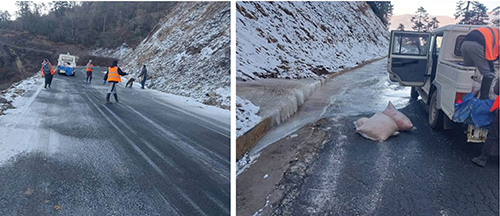
Member of Parliament (MP) Kinzang Wangchuk from Drametse-Ngatshang constituency in Mongar has questioned the recurring pavement failures on Bhutan’s Primary National Highways (PNH) at high-altitude passes, despite repeated expenditure on repairs and resurfacing works.
During the ongoing National Assembly’s session on 9th June 2026, the MP sought written clarification from the Ministry of Infrastructure and Transport (MoIT) regarding recurring failures at Dochula Pass, Pelela, Yotongla and Thrumshingla.
The MP noted that substantial public resources are spent annually on repairing and resurfacing these highway sections, yet similar failures continue to reappear at the same locations.
He suggested that the issue may extend beyond routine maintenance and could be linked to pavement design standards and their suitability for harsh mountain environments.
He pointed out that unlike highways in lower elevations, mountain passes are exposed to prolonged low temperatures, snow cover, freeze-thaw cycles, high moisture content and difficult drainage conditions.
He also noted that international experience has shown that such environments often require specialized pavement designs, including frost protection measures and enhanced drainage systems.
The MP asked whether the ministry had undertaken any technical assessment to determine if recurring failures were caused by limitations in existing pavement design standards.
He also sought clarification on whether Bhutan’s national highway design standards contain separate pavement specifications for frost-prone and snow-bound areas or whether the same standards are applied across all climatic zones.
In addition, he asked whether the ministry intended to review and adopt climate-specific pavement standards and undertake life-cycle cost analysis to assess whether more durable solutions would provide better value for public investment.
In its response, the MoIT acknowledged that high-altitude passes such as Dochula, Pelela, Yotongla and Thrumshingla experience climatic and environmental conditions that are significantly different from lower-elevation highways.
It stated that prolonged sub-zero temperatures, freeze-thaw cycles, snow cover and challenging drainage conditions place stresses on road infrastructure that standard designs may not fully address.
The ministry further acknowledged that recurring failures at these locations warrant deeper technical investigation beyond routine maintenance measures.
According to the response, existing standards were largely adopted from design manuals that do not fully account for the specific geotechnical and climatic conditions found at high-altitude passes.
The ministry stated that the Department of Surface Transport has initiated a structured research study focusing on drainage infrastructure along the Dungdungneysa-Pelela section of the Wangdue-Chuserboo Primary National Highway.
The study is examining the performance of concrete drains under high-altitude cold-region conditions and evaluating the suitability of different materials and admixtures.
Trial construction stretches have been established at Pelela and Dungdungneysa, covering both sun-facing and non-sun-facing aspects, with findings from the pilot stretches being systematically monitored.
According to the ministry, the findings from the study will contribute to a comprehensive roadmap for upgraded design standards.
It added that similar structured assessments of pavement design and performance at high-altitude passes are being considered, with the objective of developing climate-zone-specific technical specifications suited to Bhutan’s mountain environments.
The MoIT also acknowledged that the current national highway design standards do not sufficiently differentiate between climatic zones, particularly for frost-prone and snow-bound areas.
It stated that ongoing and planned research initiatives aim to address this gap and that findings from field studies will help inform revisions to technical specifications for future construction and rehabilitation works.
The ministry said it remains committed to ensuring that public investments in the national highway network produce durable outcomes and emphasized the need to move beyond annual maintenance cycles toward a longer-term investment perspective.
It stated that efforts are underway to shift from reactive maintenance approaches to research-informed and preventive solutions.