The Bhutanese Leading the way.
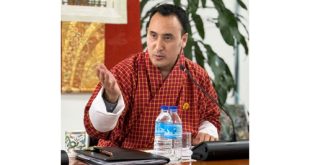
The Health Minister Lyonpo Tandin Wangchuk, in reference to a recent notification issued by the Bhutan Food and Drug Authority (BFDA), reiterated that smoking is permitted only in designated smoking areas, and that violations will be subject to fines. However, similar provisions have been in place for years, with enforcement historically constrained by limited manpower and monitoring challenges.
When asked what has changed this time and what concrete measures are being implemented to ensure effective enforcement, the Health Minister said that past difficulties were not due to a lack of will, but rather the absence of necessary enforcement conditions.
According to Lyonpo Tandin, the issue stems from two key factors. “First, there is a structural legislative gap. The Tobacco Control Act of 2010 was prohibition-based, meaning public smoking was naturally limited due to restricted access to tobacco,” he said. He explained that the 2021 amendment legalized the sale and distribution of tobacco products without corresponding updates to enforcement provisions. “As a result, public smoking has increased, while enforcement mechanisms remain tied to a prohibition-era framework,” he added.
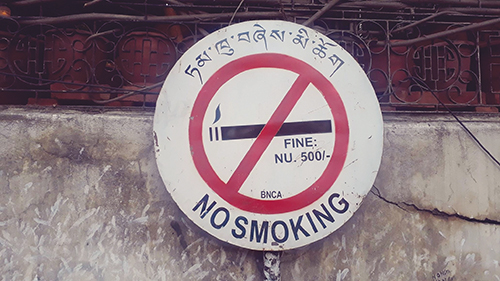
Second, he said that essential operational conditions for enforcement have not been fully established. “You cannot impose fines for smoking outside designated areas when such areas have not been clearly identified, marked, or communicated to the public,” Lyonpo said.
Director of BFDA, Gyem Bidha, said the Ministry of Health (MoH) and BFDA are currently working with dzongkhags, thromdes, and other relevant agencies to establish designated smoking areas where required, install clear signage, and define institutional responsibilities by 31st December this year.
She added that the Tobacco Control Act is also under revision to align enforcement and regulatory provisions with the current legal context, which is expected to address existing gaps more sustainably.
“We do not want people to start smoking; our priority is to prevent the exposure of non-smokers to secondhand smoke, which is harmful to health,” the Director Gyem said.
She further noted that BFDA and MoH are working to reduce the visibility of smoking in public spaces. “At present, smoking is visible in many public areas,” she said.
On enforcement challenges, she said that smokers often question officials about where they are expected to smoke, given the lack of clearly established designated smoking areas.
She added that the new Act permits smoking only in designated areas, and therefore such areas must be established by the end of this year across all agencies and public places, including thromdes.
“By doing this, we aim to make smoking less convenient, as currently it is being done freely in many public spaces,” she said, adding that the initiative is also intended to promote cleaner and safer public environments.
Regarding smoking in private vehicles, the Director clarified that under the current Tobacco Control Act, such cases fall within the definition of public space when vehicles are parked in public areas. She added that this provision is part of the ongoing revision of the Act.
Meanwhile, the Health Minister expressed concern over the increasing visibility of smoking among students, which he said was less common in the past. He added that a survey will be conducted to better understand the trend. Lyonpo said that there will be a rise in lung issues and cases in the coming years. The Act will also be amended to ban the sale of tobacco products to minors.