The Bhutanese Leading the way.
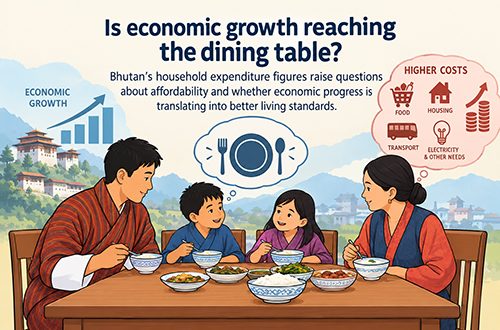
Bhutan’s household expenditure figures raise questions about affordability and whether economic progress is translating into better living standards
Bhutan’s economic performance raises an important question about whether growth is translating into improved living standards for ordinary citizens, particularly as households continue to meet their daily food expenses.
According to the National Statistics Bureau’s Household Consumption and Expenditure Survey 2025, the average monthly household food consumption expenditure stands at Nu 21,991 nationally. Urban households spend an average of Nu 23,728 a month on food, compared with Nu 17,194 for rural households. The figures, also cited in the Ministry of Finance (MoF)’s Macroeconomic Performance and Outlook Report 2026, provide a basis for examining differences in household consumption and the relationship between economic performance and affordability. The difference also reflects variations in access to markets, food prices, consumption patterns and the extent to which rural households produce food for their own consumption.
An official from MoF said Bhutan has recorded strong economic growth in recent years, with real GDP per capita growing at an average annual rate of 10.01 percent over the past five years. However, economic growth does not automatically translate into higher incomes or improved purchasing power for every household. For ordinary citizens, the key question is whether their earnings can keep pace with the rising costs of food, housing, transportation, electricity and other essential needs.
Bhutan’s recent economic growth has been driven largely by capital-intensive sectors such as hydropower, alongside the recovery of tourism. While these sectors contribute significantly to national income, the benefits may not reach all households equally or immediately. The Bhutan Productivity Account also indicates that productivity gains have been driven mainly by capital investment rather than improvements in efficiency. At the same time, labor’s share of economic output increased from 50 percent in 2022 to 54 percent in 2024, indicating that a greater proportion of output was going to workers.
Rising prices continue to put pressure on household budgets. “Higher spending does not necessarily mean that urban households are better off. It may also reflect higher living costs,” the official said.
Bishnu Maya Ghimire, who works at a travel agency in Thimphu, said she wishes she could afford to live in a well-built house like others, but her financial responsibilities have forced her to settle for temporary accommodation with lower rent. She said her family depends on her salary to meet its daily expenses, leaving her with limited options when it comes to housing. Although she would prefer to live in better accommodation, she has to prioritize affordability over comfort. For her, finding a place to live is not simply a matter of preference but a financial decision shaped by the need to support her family. With her salary covering the household’s expenses, spending more on rent would mean having less money available for food and other essential needs.
While employment provides a regular source of income, it does not always mean that workers can afford the standard of living they aspire to. As living costs continue to put pressure on household budgets, the ability to afford decent housing alongside food, transportation and other necessities remains an important part of the wider question of whether economic growth is improving the living standards of ordinary Bhutanese.
The government recognizes that economic growth must ultimately lead to improvements in people’s daily lives. Through public spending and targeted support, it provides assistance to ease the cost of essential goods and services. Measures such as subsidized domestic electricity, student meal allowances, agricultural subsidies and the National Fuel Price Smoothing Framework are intended to reduce financial pressure on households and improve access to essential services.
However, the government acknowledges that the lack of recent household income data makes it difficult to determine how much real disposable income has increased across different income groups, and how much money households have left after covering essential expenses. The Bhutan Living Standards Survey 2022 remains an important source of information on household living conditions. However, updated income data would provide a clearer picture of how the benefits of economic growth are being shared among different sections of society.
Tashi Tshomo, a farmer from Dagana, relies entirely on seasonal vegetables and cash crops to sustain her household. Unlike salaried employees with stable monthly salaries, her livelihood fluctuates with the success of each harvest and unpredictable market returns. This volatility forces her to carefully budget her irregular earnings across the entire year to cover non-negotiable daily necessities, including food, transportation, and her children’s education.
For rural households like Tshomo’s, managing living costs is a constant struggle against seasonal harvests and volatile market prices. Poor yields, isolated markets, and fluctuating crop prices directly threaten household earnings, while the rising cost of essential goods keeps budgets tightly squeezed. Although these families grow some of their own food, they remain deeply dependent on steady cash income to cover expenses that farming alone cannot meet.
Sonam, who works at a workshop in Paro, said he struggles to save money from his earnings, and sometimes has to seek financial help from family members to meet his expenses. He said managing daily expenses has become a challenge, leaving him with little opportunity to set aside money for future needs. At times, he has to rely on the support of his family to manage financially.
While employment provides a source of income, the ability to meet daily expenses and save for emergencies remains an important part of household well-being. For people like Sonam, financial security is not only about having a job but also about whether their earnings are sufficient to cover essential expenses while leaving something for unexpected costs and future needs.
When income is barely enough to meet day-to-day requirements, even employed individuals may find it difficult to build savings and can become dependent on family support during financially difficult periods.
The official said Bhutan’s economic progress should be measured not only by GDP growth but also by improvements in employment opportunities, real incomes, affordability and overall well-being. In its response, he said the 13th Five-Year Plan (FYP) places emphasis on diversifying the economy, creating productive employment, maintaining price stability and expanding economic opportunities. These priorities are intended to create jobs that provide reliable incomes and ensure that the benefits of economic growth reach a wider section of society.
He said the 13th FYP targets average annual GDP growth of 8 percent while keeping inflation below 5 percent. These targets serve as important benchmarks for assessing the country’s economic performance. He emphasized that economic progress should ultimately translate into a better quality of life for Bhutanese people, in line with the principles of Gross National Happiness.