The Bhutanese Leading the way.
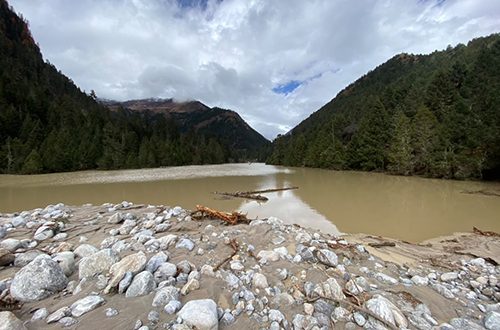
Authorities maintain continuous monitoring as PM inspects the site and controlled explosions are being considered to safely drain the lake
The artificial lake formed at the confluence of Shintaphu Chhu and Lungu Chhu (Gangchen Tag Chhu or Singchala Chhu) in Taktsemakhang, Gasa, following the glacier lake outburst flood (GLOF) on 29th October 2026 is currently stable, with no noticeable rise in water levels and its outflow remaining constant.
According to the latest information from Gasa disaster management official, a person has been assigned to the site to continuously monitor the lake, and officials have not observed any immediate signs of alarm.
Similarly, the Gasa Dzongda Jigme Namgyel said that the artificial lake that was formed is in stable condition, and no rise in the water has been noticed including the outflow of the water being constant.
The Prime Minister Dasho Tshering Tobgay, visited Taktsemakhang to inspect the site and assess the situation on the ground.
Following his visit to the mouth of the artificial lake, Lyonchhen Dasho Tshering Tobgay said the lake was not very dangerous and that controlled explosions would be used downstream to drain the accumulated water safely.
Despite the current stable condition, authorities have advised people living along the Mochhu and Punatsangchhu river valleys to remain vigilant, avoid riverbanks and stay away from flood-prone areas due to the possibility of further flooding.
The National Center for Hydrology and Meteorology (NCHM) and concerned agencies are continuously monitoring the situation, with water levels along the Mochhu being monitored at Tashithang and Yebesa stations.
The NCHM’s weather forecast for 31st October 2026 indicates cloudy conditions with light rain in Gasa and cloudy conditions with light rain or snow in Laya.
Mostly cloudy weather with light rain is also expected in Punakha, Wangdue, Tsirang and Dagana.
Meanwhile, the Wangdue Dzongkhag Administration has urged the public not to collect or consume dead and stranded fish found along riverbanks. The office warned that fish killed by floodwater could pose health risks, while the artificial lake itself remains a safety concern.
The artificial lake formed on Singchala Chhu after floodwater from the other stream blocked its outlet with debris at the confluence above Taktsemakhang. The blockage caused water to accumulate behind it, creating another lake on one of the source rivers of the Mochhu.
The original GLOF originated from Shintaphu Tsho, located below Wakila Mountain in Lungo, Laya Gewog, Gasa.
According to NCHM records, the lake had an estimated water volume of 6.2 million cubic meters, equivalent to approximately 2,480 Olympic-sized swimming pools. It covered a surface area of around 238,314 square meters, or 59 acres, and was recognized as one of the risky GLOF lakes.
The outburst flood crossed Taktsemakhang at around 8:27 pm on 29th October, with sirens activated along the Mochhu and downstream areas of Punatsangchhu.
Evacuations and warnings were issued for vulnerable settlements in Gasa, Punakha, Wangdue, Tsirang and Dagana.
The Gasa Dzongkhag administration plan to drain the lake using an excavator but there is no fuel due to the only road to Gasa from Punakha being cut off.